Science2 publishers3 min readPublished
WMO logs a second consecutive Antarctic ozone hole well below the 1990-2010 average
The World Meteorological Organization's new bulletin puts the Antarctic hole below its long-term average for a second year running, and the researchers reading the same data disagree about whether the recovery is on schedule.
The Scientist · Science desk
What happened
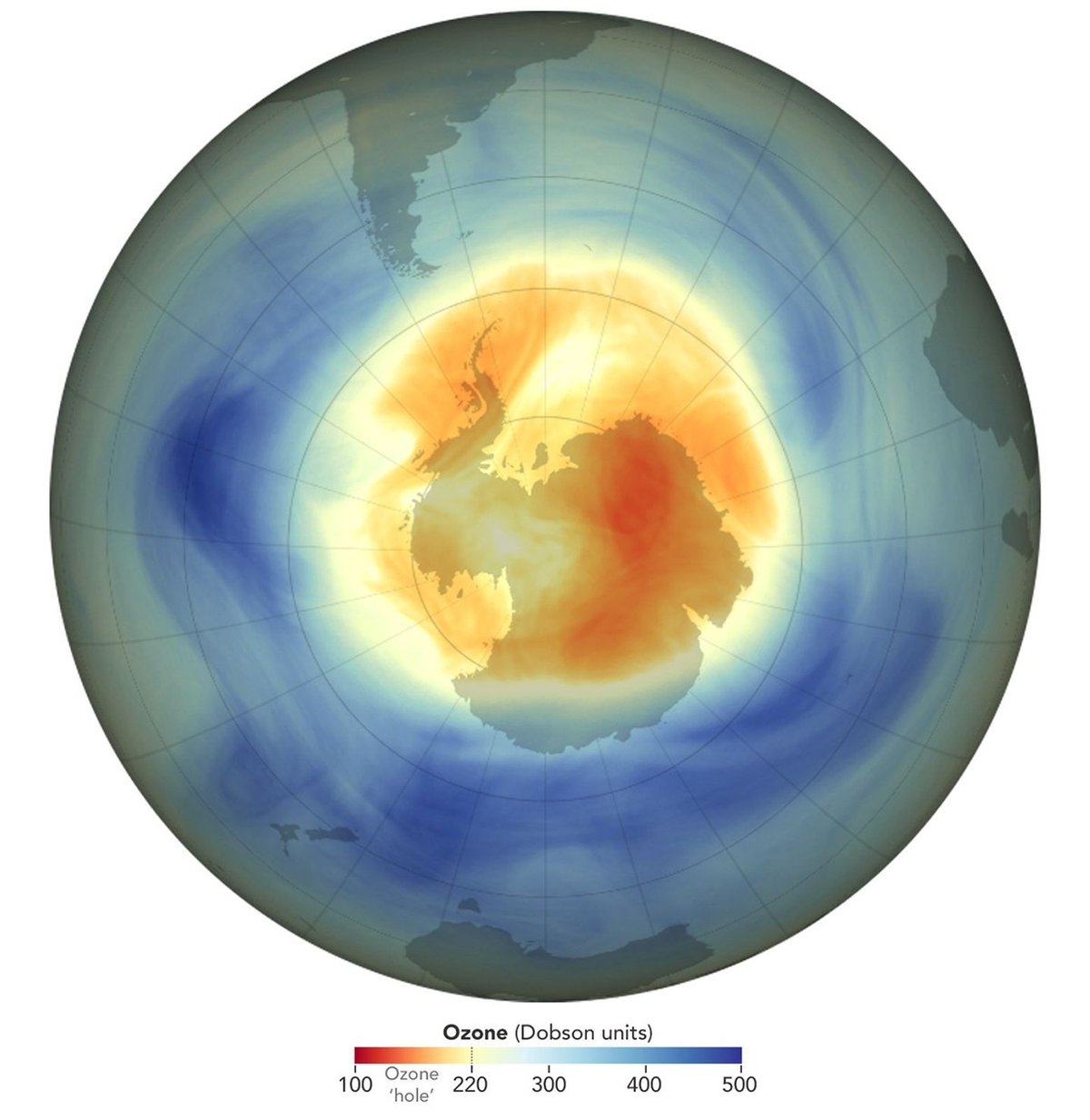
- The WMO's Ozone Bulletin ranks the 2025 Antarctic ozone hole as the fourth or fifth smallest since severe depletion patterns were first observed in 1992.
- Ozone was below average across a band from Greenland and Europe through Central Asia to northern Japan and Kamchatka, which the report attributed to a strong Arctic winter vortex in January and February 2025.
- Ozone usually reaches its annual low in October, but in 2025 the minimum arrived in September.
Compiled by The ScientistSomething wrong?How this is made
Why it matters
- constraint The observing network has lost about 15% of its stations. That same monitoring is what caught CFC-11 emissions continuing to 2018 and HFC-23, so detection of the next phase-out violation now rests on fewer instruments.
- contradiction WMO's secretary-general expects full recovery within several decades, while UCLA's Suzanne Paulson says there have been no major improvements in recent years. The same bulletin supports either summary, so a citation of it depends on who is quoted.
- exposure Populations in parts of Europe are taking up to 20% more UV than in the mid-1990s because of thinner cloud cover, so the health risk the ozone column guards against is rising there even as the column recovers.
- precedent Because three or four years since 1992 still had smaller holes, the recovery case rests on two consecutive below-average years, and one weather-driven bad year will be read as backsliding on the same basis.
Fourth or fifth smallest since 1992 means three or four years in that record had smaller holes than 2025 [3]. The new information is the pair: two years running in which both the depth and the extent of the hole sat significantly below the 1990-2010 average [2].
Size in any single year depends heavily on large-scale meteorological transport, the circulation that produces springtime depletion over Antarctica almost every austral winter and, in the Northern Hemisphere, every five to 10 years [4]. Suzanne Paulson, a professor at UCLA, told Scientific American that the hole has been healing more slowly than scientists predicted it might [7]. "It does go up and down every year, so any one year doesn't really tell you a whole lot," she said [5]. "It certainly hasn't gotten worse in recent years, but for the most part, we haven't really seen major improvements" [6].
The WMO's own framing is warmer. "This is an environmental success story. Since 2000, the ozone layer has been recovering, and we can expect full recovery within several decades," said WMO Secretary-General Celeste Saulo [8]. Laurence Rouil, director of the Copernicus Atmospheric Monitoring Service, said in a statement that "while we have seen its area increase rapidly in early September this year, other indicators remain close to historical averages" [9].
The two published accounts of the same bulletin do not use the same reference period. Phys.org reported the comparison against the 1990-2010 average [2]. Scientific American reported the hole as significantly smaller than its average size between 1990 and 2020 [13]. A window that runs to 2020 takes in a decade the shorter one leaves out, so the two comparisons are not interchangeable.
Regulatory action here has depended on measurement. Atmospheric monitoring caught unexpected emissions of CFC-11, which continued until 2018, and of HFC-23, and the WMO says such monitoring remains essential to support targeted regulatory action by national authorities [16]. The ground-based network supplying total column ozone observations has thinned from around 130 active stations in the early 2000s to 110 today, about 20 fewer, a drop of roughly 15% [14][15]. The next test of that network is the Kigali Amendment, whose 10th anniversary is this year's World Ozone Day theme, and which phases down HFCs, some of which trap thousands of times more heat than carbon dioxide [18][17].
Ozone recovery does not by itself mean less ultraviolet light at the ground. The shield is thin: about 90% of atmospheric ozone sits in the upper stratosphere, and brought down to the surface it would form a layer roughly 3 millimetres thick [23]. In some parts of Europe UV radiation has risen by as much as 20% since the mid-1990s, and ground measurements attribute that primarily to reduced cloud cover and longer annual sunshine duration [19]. Higher exposure means greater risk of skin cancer and other UV-related diseases among exposed populations [26]. The Bulletin's response is that "targeted and effective UV protection measures are of paramount importance" [20].
What to watch
- Whether the 2026 hole stays below the 1990-2010 average; a third year would begin to separate trend from meteorology.
- Whether the ground station count stabilises at 110 or keeps falling as Dobson and Brewer instruments retire.
- Whether monitoring turns up new unexpected HFC-23 or CFC emissions during Kigali's second decade.