Science5 publishers3 min readPublished Updated
Crocodile teeth from the same Montana rock anchor T. rex's 36 C body temperature
A UCLA team read rare-isotope bonds in Tyrannosaurus rex tooth enamel and got about 36 degrees Celsius, a figure that took some 15 years of work to make measurable from a museum-sized sample.
The Scientist · Science desk
What happened
- The paper was published Sept. 16 in Science Advances, and it is the first time researchers have reported an actual temperature figure for the animal rather than an inferred metabolic range.
- Rare heavy isotopes of carbon and oxygen bond together more often in enamel formed at cooler temperatures, so a warm-bodied animal leaves fewer of those bonds behind in its teeth.
- A decade of refinement cut the amount of material the test consumes by roughly 90 percent, after the original bone-based version needed more sample than a museum would surrender.
Compiled by The ScientistSomething wrong?How this is made
Why it matters
- capability Any fossil that kept its enamel is now a candidate for a direct temperature reading, and Eagle says avian dinosaurs and ancient mammalian ancestors are the next targets.
- constraint The signal survives in enamel because its crystals resist chemical alteration, so lineages and skeletal elements without enamel stay outside the method's reach.
- contradiction Persons says growth rates, predator-prey ratios and anatomy had already made the warm-blooded case extensively, so the figure sharpens a picture the field already agrees on.
- precedent Future physiology claims about extinct animals now have a harder standard to meet: an isotopic value paired with an ectotherm control from the same beds.
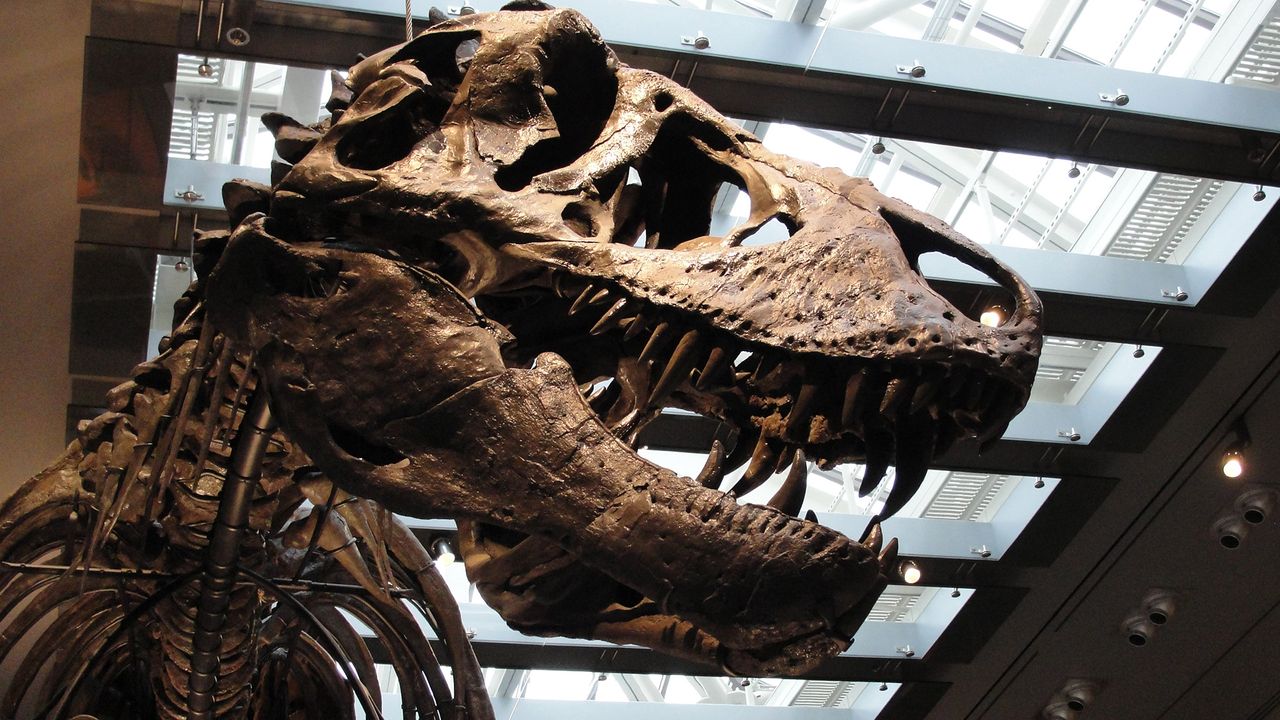
The control sits in the same rock as the fossil. Alongside the T. rex enamel, Robert Eagle's group at UCLA measured five similarly aged fossilised crocodile teeth from Hell Creek [6]. Crocodiles are ectotherms, warming up by basking in the sun [36]. "We also found that the reconstructed temperature of T. rex was significantly elevated compared to temperatures derived from crocodile teeth from the same geological formation - Hell Creek in Montana," Eagle said [7]. That comparison rules out the dull explanation, which is that the enamel simply recorded its surroundings. The team also checked the T. rex values against ambient temperatures for prehistoric Montana reconstructed from isotopic estimates and from climate models, and the animal came out warmer than both [8]. Aradhna Tripati, a geoscientist at UCLA and a co-author, told Scientific American that "the enamel chemistry is truly recording the temperature at which it formed, and 66 million years later, we can read it using those measurements on a mass spectrometer" [31]. The bone version of the method existed a decade ago, but running it on a T. rex would have needed more bone than a museum would part with [12]. The sample had to shrink. Pressurising the released carbon dioxide into a denser jet let the mass spectrometer work from less powder, and the refinement cut the material required by roughly 90 percent [11][13]. That was small enough for the Natural History Museum of Los Angeles County to release portions of two teeth from Thomas, the most complete tyrannosaur in its dinosaur hall [5]. Enamel was the target because "tooth enamel has large crystalline structures that are extremely durable, making it the part of the skeleton that most resists chemical alteration by the environment over the eons," Eagle said [15]. He told Scientific American the result is the culmination of some 15 years of work [14]. Published accounts of the sample differ. Live Science and New Scientist describe three T. rex teeth from the Hell Creek Formation [4]; the UCLA account describes portions of two teeth from Thomas [5][30]. The figure itself appears as 36 C in most accounts and as 36.3 C in Live Science's [1][2]. Modern cold-blooded reptiles run about 28 to 30 C, and most birds run 40 to 43 C [16][17]. T. rex therefore lands 6 to 8 degrees above the reptile band and 4 to 7 below the bird one [18]. A 2022 study led by Jasmina Wiemann of Johns Hopkins had already put T. rex at the lower end of endothermy [21], and she called the new paper "absolutely mind-blowing" and "impressively precise" [22]. Scott Persons of the South Carolina State Museum, who was not involved in the work, said the existing evidence already included bone growth rates and predator-prey ratios, along with a "slew of anatomical traits consistent with high-performance athleticism" [23]. Thomas Carr at Carthage College called the study an "example of science in action, converging upon a single, robust hypothesis, which in this case reveals T. rex as an active top predator" [24]. New Scientist described the enamel result as adding weight to previous findings [33]. "Using thermal performance curves and climate modelling based on these results, we found that the entire North American continent would have been habitable for T. rex in the Cretaceous Period," Eagle said [25], a period roughly 6 to 14 C warmer than today [27]. Wiemann goes further, saying the temperature would have let T. rexes live anywhere on Earth, even the Arctic [26]. The fossil evidence at high latitude is a tyrannosaur from the Kikak-Tegoseak Quarry in Alaska, from beds with no trace of lizards, turtles or crocodiles of the same period [28].
What to watch
- Whether the enamel method reproduces on avian dinosaurs and ancient mammalian ancestors, which Eagle says he wants to try next.
- Whether an independent lab gets the same value from teeth of other T. rex individuals or from other formations.
- Whether the continent-wide habitability conclusion survives a different Cretaceous climate reconstruction, since it comes from thermal performance curves plus modelling.