Science1 publisherNot yet confirmed elsewhere2 min readPublished
Chinchorro mummies took 1.4 kg of manganese a body, and left nothing to explain themselves
A first count of the pigment behind the world's oldest artificial mummies turns a burial rite into a procurement problem, and dents the idea that states come before technique.
The Scientist · Science desk
What happened
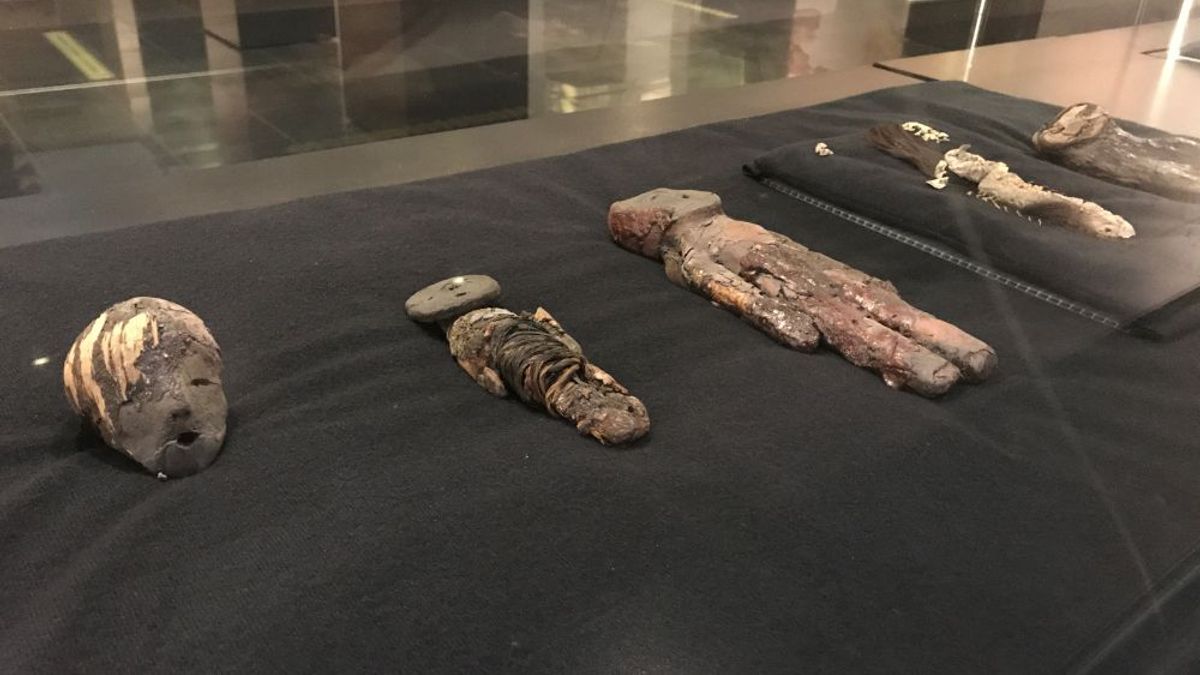
- The Chinchorro were a hunter-gatherer fishing people on the Atacama coast more than 7,000 years ago, with no writing and no monumental cities.
- A new study puts about 1.4 kilograms of manganese behind the black coating of a single adult mummy, the first such figure for the technique.
- The method removed skin and organs, dried the body with fire or ash, then rebuilt it in clay, wool and plant fiber, with sea lion skin and a wig as needed.
- Identified pigment sources run from surface outcrops near the Lluta headwaters at almost 16,400 feet to river deposits a few miles from the coast.
- The mummies, now a UNESCO World Heritage Site, predate Egyptian mummification by as much as two thousand years.
Compiled by The ScientistSomething wrong?How this is made
Why it matters
- contradiction Arriaza's short-haul procurement and Sepulveda's highland trade network describe the same coating but incompatible societies: one self-sufficient, one dependent on standing relations with people...
- constraint Putting a mass on one step converts the ritual into a budget item, so any account of Chinghorro labor organization now has to explain who was freed from fishing to gather, crush and mix stone.
- precedent It weakens the working assumption that monumental states are the precondition for advanced technique, and invites the same process-complexity accounting for other societies judged by their...
- exposure Because infants and the elderly received the treatment too, readings that treat elaborate mortuary technique as a proxy for elite power lose their easiest example.
The interesting quantity in the new paper is not the pigment but the sequence behind it. Arriaza calls it a chain of operations: locate the stone, collect it, select it, transport it, crush it, process it, mix it with other materials, then apply it to a body that has already been taken apart and rebuilt [7]. Sepulveda's remark that no complex technology is needed to gather manganese from surface outcrops is the part worth holding [9]. The hard part was never the tool but the order of operations, and holding that order intact for centuries in a society that had no writing to record it [3].
How many centuries is where the account strains. The Black Mummy technique is dated to between 4000 and 2800 B.C.E. [6], and described in the same account as a technique practiced for nearly two millennia [13]. That bracket is 1,200 years [16]. Either the dates are conservative or the duration is generous, and the difference is not cosmetic: the whole argument about undocumented technical transmission rests on how long the procedure survived without a written form.
The two procurement stories are not variants of one another. Sepulveda has highland groups mining the mineral and trading it down to the coast, pointing to fish remains, shells and shark teeth found in the Puna de Atacama as the return leg [14]. Arriaza allows that the Chinchorro fetched it themselves, and notes deposits along the Lluta River between 5 and 7.5 miles inland and near its Pacific mouth [15]. One version needs a standing relationship with people living at nearly 16,400 feet [8]; the other needs a walk. The 1.4 kg on the body is the same either way [11], but the society it implies is not.
The bodies also work against reading this as elite display. Men, women, the elderly, children and newborns were mummified, from across the social spectrum [10]. A technique that tracked state power would be rationed, and this one was applied to infants. What it required instead was skin removal, organ extraction, drying by fire or ash, reconstruction in clay and wool and plant fiber, sea lion skin where the original was insufficient, and a wig [5].
Egypt is the reference point for mummification partly because Egypt left buildings and documents that explain it. The Chinchorro left the object and nothing to read [3], and the coating on one body is the first part of the process anyone has put a number to [1].
What to watch
- Whether geochemical fingerprinting of the pigment matches the high Lluta outcrops or the low-altitude river deposits, which would settle the trade-versus-travel dispute.
- Whether the per-body figure is scaled across a known cohort of mummies to give a total demand that can be tested against deposit sizes.
- Whether revised dating widens the 4000 to 2800 B.C.E. bracket toward the two millennia the same account claims.
Clarity's read
What the record supports and how the coverage leans. The claims behind it follow.
Reality
- Evidence48
- Adoption
- Insufficient
- Hype gap+18
- Incentives55
- Confidence42
Claim ledger
Ranked by verification strength, evidence, and original report placement.
- [1]
A study published in the Journal of Archaeological Science: Reports quantifies for the first time the amount of manganese required to create the Chinchorro Black Mummies.
- [2]
The Chinchorro developed one of the most complex funerary technologies known in the ancient world, involving dismantling and reconstructing bodies, wood and plant fibers, modeled faces, clay and ash, and mineral pigment coatings.
- [3]
The Chinchorro culture was a fishing and hunter-gatherer society that inhabited the coast of the Atacama Desert more than 7,000 years ago, left behind no writing and built no monumental cities.
- [4]
The Chinchorro artificial mummies are recognized as a UNESCO World Heritage Site and were created up to two millennia before those of Egypt.
- [5]
The Black Mummy process involved removing the skin and soft tissues, extracting the organs, drying the body using fire or ash, then reconstructing and modeling it with clay, wool fibers and plant fibers; incisions or sutures were used less than in the Red Mummies, sea lion skin could replace insufficient original skin, and bodies were fitted with wigs.
- [6]
The Black Mummy form of Chinchorro mummification was practiced between 4000 and 2800 B.C.E.
- [7]
Bernardo Arriaza describes a "chain of operations" in which the manganese stones had to be located and collected, selected, transported, crushed, processed and mixed with other materials before being applied to a body that had been carefully disassembled and reconstructed.
ReportedSupportedSource: Bernardo Arriaza, director of the Chinchorro Management Center and researcher at the Institute of High Research, University of Tarapaca, Chile, speaking to DiscoverView cited source - [8]
One identified manganese source is in the high Andes near the headwaters of the Lluta Valley at almost 16,400 feet above sea level, where the mineral occurs in surface rock outcrops as hard stones with black patches that can be scraped or broken into pieces.
- [9]
Archaeologist Marcela Sepulveda of the University of Tarapaca, who did not participate in the study, said complex technology is not required to collect the manganese: the stone can be gathered, then scraped or crushed.
ReportedSupportedSource: Marcela Sepulveda, University of Tarapaca, speaking to DiscoverView cited source - [10]
The Chinchorro mummified men, women, the elderly, children and even newborns, from across the social spectrum.
- [11]
A single adult mummy could require around 1.4 kilograms (3.1 pounds) of manganese to produce its characteristic black coating.
- [12]
The team calculated the manganese requirement using samples of the coating taken from a mummy together with the dimensions of an adult body.
- [13]
The Black Mummy technique is described as having been practiced for nearly two millennia.
- [14]
Sepulveda argues that highland groups mined the mineral and traded it with coastal populations, citing fish remains, shells and shark teeth found in the Puna de Atacama as evidence of trade and maintained social contact between groups.
ReportedContestedSource: Marcela Sepulveda, University of Tarapaca2 sources— create a free account to open themView cited source - [15]
Arriaza hypothesizes that the Chinchorro themselves traveled to the mountain sources, and notes manganese was also available in low-altitude deposits along the Lluta River between 5 and 7.5 miles inland and near its mouth on the Pacific, so it could be obtained without traveling great distances.
ReportedContestedSource: Bernardo Arriaza2 sources— create a free account to open themView cited source - [16]
The stated 4000 to 2800 B.C.E. range spans 1,200 years, roughly 800 years short of the "nearly two millennia" duration asserted in the same account.
- [17]
Arriaza said the Chinchorro "transformed their loved ones into true works of art" and called the mummies the earliest examples of pre-Hispanic art in the Americas.
ReportedInsufficientSource: Bernardo Arriaza, speaking to Discover2 sources— create a free account to open themView cited source
Sources
1 independent publisher whose own reporting we read for this story.
Topics and entities
Follow any of these and your For You feed starts watching them — no settings page required.
Topics
Entities
- Chinchorro cultureFollow
- Bernardo ArriazaFollow
- Marcela SepúlvedaFollow
- University of TarapacáFollow
- Chinchorro Management CenterFollow
- Journal of Archaeological Science: ReportsFollow
- Atacama DesertFollow
- Lluta ValleyFollow
- UNESCO World Heritage SiteFollow
- Discover MagazineFollow