Science1 publisherNot yet confirmed elsewhere2 min readPublished
Underwater archaeologists recover a Pharos-engraved signet ring from Alexandria's sunken palace
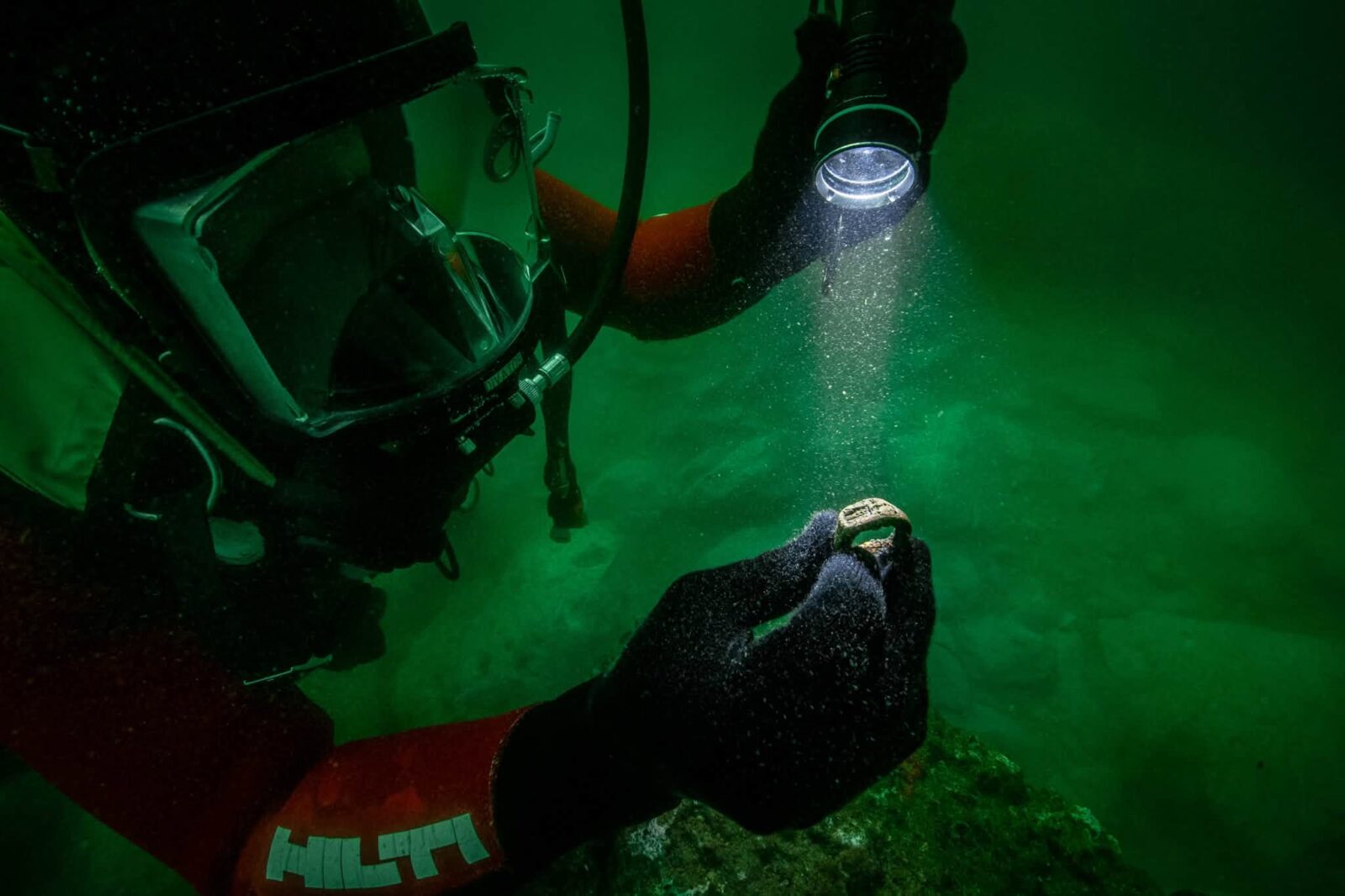
IEASM divers recovered a bronze signet ring engraved with Alexandria's Pharos lighthouse from sunken Antirhodos, the first ring of its kind found. The team links it to the palace offices that oversaw the lighthouse, though that reading rests so far on one worn ring and the spot where it lay.
The Scientist · Science desk
What happened
- Despite centuries of underwater wear, the ring's relief still shows the lighthouse, and the team says its style resembles that of some second-century AD coins.
- The same excavation exposed architectural remains across a wide stretch of seabed, including several large diorite fragments carved with hieroglyphs.
- Strabo's description of the city, written after his visit around 25 BCE, helped archaeologists locate the sunken royal quarter in 1992.
- The current mission spans several Portus Magnus sites, among them the Temple of Isis, an obelisk's remains and Mark Antony's palace, the Timonium.
- Egypt's minister of tourism and antiquities, Sherif Fathy, visited the research vessel to observe this year's field mission.
Compiled by The ScientistSomething wrong?How this is made
Why it matters
- contradiction Discover's own subheading says the ring symbolizes Alexandria's administrative power, a firmer claim than the researchers' view that it may have been used in palace administration.
- constraint Because the date comes from a stylistic match to coins, the ring cannot yet be tied to a particular reign or office holder on Antirhodos.
- capability A lighthouse device on a signet gives researchers a specific image to search for among surviving seal impressions, and matching impressions would test the administrative reading directly.
"First of its kind" is the team's description, which Discover carried from a release by the European Institute for Underwater Archaeology (IEASM) [1]. A record like that implies a comparison set: the engraved rings from Alexandria and elsewhere that this one was checked against. The report does not describe that comparison. The building on the ring was one of the Seven Wonders of the Ancient World [5].
The administrative reading rests on where the ring lay. The researchers believe it may have been used in administrative work in the palace offices on the Royal Island, the same offices that oversaw the lighthouse [11]. Franck Goddio, who heads the excavation and is president of the institute, stressed the findspot. "The discovery of the ring-signet is even more important as it has been excavated in the legendary palace of the Island of Antirhodos, that once was a [center] of power," he said [12].
A seal bearing the lighthouse, lost in the complex that oversaw the lighthouse, fits official use. I think it fits the private ring of someone who worked there about as well, and one object cannot separate an office's emblem from an official's personal device. The team's own wording is hedged: it says only that the ring may have served in administration [11].
The date is an estimate from style. According to the release, the ring's iconography resembles the style of some second-century AD coins [3]. If that holds, the ring belongs to a period more than a century after the Greek historian Strabo visited the palace around 25 BCE [6][10]. The relief is also worn from its centuries underwater [3]. Earthquakes, flooding and rising seas put many of the city's landmarks under the Mediterranean, according to Britannica as cited by Discover [9]. The report does not mention a dated layer or any laboratory test on the bronze.
What to watch
- A full IEASM excavation report giving the ring's find context, its dating method and the rings it was compared against.
- Any clay or wax sealings from Alexandria that carry the same lighthouse device.
- Readings of the hieroglyphic carvings on the diorite fragments raised in the same season.
Clarity's read
What the record supports and how the coverage leans. The claims behind it follow.
Reality
- Evidence35
- Adoption
- Insufficient
- Hype gap+30
- Incentives45
- Confidence40
Claim ledger
Ranked by verification strength, evidence, and original report placement.
- [1]
A team from the European Institute for Underwater Archaeology (IEASM) found a bronze signet ring engraved with the Lighthouse of Alexandria, described as the first ring of its kind ever discovered.
- [2]
The ring was found while archaeologists explored the Royal Quarters of Alexandria's Portus Magnus on the submerged Royal Island of Antirhodos.
- [3]
Despite visible wear from hundreds of years underwater, the ring's relief still depicts the lighthouse; according to a press statement, its iconography resembles the style seen on some coins from the second century AD.
- [4]
The excavation also revealed architectural remains scattered across a large area of the seabed, including several large diorite rock fragments covered in hieroglyphic carvings.
- [5]
The Pharos lighthouse was one of the Seven Wonders of the Ancient World.
- [6]
Greek historian Strabo visited the palace in Alexandria around 25 BCE, and his description of the city later helped modern archaeologists locate the submerged ruins of the royal quarters in 1992.
- [7]
The current excavation mission focuses on several sites within the Portus Magnus harbor area: the Royal Island of Antirhodos, the Temple of Isis, the remains of the obelisk, and Mark Antony's palace, the Timonium.
- [8]
Egypt's minister of tourism and antiquities, Sherif Fathy, and his assistant visited the research vessel and observed this year's field mission.
- [9]
After a series of earthquakes, flooding, and rising sea levels, many of Alexandria's significant landmarks eventually submerged under the Mediterranean Sea.
- [10]
A ring in the style of second-century AD coins would date to more than a century after Strabo's visit around 25 BCE.
- [11]
The researchers believe the ring may have been used in the administrative processes carried out in the palace offices on the Royal Island, which also oversaw the lighthouse.
ReportedInsufficientSource: IEASM researchers via Discover Magazine2 sources— create a free account to open themView cited source - [12]
"The discovery of the ring-signet is even more important as it has been excavated in the legendary palace of the Island of Antirhodos, that once was a [center] of power,"
ReportedInsufficientSource: Franck Goddio, head of the excavation mission and president of the institute, in the release2 sources— create a free account to open themView cited source - [13]
Discover's section heading on the find reads: Ancient Bronze Ring Symbolizes the Administrative Power of Ancient Alexandria.
ReportedInsufficientSource: Discover Magazine subheading2 sources— create a free account to open themView cited source
Sources
1 independent publisher whose own reporting we read for this story.
Topics and entities
Follow any of these and your For You feed starts watching them — no settings page required.