Science2 publishers2 min readPublished
Yellowstone crews pulled more than 20,000 objects from the park's hydrothermal features this year
The Yellowstone Volcano Observatory says 2026 set a record for objects retrieved from the park's geysers and hot springs. The count measures how much the geology crew got back out, not how much visitors dropped in.
The Scientist · Science desk
What happened
- Park staff have removed more than 20,000 items from Yellowstone's hydrothermal features so far in 2026, which the Yellowstone Volcano Observatory calls a record-setting year for such finds.
- The park's Geology Program does the retrieval, mostly with shovels and grabber tools, and in harder spots with fishing rods, strainers, slotted spoons and grabber poles up to 30 feet long.
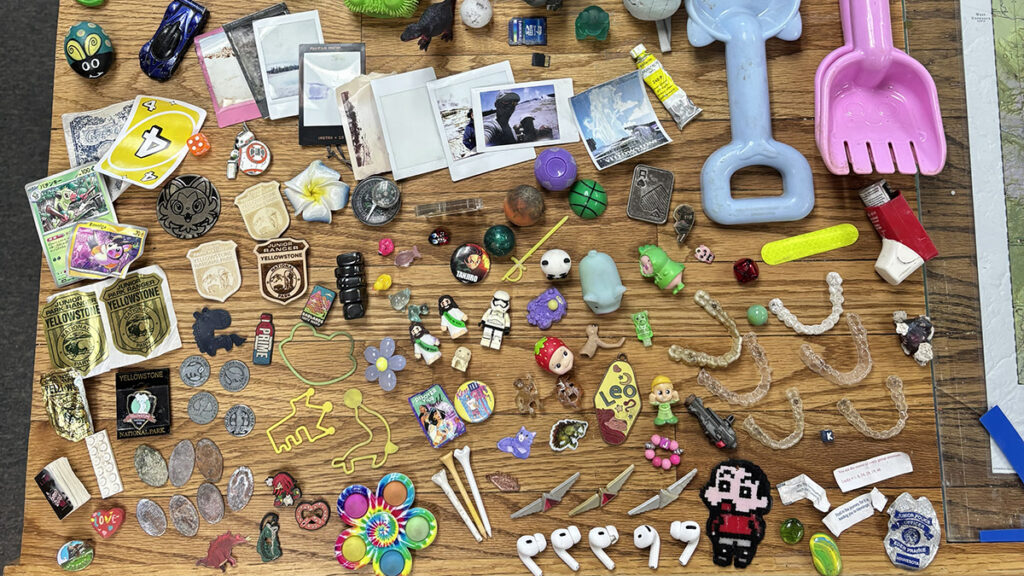
- Individual finds this year include 54 camera lens caps, 36 pairs of sunglasses, six Invisalign retainers, 15 fake nails and, among the largest objects, a single snowshoe.
- The objects come from areas including Old Faithful and Midway Geyser Basin, home to Grand Prismatic Spring, where boardwalks were built to keep guests off scalding water and delicate ground.
Compiled by The ScientistSomething wrong?How this is made
Why it matters
- constraint Getting objects back out takes specially trained staff, so crew time sets how fast the park can clear a basin.
- contradiction Eos's finding that most litter was unintentional sits beside its finding that the coins were mostly thrown in deliberately, and the two point at different fixes: hat straps and closed pockets for one, enforcement for the other.
- exposure The organisms living inside the features are what a clogged vent or a contaminated pool puts at risk, and the observatory's stated recovery time runs to months or years.
- decision A visitor whose hat blows into a basin has an answer in the record: leave it, because staff will retrieve it and the wearable ones get donated at the end of the year.
Set the 20,000 against the visitation figure both accounts use and the rate is about one object for every 225 people through the park, or 4.4 objects per thousand visitors [18]. The rate is rough. The count runs only to the date of the release, not to the end of the year [1], and 4.5 million is the park's usual annual visitation [2].
A count of removed objects is a measure of removing. It rises when the geology crew works more days in the basins [4], and it rises when visitors drop more things in. Neither account separates the two, and neither gives a prior-year count to compare against [20].
The two counts are also built differently. Discover Magazine reports more than 20,000 items pulled from the features so far this year [1]. Eos, citing a USGS press release, lists 20,000-plus pieces of trash, then 5,600 rocks and sticks and nearly 300 hats as separate lines [3]. Read additively, that is at least 25,600 objects [19]. Rocks and sticks are also the least accidental category: Discover reports that some visitors throw rocks, sticks and coins in on purpose [10].
Eos wrote that most of the litter was left unintentionally, and that the hats were likely blown off by the wind [11]. Coins are the exception. Of the $18 in change, which included euros, Canadian dollars, pesos and yen [9], Eos deputy editor Emily Gardner wrote that most "appear to have been thrown into hot springs or geysers on purpose, which is not allowed and will not make your wishes come true" [12].
The harm pathway in the record is specific. The Yellowstone Volcano Observatory says objects can clog a feature's water supply or add chemicals and sediment to it [14], and that coins and other small items can introduce contaminants that harm the microbial and algal life inside [15].
I think the 20,000 is a workload figure for the park's geology program. It is not evidence that visitors behaved worse this year. Among the finds are three golf tees, and Eos notes there is no golf course inside the park [16]. Also three fortune cookie fortunes, one of them reading "Trust in the journey, for it is leading you to blessings" [17].
What to watch
- A 2027 tally gathered by the same method, which would give this record something to compare against.
- Any published monitoring of microbial or algal communities in the features cleaned this year.
- Whether the park or USGS attaches crew hours or a cost figure to the retrieval work.