Science1 publisher3 min readPublished
UC San Diego test pits Planck's detectors against each other to vet a 0.37-degree twist in the oldest light
UC San Diego physicists compared eight Planck polarization maps against each other and recovered the same 0.37-degree twist as the standard analysis. The agreement gives cosmologists a second way to ask whether the rotation is in the sky or in the instrument, though the authors stress it does not confirm the twist is real.
The Scientist · Science desk
What happened
- The new method compares maps from different detectors and cancels any rotation they share, so leftover rotation most likely comes from calibration differences between them.
- The researchers say the result does not confirm cosmic birefringence and describe the method as an independent estimator and modeling route.
- The team hopes the method will also help avoid errors in separating B-mode from E-mode polarization, where primordial gravitational waves may leave a signal.
Compiled by The ScientistSomething wrong?How this is made
Why it matters
- capability A team reporting a birefringence angle can now set a second estimator, with its own modeling route, beside Minami-Komatsu before calling a rotation cosmic.
- constraint Both methods read the same eight Planck maps, so their agreement cannot clear a flaw in the maps themselves; that would take data the two methods do not share.
- precedent Keating's framing sets the expectation that any claimed primordial B-mode detection will have to pass calibration cross-checks like this one before it is believed.
A rotation of 0.37 degrees with an uncertainty of 0.12 degrees sits about three uncertainties away from zero [1]. In my view that is enough to take seriously. The UC San Diego team still says plainly that its result does not confirm cosmic birefringence [8].
The light being tested is the cosmic microwave background. It first appeared some 380,000 years after the Big Bang, and a small share of it is polarized [11]. Recent observations suggest that polarization turned by a fraction of a degree on its way to us [1]. A real rotation could point to physics beyond the Standard Model and bear on questions such as dark matter [2]. The same signal could also come from a small error in how a telescope's polarization detectors are oriented [3].
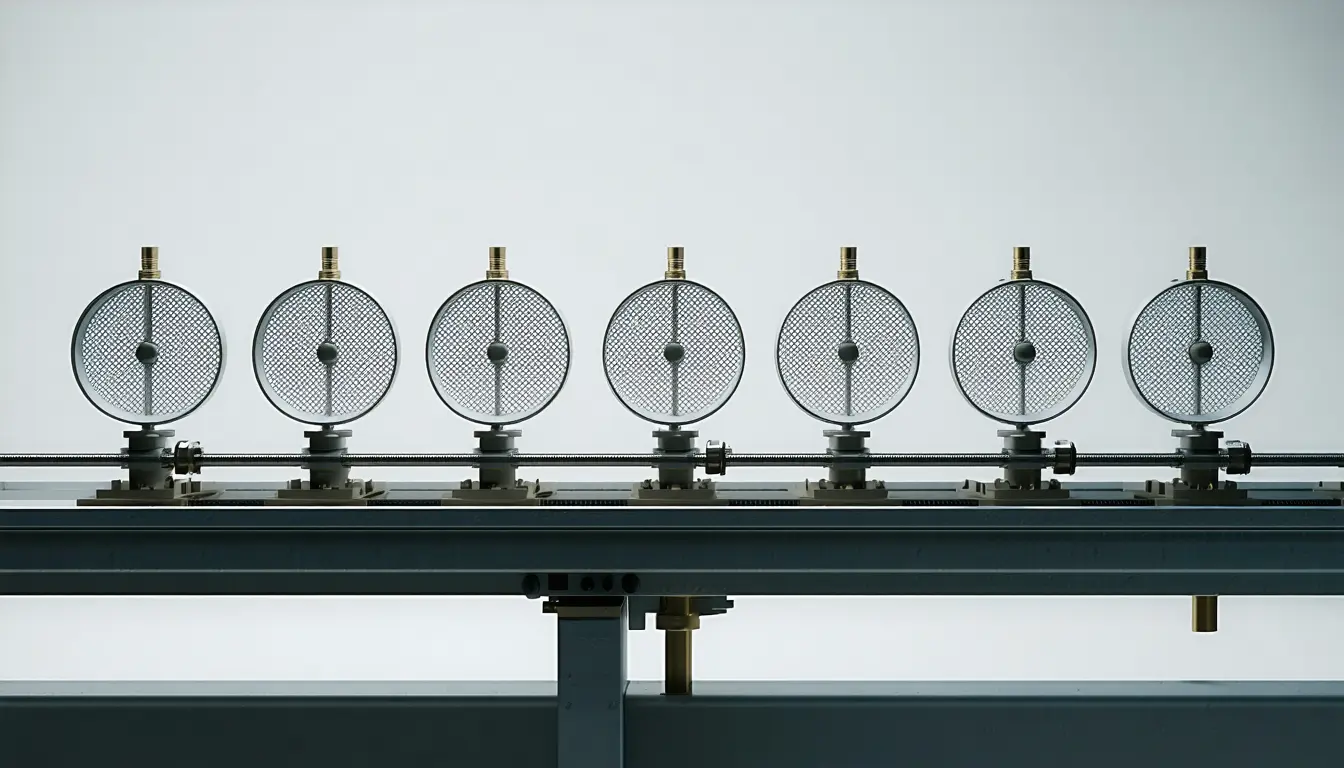
The design is a comparison. Anto I. Lonappan and colleagues took maps made by different detectors, reasoning that a genuine cosmic rotation would show up in every one [5]. Their method cancels whatever rotation the maps share, so what survives most likely reflects differences in how each detector's polarization angle was calibrated [5]. It is a relative calibration check, measuring detectors against one another [4]. The Discover account of the paper does not explain how a tilt shared equally by every detector is told apart from a cosmic one.
For a test run, the team applied the estimator to eight maps from the European Space Agency's Planck satellite and set the output beside the Minami-Komatsu analysis, the standard method for separating birefringence from calibration error [6][16]. The two agreed on 0.37 degrees, plus or minus 0.12 [7]. The researchers describe what they have as an independent estimator and modeling route [8].
The thing this comparison doesn't tell you is whether the eight maps are clean. Both methods read the same Planck data, so a flaw built into those maps would reach both [6]. The agreement shows the new estimator reproduces the established one on identical inputs.
"The signal we are looking for is incredibly small, so we have to be certain that we are seeing the universe and not our instrument," Lonappan, a postdoctoral fellow at UC San Diego, said in a statement [9]. "Before interpreting a tiny rotation as new physics, we want to know that the calibration itself can be trusted," he said [10].
The same calibration question applies to B modes, curl-like polarization patterns that gravitational lensing produces and that primordial gravitational waves from the very early universe may also produce [12]. The primordial kind has not been detected, and it could carry clues about cosmic inflation [12]. The team hopes the method helps avoid errors in telling B modes from E modes [13].
"The detection of primordial B modes would transform our understanding of the early universe, so the measurement must survive rigorous calibration checks," co-author Brian Keating, a Chancellor's Distinguished Professor of Physics, said in a statement [14]. "This is ultimately about knowing when we can trust a measurement," he said [15].
What to watch
- An application of the estimator to maps from a CMB experiment other than Planck, which would test the 0.37-degree figure on data with different systematics.
- A published account of how the method handles a polarization-angle offset shared equally by every detector, the case a relative check does not isolate by construction.
- A primordial B-mode claim that cites this relative-calibration check alongside the Minami-Komatsu analysis.