Drexel study finds Tacony-Frankford Creek under the EPA's oxygen minimum in 40% of July observations
Drexel researchers found Tacony-Frankford Creek below the EPA's minimum oxygen level for fish growth and reproduction in 40% of July observations. Their study with the Philadelphia Water Department asks which factors shape each watershed's response to sewer overflows.
The Scientist · Science desk
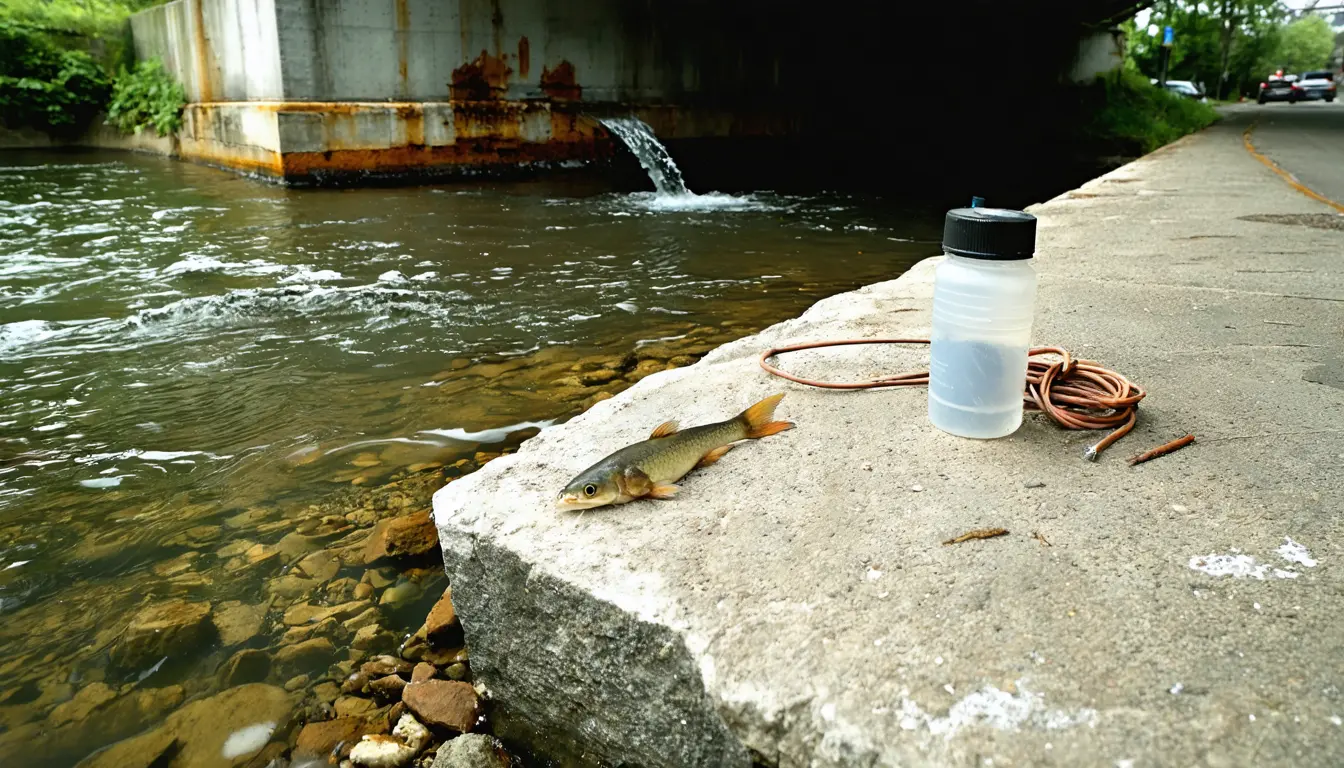
Tacony-Frankford Creek was under the EPA oxygen minimum for fish in 40% of July observations; Pennypack and Darby-Cobbs creeks rarely were. Marques says over 8 billion gallons of sewer and stormwater discharge in Philadelphia County each year. US sewers from the 1800s spill into waterways in floods.
- Who's exposed exposure Tacony-Frankford Creek Under EPA oxygen minimum for fish growth in 40% of July observations, low through September, claim 2
- Who's exposed exposure Pennypack, Darby-Cobbs creeks Rarely below the dissolved oxygen threshold throughout the entire year, claim 3
- What it costs cost Philadelphia County rivers More than 8 billion gallons of sewer and stormwater discharged yearly in floods, Marques says, claim 7
- What it sets up precedent US cities with 1800s sewers Stormwater and sewage share pipes designed to spill into nearby waterways in floods, claim 9
| Who | How | Kind | Claim |
|---|---|---|---|
| Tacony-Frankford Creek | Under EPA oxygen minimum for fish growth in 40% of July observations, low through September | exposure | 2 |
| Pennypack, Darby-Cobbs creeks | Rarely below the dissolved oxygen threshold throughout the entire year | exposure | 3 |
| Philadelphia County rivers | More than 8 billion gallons of sewer and stormwater discharged yearly in floods, Marques says | cost | 7 |
| US cities with 1800s sewers | Stormwater and sewage share pipes designed to spill into nearby waterways in floods | precedent | 9 |
What happened
- The Drexel team built a model of an overflow event's water quality impact from over a decade of USGS monitoring, NOAA precipitation data and Philadelphia Water Department overflow records.
- It covered Darby-Cobbs, Pennypack, Tacony-Frankford and the Delaware River Basin portion bordering the city from 2013 to 2024, each with USGS stations upstream and downstream of an overflow area.
- Pennypack Creek and Darby-Cobbs Creek rarely fell below the oxygen threshold at any point in the year.
- The team centered on dissolved oxygen, which indicates whether water can sustain aquatic life such as fish and macroinvertebrates.
Why it matters
- Who has to decide decision Where the Water Department directs overflow mitigation depends on telling overflow damage from a creek's own baseline, and this study is built to make that separation.
- What it limits constraint With four watersheds, traits such as size, land cover and flow magnitude vary together, so the comparison can associate them with the response but is poorly placed to isolate any one.
- Who's exposed exposure Many US cities with 1800s combined sewers face the same design, in which more frequent flooding means more spills into waterways, but one city's four watersheds may not transfer to them.
Amanda Carneiro Marques, an assistant professor in Drexel's School of Engineering, gave the scale at county level. "In Philadelphia County, more than 8 billion gallons (30 billion liters) of combined sewer and stormwater are discharged into rivers and streams each year during flooding events," she said [7]. The study areas do not follow that line. Darby-Cobbs Creek covers parts of Chester, Delaware, Montgomery and Philadelphia counties, and Tacony-Frankford Creek covers parts of Montgomery and Philadelphia [8]. The county total and the four watersheds therefore describe overlapping but different areas.
The design choice that matters is the length of the record. Using the same monitoring sites for more than a decade let the team see each watershed's regular oxygen fluctuations with seasonal temperature and flow rate [10]. Oxygen levels also tend to move with sustained changes in temperature, flow volume and the abundance of oxygen-consuming microorganisms [11]. A low July reading therefore has explanations besides a sewer overflow. Laying the Water Department's overflow records over the same years shows how each watershed responded to a rapid influx of stormwater and organic matter [15]. Marques said each watershed "had a slightly different dissolved oxygen baseline profile, depending on its physical and hydrological characteristics, such as size, land coverage and flow magnitude" [14].
Marques described the biology behind the delay. An influx of organic matter or nutrients may cause rapid algal growth, she said, and when the algae die, aerobic microorganisms that decompose them can boom and "consume vast amounts of dissolved oxygen" [13]. Dissolved oxygen is often a lagged indicator of an event's residual effects [11]. It works, in her words, "like recording a video, rather than just getting a snapshot of a moment in time," Marques said [12].
We think the same-site, decade-long record is the right design for separating season from overflow. Each creek's own history gives the overflow response something to be measured against.
The thing the 40% figure doesn't tell you is how many of those July observations followed an overflow [2]. The Phys.org text ends mid-quote, before the count of observations or the factors the team ranked highest [1].
What to watch
- The full Journal of Environmental Management paper's ranking of which infrastructure and environmental factors matter most.
- Whether the overflow records tie Tacony-Frankford's low July oxygen readings to specific overflow events.
- Whether the Water Department uses the watershed comparison to prioritize mitigation sites.
Clarity's read
What the record supports and how the coverage leans. The claims behind it follow.
Reality
- Evidence62
- Adoption
- Not scored
- Hype gap−5
- Incentives
- Not scored
- Confidence55
Claim ledger
Ranked by verification strength, evidence, and original report placement.
- [1]
Researchers at Drexel University, in collaboration with the Philadelphia Water Department, published a study in the Journal of Environmental Management that compared how different watershed regions in Philadelphia respond to the stress of a combined sewer overflow, to determine the environmental and infrastructural elements that factor most prominently into the response.
- [2]
The Tacony-Frankford Creek watershed reported dissolved oxygen levels below the Environmental Protection Agency's minimum threshold for fish growth and reproduction in 40% of observations in July, with low levels persisting through September.
- [3]
Pennypack Creek and Darby-Cobbs Creek watersheds rarely reported dissolved oxygen levels below the threshold throughout the entire year.
- [4]
Marques and her team drew on more than a decade of U.S. Geological Survey water quality monitoring, combined with precipitation data from the National Oceanic and Atmospheric Administration and the Philadelphia Water Department's combined sewer overflow records, to create a detailed model of the overall water quality impact of an overflow event.
- [5]
The team looked at data from four Philadelphia watersheds, Darby-Cobbs Creek, Pennypack Creek, Tacony-Frankford Creek and the portion of the Delaware River Basin that borders Philadelphia, from 2013 to 2024; each contains at least one designated combined sewer overflow area and Geological Survey monitoring stations both upstream and downstream of it.
- [6]
The research centered on fluctuations in dissolved oxygen, a measure of the amount of oxygen present in water, which indicates a body of water's potential to sustain aquatic life, like fish and macroinvertebrates.
- [7]
"In Philadelphia County, more than 8 billion gallons (30 billion liters) of combined sewer and stormwater are discharged into rivers and streams each year during flooding events," said Amanda Carneiro Marques, assistant professor in the School of Engineering at Drexel.
- [8]
Darby-Cobbs Creek watershed lies in parts of Chester, Delaware, Montgomery and Philadelphia counties, and Tacony-Frankford Creek watershed lies in Montgomery and Philadelphia counties.
- [9]
In Philadelphia and many urban areas across the U.S. with sewer systems dating back to the 1800s, stormwater and sewage drain into the same pipes, which are designed to spill into nearby waterways when flooding occurs, and more frequent flooding is posing a threat to people, property and surrounding ecosystems.
- [10]
Looking at more than a decade of data from the same monitoring sites allowed the researchers to observe each watershed's regular dissolved oxygen fluctuations tied to seasonal temperature and flow rate changes.
- [11]
Dissolved oxygen levels tend to fluctuate with sustained changes in temperature, flow volume and abundance of oxygen-consuming microorganisms, so it is often a lagged indicator of the residual effects of a deleterious event such as flooding or infiltration of a pollutant.
- [12]
Marques said dissolved oxygen is one of the most important indicators for aquatic ecosystem health as it can reflect cumulative environmental impacts over time, "like recording a video, rather than just getting a snapshot of a moment in time."
- [13]
Marques said an influx of organic matter or nutrients may cause rapid algal growth; when those algae die, it may trigger a boom in aerobic microorganisms that decompose the organic matter, and these microorganisms "consume vast amounts of dissolved oxygen during respiration," which can lead to very low dissolved oxygen levels in the water.
- [14]
Marques said each watershed "had a slightly different dissolved oxygen baseline profile, depending on its physical and hydrological characteristics, such as size, land coverage and flow magnitude."
- [15]
Overlaying the monitoring information with the Water Department's combined sewer overflow records from the same time period illuminated how each watershed responded to a rapid influx of stormwater and organic matter from sewage.
Get this ledger inside ChatGPT. Ask about any of our stories and the answer brings its figure, each claim’s verdict and the sources. Free, no account.
Sources
1 independent publisher whose own reporting we read for this story.
- phys.orgHow do combined sewer overflows affect water quality in Philadelphia?
1 article · October 16, 2026
Topics and entities
Follow any of these and your For You feed starts watching them — no settings page required.