Wastewater DNA from Desulfobulbus bacteria improves a model that flags corroded sewer pipes
Tohoku University researchers found that adding wastewater DNA from sulfate-reducing bacteria improved a model's flagging of severely corroded sewer pipes. They say the resulting maps could help cities choose which pipes to inspect first.
The Scientist · Science desk
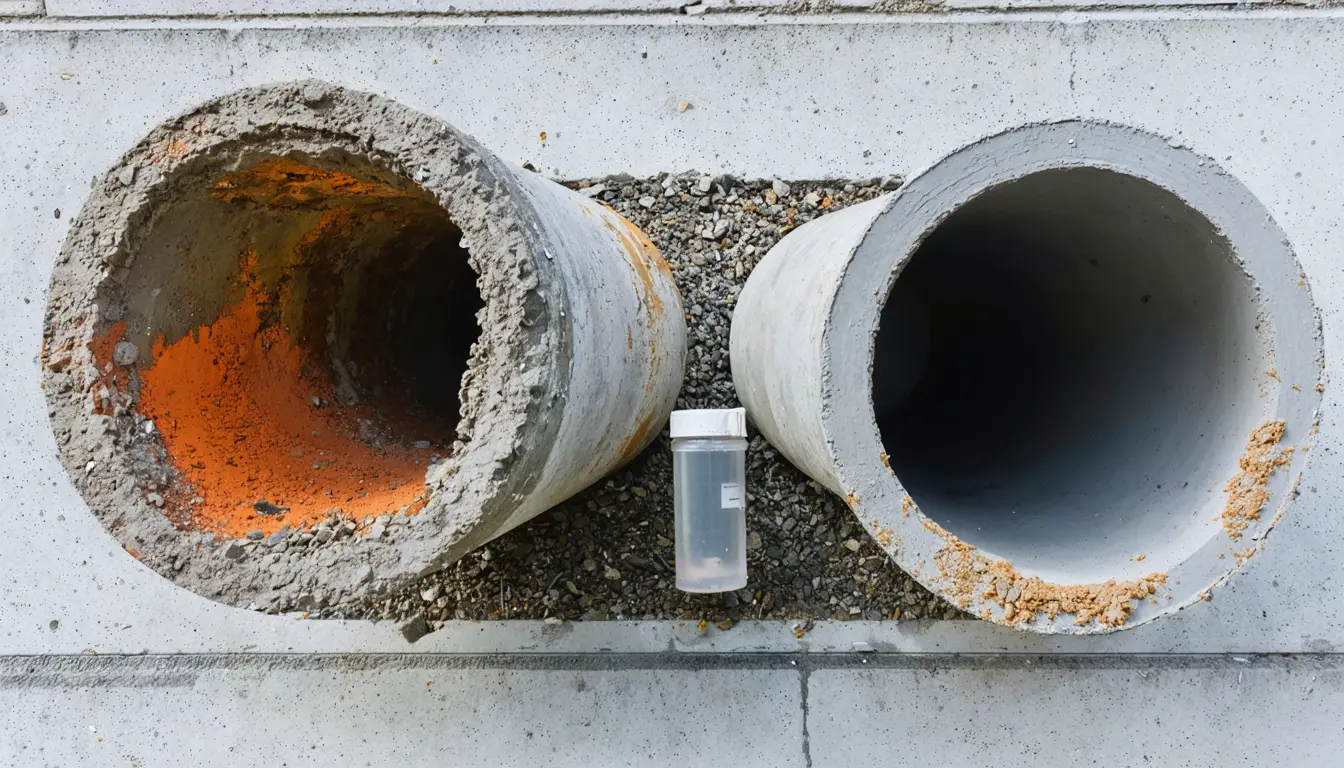
40 manholes: wastewater DNA of sulfate-reducing bacteria measured. Desulfobulbus: top microbial predictor. Model: microbial data improved flagging of severely corroded pipes. Records: tested on 3,498 pipe sections. Municipalities: Sano says it can help prioritize inspections.
- What's now possible capability 40 sampled manholes Wastewater samples across a residential sewer network; DNA of sulfate-reducing bacteria measured, claim 5
- What's now possible capability Desulfobulbus bacteria Strongest relationship with pipe deterioration; the most important microbial predictor in the model, claim 3
- What's now possible capability Corrosion risk model Adding the microbial information improved its ability to identify severely corroded pipes, claim 9
- What it limits constraint Pipe inspection records The model was tested against inspection records from 3,498 pipe sections, claim 8
- Who has to decide decision Municipalities Sano says the method can help them prioritize inspections and identify high-risk areas before costly failures, claim 12
| Who | How | Kind | Claim |
|---|---|---|---|
| 40 sampled manholes | Wastewater samples across a residential sewer network; DNA of sulfate-reducing bacteria measured | capability | 5 |
| Desulfobulbus bacteria | Strongest relationship with pipe deterioration; the most important microbial predictor in the model | capability | 3 |
| Corrosion risk model | Adding the microbial information improved its ability to identify severely corroded pipes | capability | 9 |
| Pipe inspection records | The model was tested against inspection records from 3,498 pipe sections | constraint | 8 |
| Municipalities | Sano says the method can help them prioritize inspections and identify high-risk areas before costly failures | decision | 12 |
What happened
- Of the sulfate-reducing bacteria studied, Desulfobulbus had the strongest link to pipe deterioration and was the top microbial predictor in the model.
- Those habitat estimates went into a random forest model alongside pipe age, diameter and slope.
- The model was tested against inspection records from 3,498 pipe sections.
Why it matters
- What it limits constraint Camera inspection records are the yardstick the model was scored against, so the method can shorten a survey list but cannot yet stand in for the surveys.
- Who has to decide decision A utility weighing it would be ordering inspections from a ranking built on 40 water samples, and would have to decide how far to trust it without a published effect size.
- What it limits constraint The evidence comes from one residential network, so there is no basis yet for assuming the bacterial signal ranks pipes the same way in other networks.
Professor Daisuke Sano describes the payoff as sequencing the work. "This can help municipalities prioritize inspections more efficiently and identify high-risk areas before costly failures occur," he said [12]. Camera inspections are costly and time-consuming [13], and the model was scored against their output: it was tested against inspection records from 3,498 pipe sections [8].
The microbe result carries a caveat. Sano said: "Among all the biological factors we tested, it was the strongest predictor, second only to pipe age" [4]. Pipe age is also an input to the model [7], so Desulfobulbus ranks behind a variable that needs no water sample. Importance in a random forest measures how much a variable helps prediction. It does not show cause, although sulfate-reducing bacteria can contribute to pipe corrosion [2].
The study rests on a small sample. The team sampled wastewater at 40 manholes in one residential network [5]. Against 3,498 inspected sections, that is roughly one sample for every 87 sections [11]. The ecological model fills the gap, using pipe slope and upstream building area to estimate where the bacteria are likely to occur [6]. Those habitat estimates then went into the random forest alongside pipe age, diameter and slope [7].
Adding the microbial information improved the model's ability to identify severely corroded pipes [9]. The summary does not say how large the improvement was, what share of the 3,498 sections were severely corroded, or whether the scored sections were held out from training.
The paper, by Junming Zhang and colleagues, is published in the Journal of Environmental Management [10].
What to watch
- A test on a second sewer network, or on pipe sections held out from model training.
- A follow-up that reports the size of the gain over the same model without microbial inputs.
- A utility comparing the cost of manhole DNA sampling with the camera surveys it would defer.
Clarity's read
What the record supports and how the coverage leans. The claims behind it follow.
Reality
- Evidence52
- Adoption
- Not scored
- Hype gap+15
- Incentives
- Not scored
- Confidence50
Claim ledger
Ranked by verification strength, evidence, and original report placement.
- [1]
Researchers at Tohoku University developed a method to predict the risk of severe corrosion in underground sewer pipes more efficiently.
- [2]
Sulfate-reducing bacteria found in sewer wastewater can contribute to pipe corrosion, and the researchers measured their DNA.
- [3]
Among the bacteria studied, Desulfobulbus showed the strongest relationship with pipe deterioration and was the most important microbial predictor in the model.
- [4]
Professor Daisuke Sano said: "Among all the biological factors we tested, it was the strongest predictor, second only to pipe age."
- [5]
The team collected wastewater samples from 40 manholes across a residential sewer network and measured DNA from sulfate-reducing bacteria.
- [6]
The team combined the DNA measurements with information on pipe slope and upstream building area to map bacterial habitat potential across the network, using ecological modeling to estimate where the bacteria were more likely to occur.
- [7]
The habitat estimates were combined with pipe age, diameter and slope in a random forest machine-learning model.
- [8]
The model was tested against inspection records from 3,498 pipe sections.
- [9]
Adding the microbial information improved the model's ability to identify severely corroded pipes.
- [10]
The work, by Junming Zhang et al., is published in the Journal of Environmental Management (2026).
- [11]
The 3,498 inspected pipe sections amount to roughly 87 sections for each of the 40 sampled manholes.
- [12]
Sano said: "This can help municipalities prioritize inspections more efficiently and identify high-risk areas before costly failures occur."
- [13]
Traditional camera inspections of sewer pipes are costly and time-consuming.
Get this ledger inside ChatGPT. Ask about any of our stories and the answer brings its figure, each claim’s verdict and the sources. Free, no account.
Sources
1 independent publisher whose own reporting we read for this story.
- phys.orgAI and wastewater DNA-based mapping help identify sewer pipes at risk of corrosion
1 article · October 16, 2026
Topics and entities
Follow any of these and your For You feed starts watching them — no settings page required.
Topics
- Environmental DNAFollow
- Sewer infrastructureFollow
- Machine learning for infrastructureFollow