ScienceNot yet confirmed elsewhere1 publisher2 min readPublished
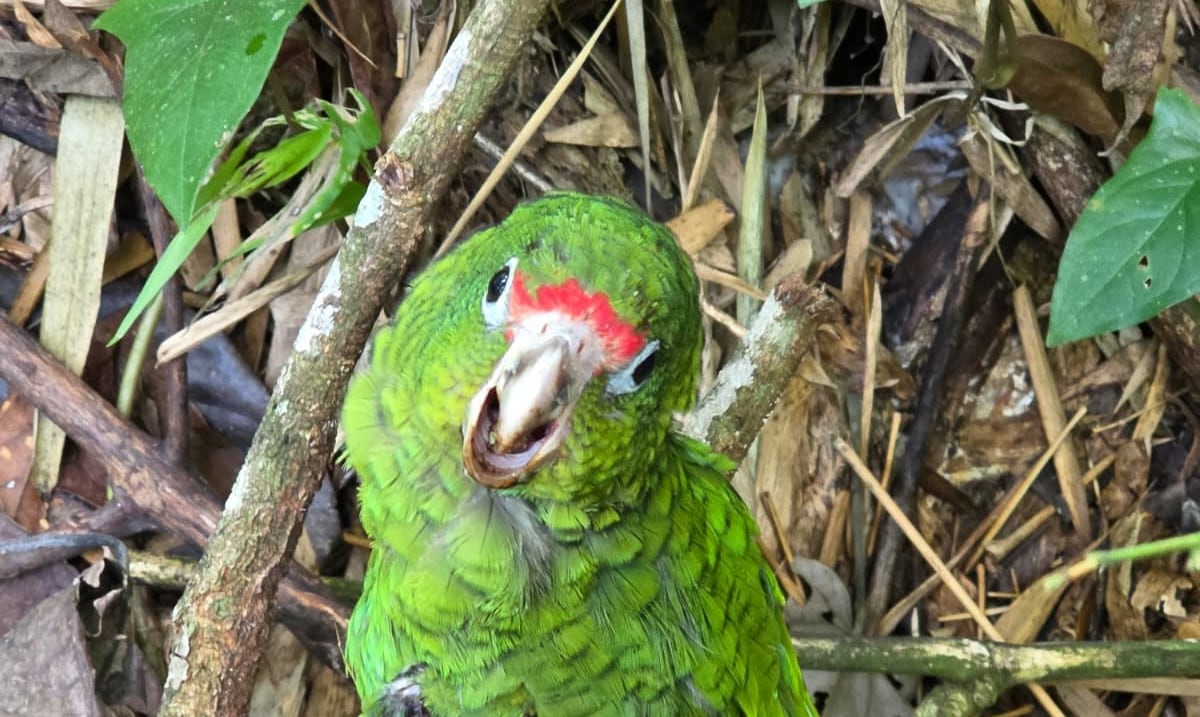
Fish and Wildlife biologist cuts a juvenile Puerto Rican parrot free from an invasive boa
Raúl Correa of the US Fish and Wildlife Service cut a juvenile Puerto Rican parrot free from an invasive red-tailed boa in Maricao State Forest. It is a witnessed attack by the pet-trade snake on a critically endangered bird, though one case cannot show how many parrots the boas kill.
The Scientist · Science desk
A comparison of maximum lengths: the invasive red-tailed boa exceeds 10 feet while Puerto Rico's native boa grows up to 7 feet.
Maximum length by species In feet
| Item | Value | Claim |
|---|---|---|
| Invasive red-tailed boa | 10 feet | 6 |
| Native Puerto Rican boa | 7 feet | 5 |
What happened
- The boa had pinned the young parrot on a bamboo stalk, and it lost its grip and let go when Correa sliced through the bamboo.
- Wildlife service staff watched the parrot for lingering injuries afterward, and a day later it was flying with its flock again.
- Red-tailed boas are native to South America and arrived in Puerto Rico in the 1990s through the illegal exotic pet trade.
- A 2023 study found that the invasive boa has introduced viruses into the island's native snake populations.
Why it matters
- exposure With nothing above it in Puerto Rico's food chain, the boa faces no natural check, so its pressure on the critically endangered parrot continues unless people remove snakes.
- constraint A single intercepted attack cannot tell wildlife managers whether boa predation is a main cause of parrot losses or an occasional one; that takes counted rates from long-term monitoring.
- cost If removal is the answer, someone has to fund it in staff time or bounties, as Florida does with prize money for its annual python hunt.
- exposure Puerto Rico's smaller native boa is at risk from the invader through infection, so snake control would protect native snakes as well as the parrot.
Correa found the attack by ear. A flock of parrots was in a panic, and he followed the squawks until he reached a young bird held by the snake [1]. The encounter is one observed case of an invasive constrictor seizing a juvenile of a critically endangered species in western Puerto Rico's Maricao State Forest [1][12]. It cannot say how often such attacks happen, or how many end with no one close enough to cut the bird loose.
The broader charge is Popular Science's. The outlet wrote that the boas spread rapidly on an island where nothing sits above them in the food chain, and that they have caused widespread damage to native wildlife, the parrot included [12]. The article does not give a count of parrots lost to snakes or an estimate of how many remain in the wild.
The invader is also the larger snake. Puerto Rico's native boa, Chilabothrus inornatus, grows up to 7 feet long [5]. The red-tailed boa can exceed 10 feet [6], a margin of at least 3 feet over the native species' maximum [11].
Marcia McNutt, identified in the article as director of the US Geological Survey, said: "Experience has shown that island ecosystems are particularly vulnerable to snake invasions, and unfortunately Puerto Rico has no natural predators that can keep the numbers of these prolific, snakes in check" [8]. "Humans were responsible for introducing this scourge to the island, and are the only hope for mitigating the problem before it is too late for the native species," she said [9].
Other places have answered invasive snakes with removal. Florida holds an annual Python Hunt in which amateur and professional hunters kill invasive Burmese pythons for prize money [10].
In our view, the rescue adds one witnessed case to a threat the source already describes as widespread [12]. Wildlife managers would need a rate, such as boa attacks or deaths per parrot per season, gathered by monitoring birds and nests over several years. Only that rate would show whether boa predation limits the parrot population.
What to watch
- Published predation rates or parrot survival counts from monitoring in Maricao State Forest, which would show whether boa attacks limit the population.
- Any boa removal programme in Puerto Rico, and whether it follows a bounty model like Florida's annual Python Hunt.
- Follow-up work on the 2023 virus finding showing whether infections are spreading through native Puerto Rican boas.
Clarity's read
What the record supports and how the coverage leans. The claims behind it follow.
Reality
- Evidence40
- Adoption
- Insufficient
- Hype gap+10
- Incentives
- Insufficient
- Confidence55
Claim ledger
Ranked by verification strength, evidence, and original report placement.
- [1]
In the Maricao State Forest on the western end of Puerto Rico, Raúl Correa of the U.S. Fish and Wildlife Service encountered a panicking flock of parrots, followed the squawks, and found a young bird in the grips of a red-tailed boa.
- [2]
The snake had trapped a juvenile Puerto Rican parrot (Amazona vittata) on a bamboo stalk; Correa sliced the bamboo, causing the snake to lose its grip and release the bird.
- [3]
USFWS observed the parrot after the incident to ensure it did not suffer lingering injuries; a day later the bird returned to flying with its flock.
- [4]
Red-tailed boas are considered invasive in Puerto Rico; native to South America, they came to the island in the 1990s through the illegal exotic pet trade.
- [5]
Puerto Rico's native boa (Chilabothrus inornatus) is smaller and can grow up to 7 feet long.
- [6]
The invasive red-tailed boa can grow over 10 feet.
- [7]
The invasive red-tailed boa has introduced viruses to native snake populations on the island, according to a 2023 study.
- [8]
"Experience has shown that island ecosystems are particularly vulnerable to snake invasions, and unfortunately Puerto Rico has no natural predators that can keep the numbers of these prolific, snakes in check,"
ReportedSupportedSource: Marcia McNutt, identified as USGS Director, quoted by Popular ScienceView cited source - [9]
"Humans were responsible for introducing this scourge to the island, and are the only hope for mitigating the problem before it is too late for the native species."
ReportedSupportedSource: Marcia McNutt, identified as USGS Director, quoted by Popular ScienceView cited source - [10]
Florida hosts an annual Python Hunt in which amateur and professional hunters kill invasive Burmese pythons (Python bivittatus) for prize money.
- [11]
The invasive red-tailed boa's maximum length exceeds the native Puerto Rican boa's maximum by at least 3 feet.
- [12]
Without anything above it in the food chain, the red-tailed boas spread rapidly and have caused widespread damage to native wildlife populations, including the critically endangered Puerto Rican parrot.
Sources
1 independent publisher whose own reporting we read for this story.
- popsci.comYoung parrot rescued from grips of invasive boa snake
1 article · October 11, 2026
Topics and entities
Follow any of these and your For You feed starts watching them — no settings page required.
Topics
- Exotic pet tradeFollow
- Puerto Rico ecologyFollow
- Endangered species conservationFollow
- Invasive SpeciesFollow