ScienceNot yet confirmed elsewhere1 publisher2 min readPublished
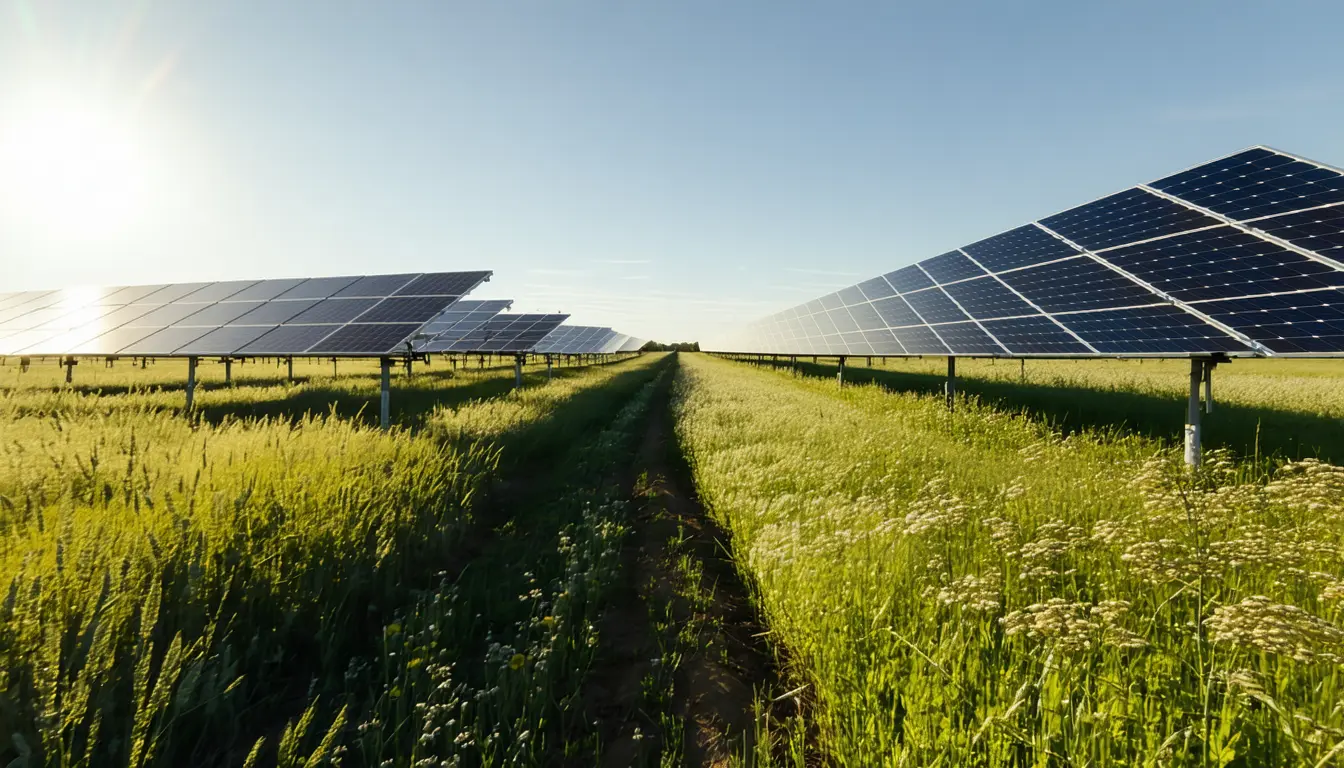
Seeded native grasses split between shade and sun beneath an Edmonton solar farm
University of Alberta researchers tracked seven seeded native grasses for two years at an Edmonton solar farm and found some favour shade, others sun. That points to zone-matched native seed mixes as an alternative to the cheap turf often sown on solar ground.
The Scientist · Science desk
What happened
- Between panel rows, plants received nearly 12 times more sunlight, and the soil ran about 3.2 C warmer and 12% drier, than directly beneath the panels.
- The open rows supported more than twice as many plant species as the shaded ground under the panels.
- Low spots where rainwater pooled after construction grew 68% more vegetation and nearly twice the grass of higher, drier ground.
- Some non-native grasses survived in every zone at the site, in full sun and in deep shade.
- A companion paper in Invasive Plant Science and Management found selective herbicide and mowing suppressed invasive weeds and helped the native grasses establish.
Compiled by The ScientistSomething wrong?How this is made
Why it matters
- cost Operators who replant with natives take on follow-up weed control, because the sunny rows where natives do best also drew the most invasive weeds.
- decision Row spacing and panel height become vegetation decisions, and the university's account names wider rows and higher-mounted panels as options for developers.
- constraint The species results come from one former field in Canada's cooler aspen parkland over two years, so hotter or drier solar sites would need their own trials before copying the mix.
The panels created the treatments. Each row leaves three kinds of ground: full shade underneath, partial shade along the edges and open sun between rows [3]. Zheng's team sowed native grasses across all three on old cropland at a solar farm in Edmonton's North Saskatchewan River valley, logging soil temperature, moisture and light as the plants grew [1][4]. Former fields are a common home for solar farms [16].
The limit of that design is that the treatments come bundled. Light, soil heat and moisture all changed together between the shaded ground and the open rows [5]. A species that did well between rows could be responding to any of the three, and the study cannot pull them apart.
The wet patches carry the same caveat. They were an accident of construction, low ground where water collected [7]. Grass gained more there than vegetation as a whole did, so grass made up a larger share of the cover, by as much as a fifth on the rounded figures [17]. Water is the likeliest cause, but the comparison follows terrain the builders left behind [7].
Turf and other fast-growing non-native grasses are often sown on solar ground because they are cheaper and more convenient [2]. The hardiness of some non-natives across every zone [9] explains part of that choice. The natives behaved differently: individual species settled either in the shade under the panels or in the sunny rows [10], and the sunny rows drew more planted natives and more invasive weeds at once [8]. The public account of the study names neither the species nor their survival rates, and it describes no turf plots grown alongside for comparison. The evidence supports matching native species to zones [10].
Zheng's case for the effort is ecological. "Native grasslands are one of the rarest ecosystems remaining in the aspen parkland, so every opportunity for restoration is valuable," Zheng said [13]. Natives, Zheng said, "provide improved soil stability, soil carbon storage, water infiltration and refuge for pollinators" [14]. This study measured establishment, cover and diversity [4], so those benefits are Zheng's argument for native grassland in general. Taken with the companion herbicide-and-mowing paper, the work shows "that successful restoration requires adaptive management rather than a single solution," Zheng said [12].
What to watch
- Publication of which of the seven native species established under the panels and which in the open rows, with survival rates for each.
- A side-by-side trial of turf and native seed mixes under panels that measures invasive weed cover over several seasons.
- Results from arrays with wider row spacing or higher panels, showing whether layout changes where natives establish.
Clarity's read
What the record supports and how the coverage leans. The claims behind it follow.
Reality
- Evidence58
- Adoption
- Insufficient
- Hype gap+12
- Incentives
- Insufficient
- Confidence52
Claim ledger
Ranked by verification strength, evidence, and original report placement.
- [1]
A University of Alberta study led by Fengxue Zheng, published in Ecological Engineering, was conducted on old cropland at a solar farm in the North Saskatchewan River valley in Edmonton.
- [2]
Fast-growing turf or other non-native grasses are often used as a less costly, more convenient replacement in reclamation efforts at solar farms.
- [3]
The researchers studied the survival of seven seeded native grass species over two years, comparing shaded areas directly under the panels, partially shaded areas along panel edges and sunny open spaces between rows.
- [4]
They measured soil temperature, moisture and light, and analysed plant growth and diversity, ground coverage, the types of plants in each area, and how successfully planted native grasses grew and blocked out invasive weeds.
- [5]
In the open spaces between panels, plants got nearly 12 times more sunlight, the soil was about 3.2 C warmer and 12% drier than in shaded spots directly under the panels.
- [6]
The open spaces between panels had more than twice as many plant species growing as the shaded areas.
- [7]
Wetter, lower-lying spots where water accumulated after solar farm construction grew 68% more vegetation and nearly double the amount of grass compared with dry areas in higher spots.
- [8]
Sunny areas had more planted native grasses but also more invasive weeds.
- [9]
Some non-native grasses managed to survive everywhere, whether in full sun or deep shade.
- [10]
Different species of planted native grasses preferred growing either under the panels in shade or in the sunny areas between panel rows.
- [11]
A related study published in Invasive Plant Science and Management showed that targeted management, including selective herbicide spraying and mowing, suppressed invasive weeds, reduced competition and promoted native grass establishment around the solar panels.
- [12]
that successful restoration requires adaptive management rather than a single solution
- [13]
Native grasslands are one of the rarest ecosystems remaining in the aspen parkland, so every opportunity for restoration is valuable,
- [14]
They're the most resilient and beneficial choice when replanting vegetation after solar farms are constructed, as they provide improved soil stability, soil carbon storage, water infiltration and refuge for pollinators.
- [15]
The work is one of the few studies exploring how solar panels affect seeded grass establishment in Canada's cooler aspen parkland region.
- [17]
Grass rose proportionally more than total vegetation in wet spots, so grass's share of vegetation there was higher by up to about a fifth.
- [18]
The findings can contribute to native grass seed mixes that include shade and drought tolerance for replanting around solar panels; developers could also consider spacing rows farther apart or mounting panels higher.
Sources
1 independent publisher whose own reporting we read for this story.
Topics and entities
Follow any of these and your For You feed starts watching them — no settings page required.