Science1 publisher2 min readPublished
An Alberta model traces decadal day-length swings to the inner core's gravitational pull
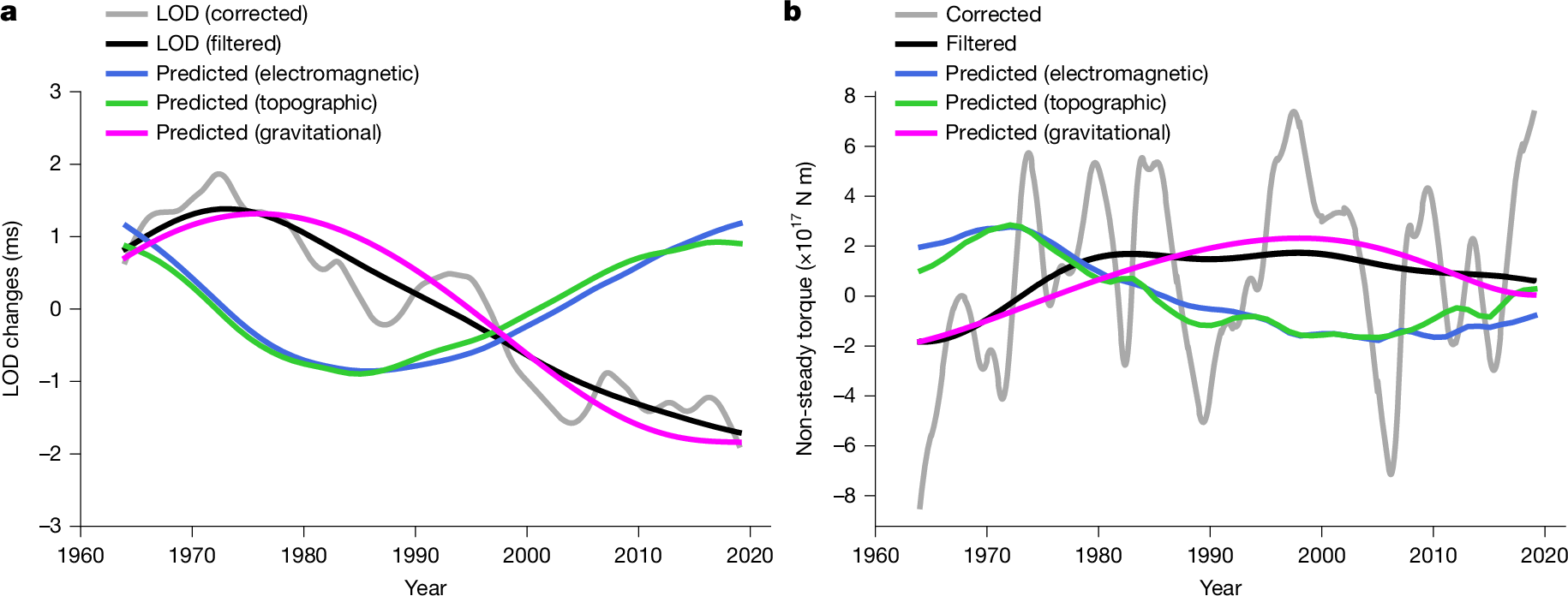
Huifeng Zhang and Mathieu Dumberry reconstructed the torques between Earth's core and mantle and found the inner core's gravity driving the millisecond wobble in day length while electromagnetic and topographic coupling resist it.
The Scientist · Science desk
What happened
- Huifeng Zhang and Mathieu Dumberry report in Nature that multidecadal changes in the length of day are driven mainly by the inner core's gravitational torque, with electromagnetic and topographic coupling resisting it.
- A key input is a 2023 seismic study of the inner core's rotation relative to the rest of the planet since the 1960s, which found it turning slightly faster until about 2010 and more slowly after that.
- The other input is flow near the top of the fluid core, reconstructed from the geomagnetic field's secular variation, whose angular momentum already matched the observed day-length record.
- The reconstructed torque histories support a lowermost mantle with near-neutrally buoyant thermochemical piles, low-viscosity post-perovskite and a highly conducting iron-enriched layer a few kilometres thick at its base.
Compiled by The ScientistSomething wrong?How this is made
Why it matters
- capability A few milliseconds of Earth's spin becomes a way to put numbers on the viscosity of post-perovskite and the conductance of the mantle's basal layer, quantities no seismic wave measures directly.
- constraint The deep-mantle inferences rest on one seismic estimate of inner core rotation, so a revision of that history means refitting the torques before the mineral-physics conclusions can stand.
- contradiction Earlier work made the thin conducting basal layer the source of the driving torque; here the layer survives and its torque becomes the brake, so the same nutation-derived conductance now supports the opposite reading.
The solid inner core turns independently inside the molten outer core, and both sit within a ball of mostly iron roughly the size of Mars [22]. Averaged over time, the bumps on the inner core's boundary line up with the dense patches of mantle that pull on them, offset slightly to the east [13]. East-west flows in the outer core exert electromagnetic stress on the inner core and twist it out of that alignment, and the mantle feels a fluctuating gravitational torque in return [14]. Dumberry said the inner core "wants to be aligned" with the mantle because its dense regions are attracted to the mantle's dense regions, and that the generally westward flows of the outer core drag it out of line before gravity pulls it slowly back eastward [20].
The two rival torques each had a numerical problem. Viscous stress from core flows is far too small to do the job [8]. Electromagnetic coupling can reach the required magnitude if a several-kilometre iron-enriched layer with a conductance near 10^8 siemens lies at the base of the mantle, which studies of Earth's nutations have suggested [9], but predicted electromagnetic torques generally match the observed decadal record poorly unless the core flows are designed to produce the torque needed [10]. Topographic predictions built from geostrophic pressure and seismically derived maps of core-mantle boundary topography come out about 100 times too large, and they swing with small changes to the topography or the flow [11].
Earth-like dynamo models produce the same competition between the three torques that Zhang and Dumberry reconstruct [4]. "Before we obtained the result, we didn't know they are competing with each other," Zhang said [18].
Their record is short relative to the signal. Fluctuations of a few milliseconds run on periods of 10 to 70 years, and the series shown covers 1964 to 2019 [1]. That is 55 years, so the slowest component in the band never completes one cycle inside the data [23]. Only about nine years of the window fall after the 2010 turnaround in inner core rotation [24].
The same reconstruction also yields an inner core soft enough to deform within a few years and an upper limit on how strongly the top of the fluid core is stratified [7]. The authors write that their torque histories are tied to the accuracy of the inner core rotation and core flow models [5]. The signal underneath all of it is a few milliseconds of Earth's spin, measured by observing the planet's position relative to distant cosmic objects [21].
What to watch
- A published length-of-day prediction from the newer topographic torque formulation, based on core flows deflected over boundary bumps; the paper says none has been presented.
- Independent seismic work on the inner core's differential rotation since the 1960s, since the torque reconstruction inherits that model's errors.
- Revised estimates of the conductance of the mantle's basal iron-enriched layer, currently taken near 10^8 siemens from nutation studies.