Science1 publisher3 min readPublished
Ancient DNA traces plague through hunter-gatherer families at Lake Baikal 5,500 years ago
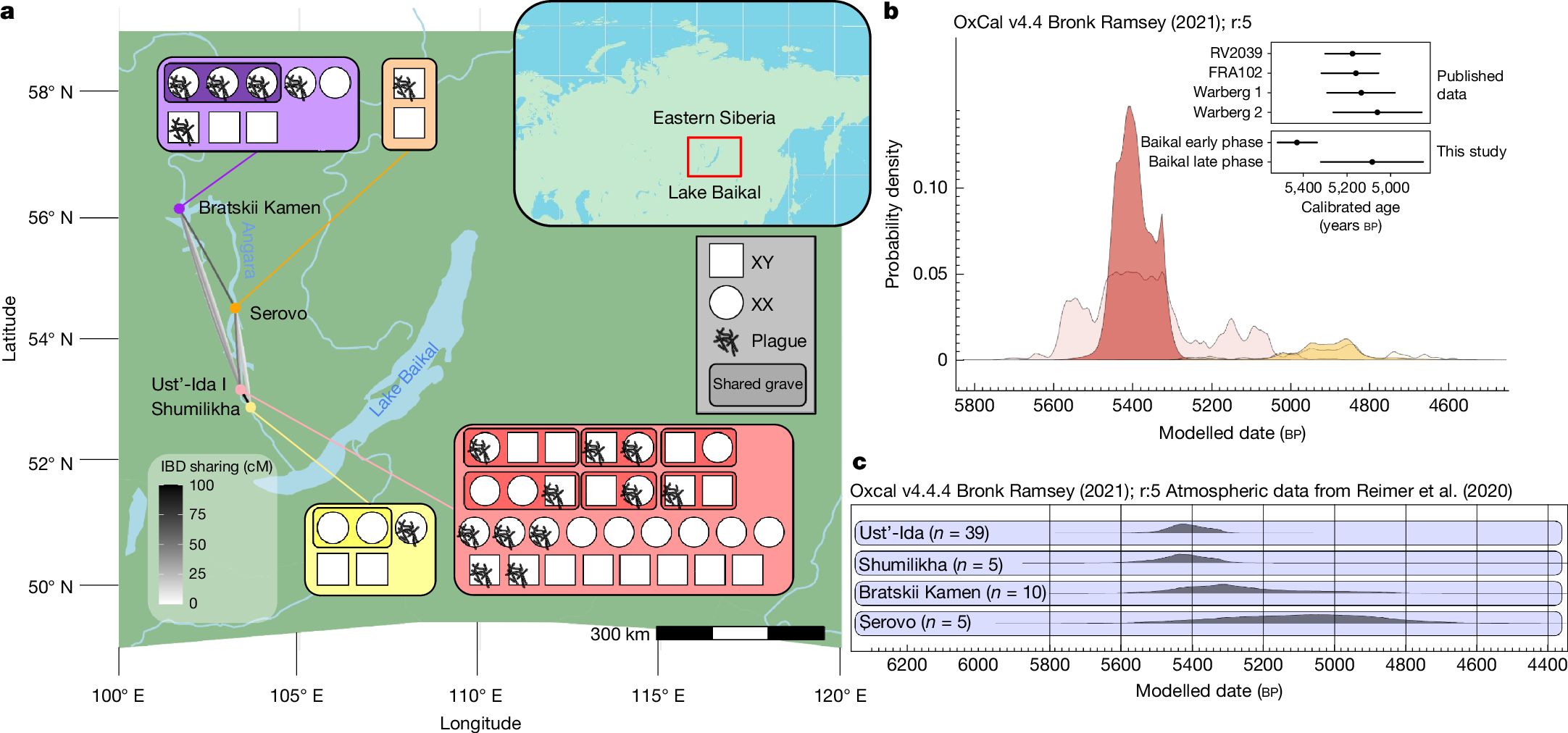
An international team sequenced Yersinia pestis from teeth at four Siberian cemeteries and found it in 18 of 46 people, among them siblings and parents who appear to have died in the same outbreak. The work is published in Nature.
The Scientist · Science desk
What happened
- A team working with ancient DNA from human remains at four hunter-gatherer burial sites in the Lake Baikal region of East Siberia reconstructed early Yersinia pestis genomes from genetic material preserved in teeth.
- Radiocarbon dates put many of the deaths close together in time, and the genetic work identified siblings who appear to have died together plus graves holding parents and children.
- At the two largest cemeteries the dead skewed heavily toward children and young teenagers, buried over a short span of time.
Compiled by The ScientistSomething wrong?How this is made
Why it matters
- constraint The working assumption that early plague was mild because it lacked flea-adapted genes no longer covers these strains, so anyone reconstructing pre-Bronze Age epidemics needs a transmission route that works at hunter-gatherer densities.
- capability Pairing pathogen genomes with kinship and radiocarbon dating in the same skeletons lets archaeologists assign a cause to a mortality cluster, which excavation and age profiles alone could not do.
- decision Groups modelling early plague virulence now have to decide whether to treat the superantigen as the explanation for lethality or as a hypothesis awaiting a functional test.
- precedent Other prehistoric cemeteries with unexplained clusters of young dead become candidates for pathogen screening on the same evidence.
Eighteen of 46 is 39 percent, and the 46 is the number of people whose remains could be tested at the four cemeteries, not the number of people living in those groups [4][5][2]. Cemetery detection rates measure who was buried and excavated, and how well DNA survived in a tooth. The University of Copenhagen release says the Baikal rate runs higher than what has been reported at some medieval plague burials [4]. The two figures are not directly comparable, though: those medieval graves were dug and sampled under different criteria.
The stronger part of the case is the patterning. The team combined the bacterial genomes with archaeology, genetic relatedness and radiocarbon dating [21], and the dates place many of the deaths close together, with siblings apparently dying together and other graves holding parents and children [7].
"Based on the plague DNA, the genetic relationships between the victims, the archaeological analysis and the radiocarbon dating, we've built a really clear, complete picture of what happened during these outbreaks," said Ruairidh Macleod, the lead author. Macleod carried out the work as a PhD student at the University of Cambridge and is now a research fellow at Oxford [8][9].
That resolves a long-standing archaeological problem at the two largest sites [6]. "The unusually high number of children and the short timespan was a real puzzle that we've been trying to solve since the 1990s. Finding out that plague was the cause is extraordinary, but it makes so much sense," said Andrzej Weber, the University of Alberta archaeologist who leads the Baikal Archaeology Project [10][11].
The genomes also carry a superantigen, a toxin-producing genetic factor the team did not see in historic plague strains [12]. Superantigens can push the immune system into reacting with unusual intensity, and that reaction can produce severe inflammation [13]. "This finding changes our understanding of the earliest plague outbreaks: Even before the bacterium evolved efficient flea-borne transmission, these ancient strains appear to have carried a potent combination of virulence factors that could make infection highly lethal," said Martin Sikora, a senior author. Sikora is an associate professor at the University of Copenhagen [14][15]. The release documents the factor's presence in the ancient genomes. It reports no test of what the factor does in a living host.
Earlier work had found that ancient Yersinia pestis was missing some of the genetic features that later let bubonic plague move efficiently through fleas and rodents. Researchers took that to mean the earliest strains could not trigger severe outbreaks [18]. Eske Willerslev is a senior author and a professor at Copenhagen and Cambridge. "Whether the earliest forms of plague were mild or virulent has been a matter of debate, but our findings demonstrate that these ancient strains were already highly lethal," he said [16][17]. The material released with the paper does not say how the infection moved between families in small mobile groups. The authors conclude that some of the earliest known plague outbreaks may already have been as deadly as later historical epidemics, particularly for children [19].
What to watch
- A functional test of the ancient superantigen in a host or cell model, which would move the virulence claim from a gene's presence to a measured effect.
- Screening of other pre-agricultural cemeteries with child-heavy age profiles for Yersinia pestis, to see whether the Baikal pattern repeats outside Siberia.
- A published account of how these strains transmitted between small mobile groups without the flea-borne machinery of later bubonic plague.