ScienceNot yet confirmed elsewhere1 publisher2 min readPublished
DGIST-led team patterns stretchable quantum-dot pixels at up to 16,000 per inch
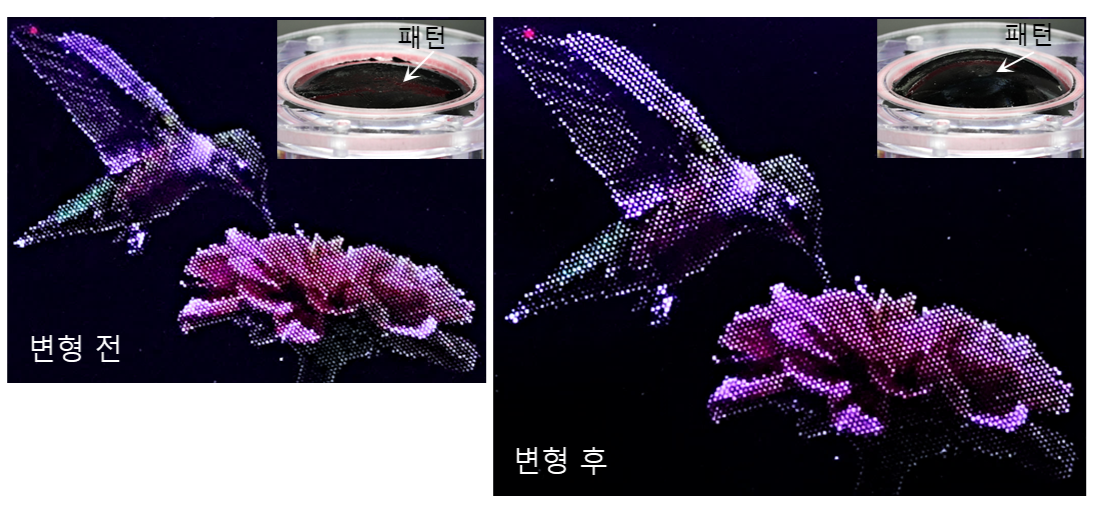
Researchers led by DGIST's Jiwoong Yang patterned stretchable quantum-dot pixels at up to 16,000 per inch, and their device kept working at about 65% strain. The team expects pixels that hold image quality under strain to widen the commercial prospects of skin-like screens.
The Scientist · Science desk
What happened
- The device reached a peak brightness of 53,300 nits, against a previous limit of 15,000 nits or less for stretchable light-emitting devices, according to DGIST.
- Earlier stretchable displays stretched only the wiring and left the emitting regions unchanged, so the share of the screen giving off light fell as it stretched.
- The team built multicolor pixels from stretchable red, green and blue quantum-dot emitting layers.
- Groups led by Moon Kee Choi at UNIST and Dae-Hyeong Kim at the IBS Center for Nanoparticle Research developed the work with DGIST.
Why it matters
- capability Peak output at least 3.5 times the old ceiling leaves stretchable emitters room to lose some brightness to strain or aging and still outshine earlier stretchable devices.
- precedent A stamp-style transfer step that patterns soft emitters at fine pitch gives other labs a fabrication route to test, on a step the field has found extremely hard.
- decision Teams weighing stretchable screens for wearables now have resolution and brightness figures to plan around, so the product decision moves to lifetime under repeated flexing.
The usual fix for a shrinking lit area is intrinsic stretchability, where the pixels themselves stretch like rubber bands [4]. That approach has had problems of its own. Soft, rubbery emitting layers are hard to pattern into fine pixels. The organic composite materials tried so far also lost much of their color reproduction and brightness, according to DGIST's account of the work, published by phys.org [5].
The team's fabrication process, called LIFT, targets both problems [6]. Quantum dots, the light-emitting nanoparticles, are chemically bonded to an elastic polymer. The fine pattern is then transferred onto a surface, much like stamping a seal [6]. The paper's title in Nature Nanotechnology names the method thermally assisted intaglio transfer printing [1][8]. The researchers also treated the surface of the emitting layer to improve its electrical conductivity and adhesion. They credit that step with producing precise patterns and strong emission at the same time [7].
In my view the team has gone after the right failure. Its emitting layer stretches with the screen, and the device ran without mechanical damage or loss of image quality at the strain tested [11]. DGIST calls the work the world's first foundational technology for ultrahigh-resolution stretchable quantum-dot displays [16].
What the release doesn't tell you is whether the finest patterns, the brightest device and the stretched device were the same sample, or how any of them hold up after long operation and repeated stretching [9][10][11]. Those are the conditions a screen built for wearable devices or electronic skin would face [12].
Yang made the case for the work himself. "This study is highly significant because we simultaneously achieved fine pixel fabrication and improved light-emitting performance by precisely controlling surfaces and interfaces while maintaining the stretchability of quantum dot composites," he said [14]. He added: "By successfully combining the chemical design of materials with precision fabrication technologies, this research will significantly expand the potential for the commercialization of next-generation stretchable displays." [15]
What to watch
- Whether the transfer-printing step works over panel-sized areas, beyond the patterned samples described.
- Whether another group reproduces stretchable emitters brighter than the earlier 15,000-nit ceiling.
- Whether a follow-up drives these pixels as an addressable display with circuitry that stretches too.
Clarity's read
What the record supports and how the coverage leans. The claims behind it follow.
Reality
- Evidence55
- Adoption
- Insufficient
- Hype gap+30
- Incentives60
- Confidence55
Claim ledger
Ranked by verification strength, evidence, and original report placement.
- [1]
A research team led by Professor Jiwoong Yang of DGIST's Department of Energy Science and Engineering developed foundational technology for an ultrahigh-resolution stretchable quantum dot display (QLED); the findings were published in Nature Nanotechnology.
- [2]
The work was developed in collaboration with a team led by Professor Moon Kee Choi of UNIST and a team led by associate director Dae-Hyeong Kim of the IBS Center for Nanoparticle Research.
- [3]
Conventional stretchable display technologies stretch only the wires (interconnects) while leaving the light-emitting regions unchanged, so the proportion of display area that emits light decreases as the display is stretched, significantly deteriorating image quality.
- [4]
Researchers have been developing light-emitting devices based on intrinsic stretchability, in which the pixels themselves stretch like rubber bands.
- [5]
Precisely patterning soft, rubber-like stretchable light-emitting layers into fine, high-resolution pixels has proven extremely challenging, and conventional organic electronic composite materials have suffered from significantly reduced color reproduction and brightness.
- [6]
The joint team developed a fabrication process called LIFT that chemically bonds quantum dots with an elastic polymer and then transfers fine patterns onto a surface, much like stamping a seal.
- [7]
The team applied a specialized treatment to the surface of the light-emitting layer to improve its electrical conductivity and adhesion, enabling both precise pattern formation and excellent light-emitting performance.
- [8]
The paper is Jisu Yoo et al, 'High-resolution intrinsically stretchable quantum-dot displays through thermally assisted intaglio transfer printing', Nature Nanotechnology (2026).
- [9]
The team created ultrahigh-resolution patterns with a pixel density of up to 16,000 pixels per inch and produced multicolor pixels using stretchable red, green and blue light-emitting layers.
- [10]
The device achieved a maximum brightness of 53,300 nits, exceeding the previous limit of 15,000 nits or less for stretchable light-emitting devices and the highest level reported for stretchable devices.
- [11]
The device operated stably without mechanical damage or degradation in image quality when stretched to approximately 65% beyond its original length.
- [12]
Stretchable displays are widely regarded as a key technology for next-generation wearable devices and electronic skin.
- [13]
The device's peak brightness is at least about 3.5 times the previous ceiling reported for stretchable light-emitting devices.
- [14]
"This study is highly significant because we simultaneously achieved fine pixel fabrication and improved light-emitting performance by precisely controlling surfaces and interfaces while maintaining the stretchability of quantum dot composites," said Yang of DGIST.
- [15]
"By successfully combining the chemical design of materials with precision fabrication technologies, this research will significantly expand the potential for the commercialization of next-generation stretchable displays."
- [16]
DGIST describes the work as the world's first foundational technology for an ultrahigh-resolution stretchable quantum dot display, expected to significantly expand the commercial potential of next-generation stretchable displays.
Sources
1 independent publisher whose own reporting we read for this story.
- phys.orgNew display technology combines record brightness with pixels that stretch like rubber
1 article · October 7, 2026
Topics and entities
Follow any of these and your For You feed starts watching them — no settings page required.
Entities
- Daegu Gyeongbuk Institute of Science and TechnologyFollow
- UNIST (Ulsan National Institute of Science and Technology)Follow
- IBS Center for Nanoparticle ResearchFollow
- Jiwoong YangFollow
- Moon Kee ChoiFollow
- Dae-Hyeong KimFollow
- Nature NanotechnologyFollow
- LIFTFollow