Science1 publisher2 min readPublished
University of Pennsylvania physicists entangle four diamond qubits ten times faster with one parallel gate
University of Pennsylvania physicists entangled four qubits in a diamond defect within 14.8 microseconds, ten times faster than pairwise gates. Run at room temperature, the parallel gate was also more accurate than the step-by-step version.
The Scientist · Science desk
What happened
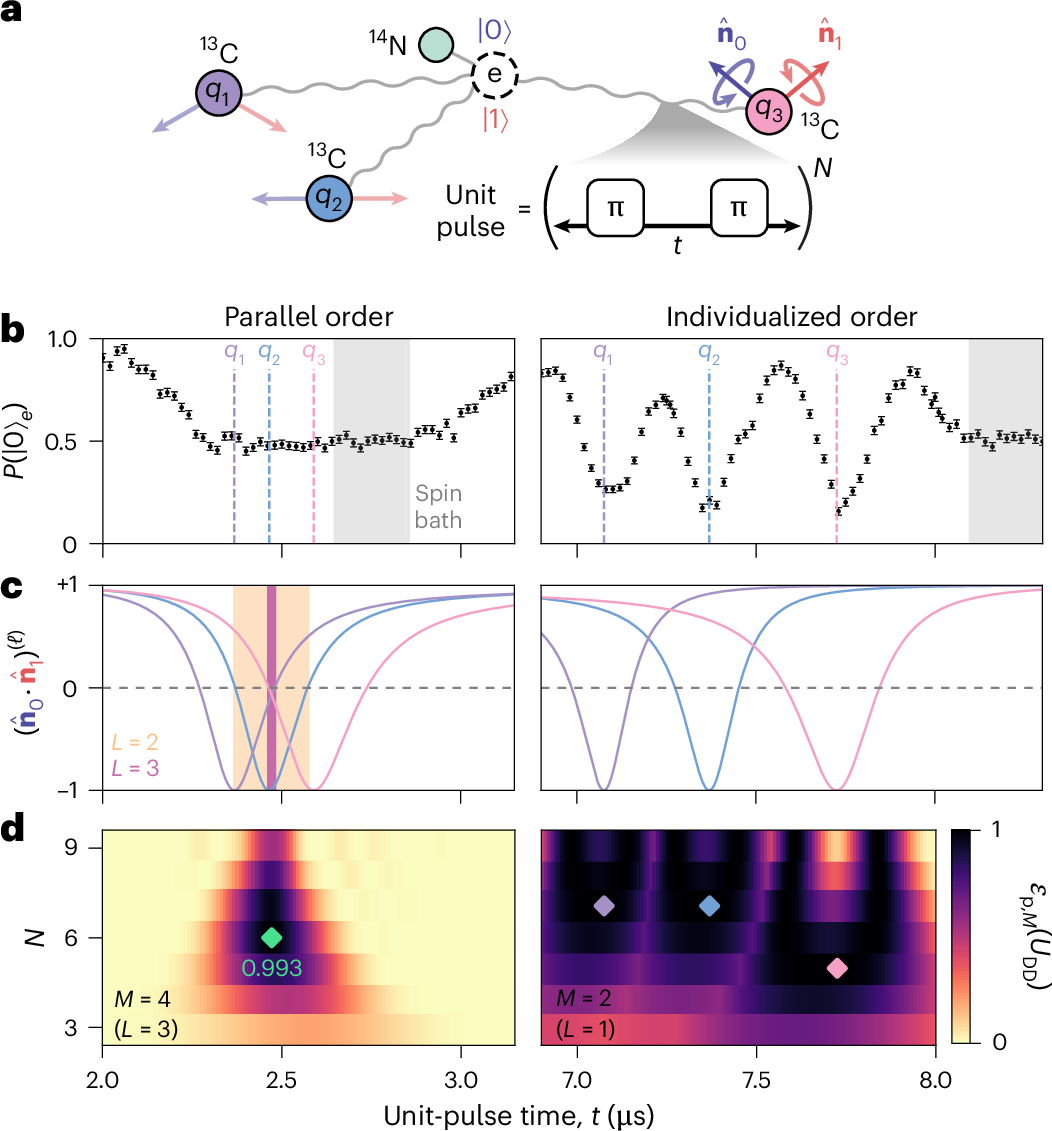
- The four qubits were the defect's electron and three nearby carbon-13 nuclei, driven by a timed control sequence that made the electron interact with all three nuclei in parallel.
- Fidelity for the parallel four-qubit gate was 0.92, plus or minus 0.04, against 0.69, plus or minus 0.03, for the sequential four-qubit gate.
- To confirm the entanglement, the team varied the nuclear qubits' quantum phases and read the light the defect emitted, a pattern that showed how many qubits were entangled.
- The group also realized parallel three-qubit gates on subsets made up only of nuclear qubits.
Compiled by The ScientistSomething wrong?How this is made
Why it matters
- decision Teams building nitrogen-vacancy registers now have a measured reason to try parallel entangling steps first, because the pairwise route was both slower and less accurate on the same task.
- constraint With the gate already near the hyperfine limit, speed has little room left to improve; larger registers will be judged on whether fidelity holds as more nuclei join.
- precedent The authors say the approach generalizes to other solid-state platforms, so other defect-based qubit systems are the next place to test the parallel scheme.
Converted to error, those fidelities come to about 0.08 for the parallel gate and 0.31 for the sequential one, close to a fourfold reduction [2]. The gap is wider than the stated uncertainties. At its low end the parallel gate sits at 0.88, well above the sequential gate's high end of 0.72 [3].
The team ran both versions itself, comparing parallel gates against gates applied one pair of qubits at a time [9]. That makes the comparison mostly a test of how the entangling steps are scheduled on the same hardware. At the reported tenfold speedup [12], the sequential route to the four-qubit state takes roughly 148 microseconds [1].
The authors put the accuracy gap down to crosstalk, which is an operation disturbing qubits it was not aimed at [2]. "This sequential approach is slow and suffers from crosstalk errors," Joseph D. Minnella, Mathieu Ouellet and their colleagues wrote in the paper [6]. A gate that finishes ten times sooner could also gain accuracy by leaving less time for errors to build up. Two fidelity figures cannot separate those causes.
The state they made is a Greenberger-Horne-Zeilinger state, in which the four qubits share a quantum combination of two collective arrangements, such as all 0s and all 1s [3]. The authors place the 14.8-microsecond gate "close to the fundamental limit set by the hyperfine coupling frequencies" [13].
The defect itself is a nitrogen atom sitting beside a missing carbon atom in diamond [1], and the experiment ran at room temperature [3]. The authors wrote that multipartite entanglement is "needed to execute quantum algorithms, implement error correction and achieve quantum-enhanced sensing" [11]. They also wrote that their approach "lays the foundation for scalable generation and control of entanglement in practical devices" [10]. The reported work includes no sensing measurement and no link between two defects. I think the fidelity comparison holds up on this evidence. Diamond sensors and network hardware that run without cooling are still a prospect this experiment did not test.
What to watch
- Whether the parallel gate keeps fidelity near 0.9 once a fourth or fifth carbon-13 nucleus is added to the register.
- A room-temperature sensing measurement that uses the four-qubit entangled state, the experiment that would test the authors' sensing claim directly.
- A demonstration of the same parallel gate on a solid-state platform other than diamond.