Science1 publisher2 min readPublished
Packing a liquid-hydrogen tank with IRMOF-20 more than triples its modeled holding time
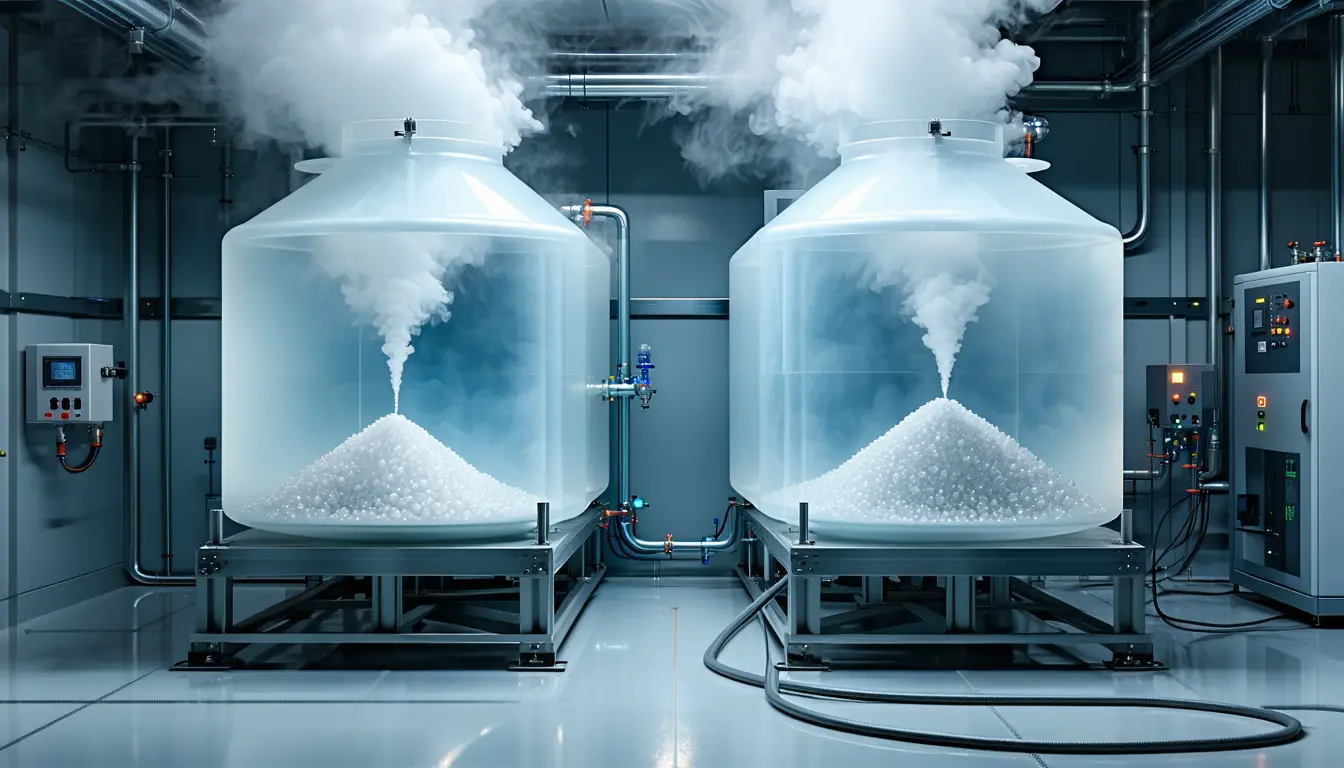
UNIST-led chemists calculate that packing a liquid-hydrogen tank with the porous crystal IRMOF-20 stretches its time to empty from about 64 days to 221. Those figures come from a model of a transport-scale tank, and no working vessel has yet been tested against them.
The Scientist · Science desk
What happened
- Hyunchul Oh's group at UNIST did the work with Ewha Womans University, the Technical University of Munich and the Institut Laue-Langevin, and published it in Nature Communications.
- Counting the space the framework itself takes up, a tank filled with rigid IRMOF-20 kept about 97% of the volumetric capacity of neat liquid hydrogen.
- The flexible framework MIL-53(Al) held on to hydrogen more strongly as it warmed, but it kept only about 53% of liquid hydrogen's capacity.
- Neutron scattering on ILL's IN1-Lagrange instrument showed that hydrogen molecules rotate less freely inside the pores, indirect evidence that they bind strongly to the framework.
Compiled by The ScientistSomething wrong?How this is made
Why it matters
- capability Tank designers gain a second lever beside insulation, a material inside the tank that changes how hydrogen behaves after heat has already leaked in.
- decision Choosing a framework now means trading capacity against retention, because large pores preserve volume while tight confinement holds hydrogen as it warms.
- constraint Planners cannot yet carry the 221-day figure over to their own tanks, because it holds for the mid-vacuum insulation case the team modeled.
In the model, 221 days against 64 is a factor of about 3.45 [1], or roughly 157 extra days before the tank runs dry [2]. The comparison already charges the framework for the room it occupies. A tank packed with IRMOF-20 starts with about 3 percent less hydrogen by volume than a tank of neat liquid [3], and it still lasts longer.
Heat gets into even well-insulated tanks. As the liquid warms, hydrogen evaporates and the pressure climbs [1]. A metal-organic framework is a crystal full of nanoscale pores that adsorb hydrogen onto their inner surfaces [4]. At cryogenic temperatures, the pull of the pore walls keeps the gas confined and slows the pressure rise [4].
The small capacity loss comes down to density. Adsorption measurements found hydrogen inside IRMOF-20's pores at an effective density higher than bulk liquid hydrogen [11]. That dense packing makes up for much of the volume the solid takes from the tank [6].
Park, of TUM, said neutrons suit the problem because "hydrogen has a large neutron-scattering cross section, and inelastic neutron scattering directly probes molecular motion without the optical selection rules that constrain infrared and Raman spectroscopy" [13]. The reference is solid parahydrogen, whose rotational spectrum has one sharp line at 14.7 meV. Where that line moves when hydrogen meets a host material tells the experimenters about the forces between them [14].
Oh set his own limit on the day counts. "By considering pore volume, hydrogen density, and desorption behavior together, we found that porous materials could reduce boil-off while preserving much of the storage capacity needed for liquid hydrogen transport. These calculations represent an idealized upper bound, so further work is needed to determine how closely this performance can be reproduced in practical tank systems," he said [15].
I think the capacity result is the firmer half of the paper. It rests on adsorption measurements [11], while the 221 days comes from a modeled tank under mid-vacuum insulation [8]. The thing this doesn't tell you is how a real tank packed with the framework compares with the modeled one. The published account does not give the materials' mass or cost, or say how they hold up over repeated filling and emptying.
What to watch
- Tests of a practical tank packed with IRMOF-20, showing how close it gets to the idealized 221-day upper bound.
- Modeled or measured results for the framework under insulation other than mid-vacuum.
- A framework that combines IRMOF-20's pore volume with MIL-53(Al)'s stronger hold on warming hydrogen.