Science1 publisher2 min readPublished
Current pulses drop a ferrimagnet's compensation temperature by 110 kelvin
A DGIST group passed current through a platinum, IrMn3 and CoGd stack and moved the temperature where the two magnetizations cancel, by 70 K in one film and 110 K in another, with the alloy composition left alone.
The Scientist · Science desk
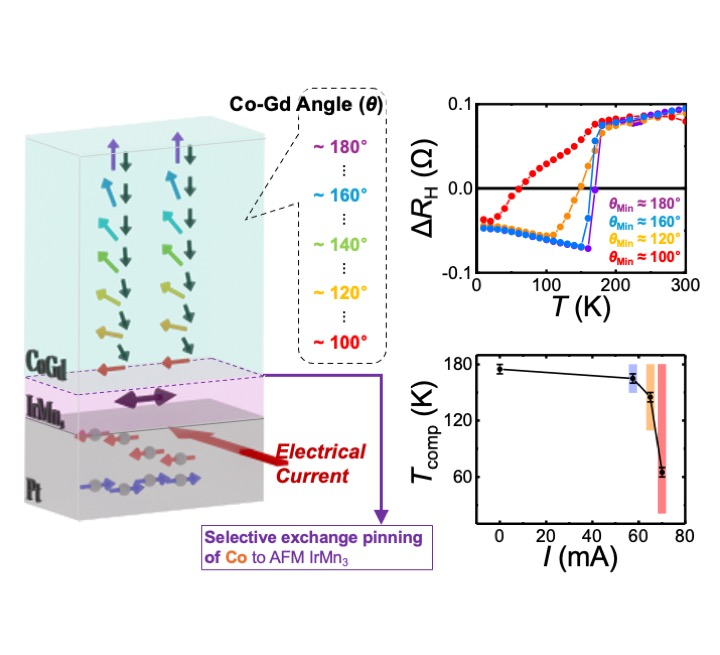
What happened
- A DGIST team led by Jung-Il Hong pulsed current through a platinum, IrMn3 and CoGd multilayer and lowered the alloy's compensation temperature, the point where its two magnetizations cancel, by up to 110 K.
- In a Co0.5Gd0.5 film the compensation temperature fell by about 70 K, from roughly 350-360 K to roughly 280-290 K, once the current had been applied.
- A Co0.68Gd0.32 film moved further, from about 170-180 K down to 60-70 K, which is where the 110 K figure comes from.
- The shift comes from the current changing the spin configuration of the IrMn3 layer, which then changes the spin state of the CoGd beside it.
Compiled by The ScientistSomething wrong?How this is made
Why it matters
- capability Because the pulse acts where the current goes, one deposited stack could hold cells with different compensation temperatures, set after the wafer leaves the fab. Hong names that as the target application.
- cost Implantation and heat treatment are masked process steps in the fab. Doing the same tuning with current moves the adjustment onto the finished device, and the cost becomes pulse energy.
- constraint The fast, efficient switching window follows the compensation temperature, so any design built on this has to hold the pulsed state stable at operating temperature. Retention of that state is a different measurement from the size of the shift.
- precedent If internal spin configuration is a variable you can write electrically, other antiferromagnet and ferrimagnet stacks become candidates for the same test, and their compensation temperatures stop being fixed by composition alone.
Compensation temperature is an odd property to chase. At that point a ferrimagnet's two opposing magnetizations cancel exactly [4], and near it the magnetization can be controlled rapidly and efficiently, which is why memory designers care where the point sits [5].
The route the DGIST group took goes through the middle layer of the stack. Current in the platinum produces spin-orbit torque [7]. That torque changes the spin configuration of the IrMn3, the IrMn3 changes the spin state of the CoGd next to it, and the CoGd's compensation temperature moves with it [8]. Nothing about the alloy's composition or thickness changes [3].
Take the midpoints of the reported ranges. The Co0.5Gd0.5 film went from 355 K to 285 K, a 70 K drop and about a fifth of where it started [1]. The Co0.68Gd0.32 film went from 175 K to 65 K, which is the 110 K figure and close to 63 percent of its starting value [2]. The larger absolute shift came from the film with the lower starting point [4], so the headline number and the fractional number rank the two films the same way.
Where those points land matters as much as how far they moved. After the pulse, the Co0.5Gd0.5 film's compensation temperature sits between roughly 7 C and 17 C [3], which is below a room and well below a running chip. A shift of this size shows that current moves the compensation temperature. It does not show that the point can be set where a device would need it.
The phys.org account says the size of the change follows the intensity and duration of the current pulses [11], without giving the densities or the pulse lengths used. Whether the shifted state holds for years at operating temperature, how many pulses a film tolerates, and whether the effect survives being patterned into cells are separate experiments from this one.
"This study demonstrates that the magnetic properties of a material can vary significantly depending not only on the types and spatial arrangement of its atoms but also on the configuration of its internal spins," said Jung-Il Hong, who led the work [12].
Hong also said the approach "has significant potential for next-generation spin memory technologies in which different magnetic properties can be created at specific locations" [13]. Hong's claim is worth testing next, because the existing alternatives, composition changes, thickness changes, heat treatment and ion implantation, all act on the film before a device is finished [6].
The paper, by Won-Chang Choi and colleagues, is in Advanced Functional Materials under DOI 10.1002/adfm.78034 [14].
What to watch
- The current densities and pulse durations in the Advanced Functional Materials paper. Those numbers decide whether this tuning fits a memory write budget.
- Any report of the compensation temperature being raised again electrically. Raising it back would make the pulse a reversible control.
- A patterned device holding two different compensation temperatures in adjacent cells, the application Hong describes.