Sucker-bearing spaghetti worms from Australian seamounts get a genus of their own
Australian Museum scientist Elena Kupriyanova and co-authors have named Terebellosuctoria, a new genus of sucker-bearing deep-sea spaghetti worms. Museum worm specialist Pat Hutchings says only a tiny fraction of marine worms has been officially named.
The Scientist · Science desk
Key figures: more than 850 marine worms were collected at seamounts off Christmas Island and the Cocos (Keeling) Islands; 13 new species from them had already been described; the new paper adds seven more new species.
| Figure | Value | Note | Claim |
|---|---|---|---|
| Marine worms collected at the seamounts, more than | 850 worms | 3 | |
| Already described | 13 new species | 3 | |
| Added in this paper | 7 new species | 4 |
What happened
- The worms came from voyages led by Museums Victoria aboard the research vessel Investigator in 2021 and 2022, and the study appeared in Records of the Australian Museum.
- More than 850 marine worms came up from seamounts off Christmas Island and the Cocos (Keeling) Islands. Thirteen previously unknown species had already been described.
- The new paper adds seven more new species from three families, two of them in Terebellosuctoria.
Why it matters
- What it costs cost A survey's cost continues after the ship docks: museum taxonomists can spend years working out what a trawl brought up.
- What it limits constraint A genus of two new species cannot size the unnamed share of deep-sea life. The only estimate on offer is Hutchings's general statement about marine worms.
- What's now possible capability Because the specimens sit in museum collections, the 850-worm haul can keep yielding names after the voyages, as the 20 described species so far show.
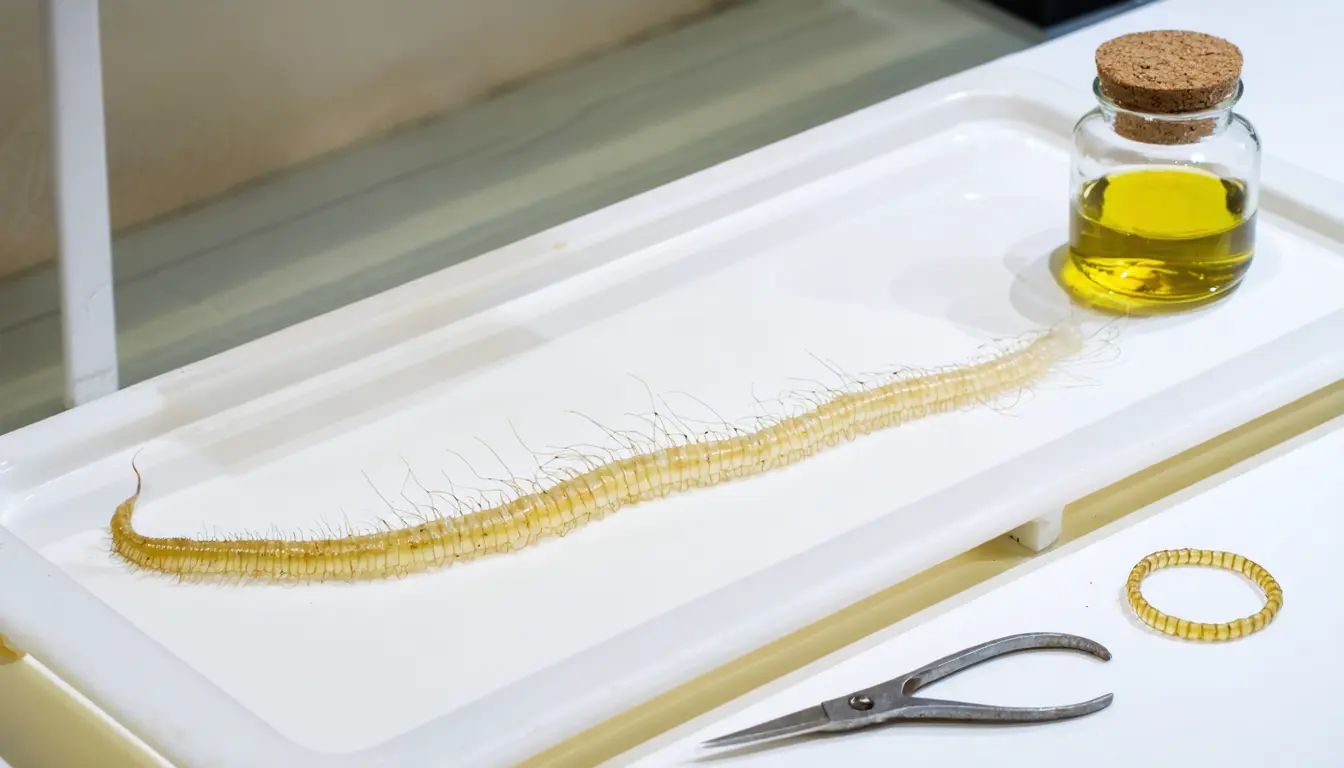
The find began with a tangle that did not look like an animal. On a seamount more than 670 meters deep near the Cocos (Keeling) Islands, numerous branching brown "tentacles" stood out when a beam trawl came up [5]. Kupriyanova, a senior research scientist at the Australian Museum, then spotted multiple orange spheres among the branches [6]. "I thought that those look suspiciously a lot like polychaete eggs," she said [7]. Dissection showed the branching structure was the elaborate extension of a worm's tubes, and bright orange worms up to 75 mm long emerged from them [8].
Spaghetti worms build tubes in soft sediment and collect fine food particles from its surface with long tentacles [17]. The new genus name, Terebellosuctoria, means "terebellids with suckers" and was inspired by sucker-like structures on the underside of the body [1]. "The sucker-like structure is what makes this new genus so interesting and unique," Kupriyanova said [21]. The scientists named the species T. jimii after a colleague, Naoto Jimi, who had described similar sucker-like structures on another marine worm species [18].
Getting from a new species to a new genus took three kinds of evidence. At the museum in Sydney, Kupriyanova and an international team of taxonomists ran morphological, DNA sequencing and scanning electron microscopy analyses before concluding the worms were a previously unknown genus [9]. According to Hutchings, such work often combines morphological and molecular data to establish evolutionary relationships with other species [10].
The researchers suggested that the suckers are an adaptation among sediment-dependent groups such as spaghetti worms to living attached in sediment-scarce places such as seamount slopes [20].
As for how much deep-sea life is still unnamed, more than 850 worms came up on the seamount expeditions, 13 species had already been described, and this paper adds seven, so at least 20 species are now named [3][4][19]. The 850 are specimens, and the account gives no count of how many species they represent.
Hutchings put it in broader terms. "Only a tiny fraction has been officially named and described," she said of marine worms [11]. She was speaking of marine worms in general. The 850 are one collection from seamounts at two island groups [3]. Establishing a genus is the rarer event: finding new deep-sea species is not uncommon, but it is rare for scientists to establish a new genus [12].
In our view the evidence best supports a claim about pace. "An expedition may collect hundreds or thousands of specimens, but discovering what they actually are can take years," Kupriyanova said [13]. New species are often discovered faster than researchers can describe them [15]. We would hold that for this collection only. The specimens go into museum research collections, and the 2021 and 2022 voyages have so far produced at least 20 described species [14][19].
What to watch
- How many more new species and genera come out of the rest of the 850-worm collection beyond the 20 described so far.
- Whether anyone tests the suggestion that the suckers hold the worms in place on sediment-scarce seamount slopes.
- Whether Terebellosuctoria turns up on seamounts beyond Christmas Island and the Cocos (Keeling) Islands.
Clarity's read
What the record supports and how the coverage leans. The claims behind it follow.
Reality
- Evidence70
- Adoption
- Not scored
- Hype gap−5
- Incentives
- Not scored
- Confidence65
Claim ledger
Ranked by verification strength, evidence, and original report placement.
- [1]
Scientists established the new genus Terebellosuctoria ('terebellids with suckers') of deep-sea spaghetti worms, named for unusual sucker-like structures on the underside of the body.
- [2]
The study, published in Records of the Australian Museum, examined worm specimens collected on voyages led by Museums Victoria aboard the CSIRO research vessel Investigator in 2021 and 2022.
- [3]
More than 850 marine worms were collected during the deep-sea expeditions to the seamounts of Christmas Island and the Cocos (Keeling) Islands, and 13 species new to science have already been described.
- [4]
The paper describes an additional seven new species of marine worms from three families, two of them from the new genus Terebellosuctoria of the family Terebellidae.
- [5]
One species was collected on a seamount over 670 meters (2,200 feet) deep near the Cocos (Keeling) Islands; numerous branching brown 'tentacles' stood out when specimens were brought up by a beam trawl.
- [6]
Australian Museum senior research scientist Elena Kupriyanova spotted multiple orange spheres among the 'branches'.
- [7]
"I thought that those look suspiciously a lot like polychaete eggs," Kupriyanova said.
- [8]
Closer examination and dissection showed the 'branching organism' was not an animal itself but the elaborate extensions of a worm's tubes; bright orange marine worms, some up to 75 mm (3 inches) long, emerged from the tubes.
- [9]
Back at the Australian Museum in Sydney, Kupriyanova and an international team of taxonomists conducted morphological, DNA sequencing and scanning electron microscopy analyses before concluding the worms were not just a new species but a previously unknown genus.
- [10]
Hutchings says a taxonomic study requires detailed documentation and analysis, often using multiple lines of evidence such as morphological and molecular data to establish evolutionary relationships with other species.
- [11]
"Only a tiny fraction has been officially named and described," Hutchings said of marine worms, which she described as among the most abundant and diverse animals on the seafloor.
- [12]
While finding new deep-sea species is not uncommon, it is rare for scientists to establish a new genus.
- [13]
"An expedition may collect hundreds or thousands of specimens, but discovering what they actually are can take years," Kupriyanova said.
- [14]
Kupriyanova said the specimens become part of museum research collections, where taxonomists can continue studying them long after the voyage has finished.
- [15]
Taxonomy is a time-consuming and meticulous process, and new species are often discovered faster than researchers can describe them.
- [16]
Dr. Pat Hutchings is a senior fellow at the Australian Museum and a marine worm specialist.
- [17]
Spaghetti worms build tubes in soft sediments and are so called because of their numerous long tentacles, which they use to collect fine food particles on the surface of the sediment.
- [18]
The scientists named the species Terebellosuctoria jimii after a colleague, Dr. Naoto Jimi, who had described similar sucker-like structures on another marine worm species.
- [19]
At least 20 species from the 2021 and 2022 expedition collection are now described: 13 already described plus seven added in this paper.
- [20]
The researchers suggested that the sucker-like structure is an adaptation among sediment-dependent taxa, such as spaghetti worms, to living attached in sediment-scarce environments, such as seamount slopes.
- [21]
"The sucker-like structure is what makes this new genus so interesting and unique," Kupriyanova said.
Get this ledger inside ChatGPT. Ask about any of our stories and the answer brings its figure, each claim’s verdict and the sources. Free, no account.
Sources
1 independent publisher whose own reporting we read for this story.
- phys.orgScientists establish new genus of deep-sea 'spaghetti worms'
1 article · October 14, 2026
Topics and entities
Follow any of these and your For You feed starts watching them — no settings page required.