Cortisol detected in spiny dogfish blood, a hormone sharks were long assumed not to make
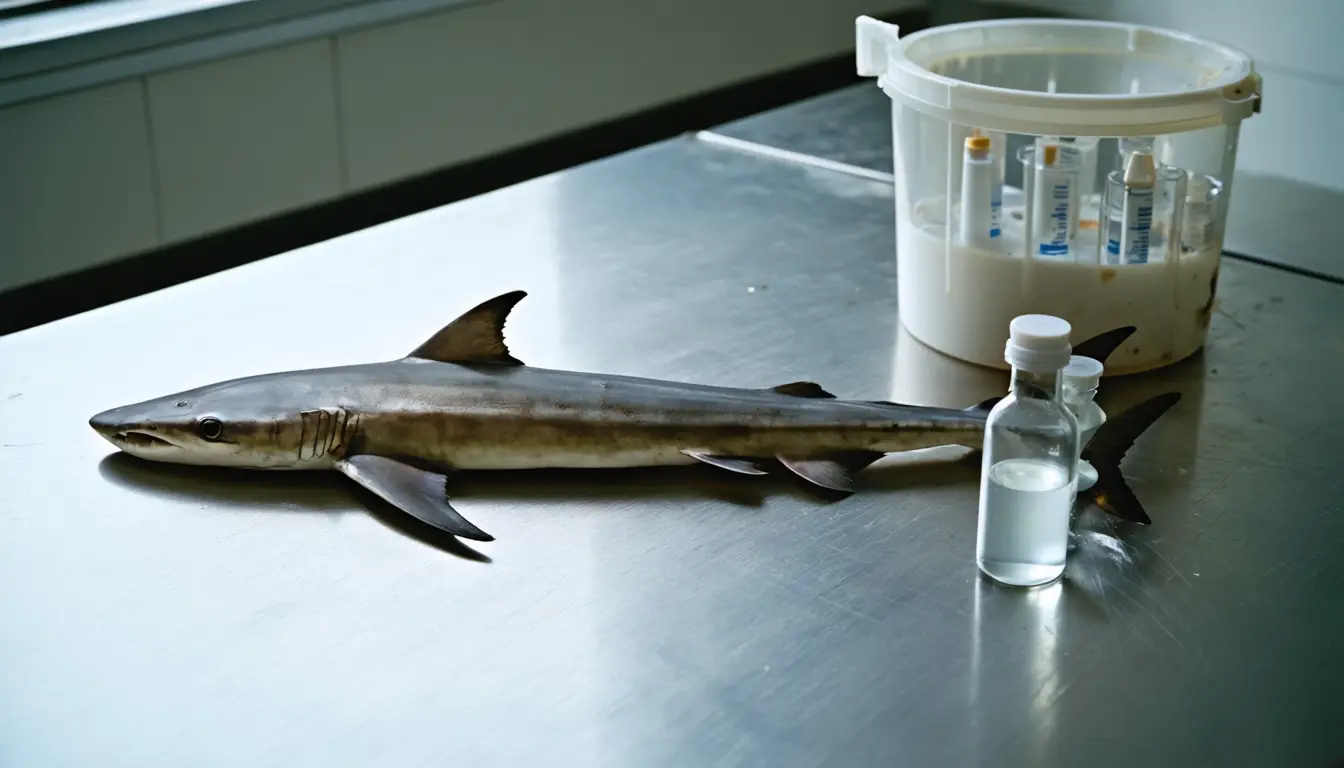
Manitoba and Bamfield researchers detected cortisol in North Pacific spiny dogfish blood, a hormone sharks were long thought not to make. The paper covers one species, and its experiments used groups of five or six sharks.
The Scientist · Science desk
Two bars for the five sharks monitored throughout recovery. At 36 hours, 5 of 5 had detectable cortisol. At 72 hours, 1 of 5 did.
- Detectable cortisol, 36 hours, claim 6 5 of 5 sharks 100% computed
Detectable cortisol, 36 hours The rest of the 5
- Detectable cortisol, 72 hours, claim 6 1 of 5 sharks 20% computed
Detectable cortisol, 72 hours The rest of the 5
| Share | Part | Whole | Percent | Claim |
|---|---|---|---|---|
| Detectable cortisol, 36 hours | 5 sharks | 5 sharks | 100% (computed) | 6 |
| Detectable cortisol, 72 hours | 1 sharks | 5 sharks | 20% (computed) | 6 |
What happened
- The assumption dates to 1960s and 1970s work that identified a look-alike steroid, 1alpha-hydroxycorticosterone, and suggested earlier cortisol readings had picked it up by mistake.
- After 48 hours in diluted seawater, all five monitored sharks had detectable cortisol at 36 hours of recovery, but only one did at 72 hours.
- Six sharks given cortisol implants showed lower blood glucose overall than six given oil alone, though not at every sampling time.
Why it matters
- Who has to decide decision Sampling schedule becomes a design choice for anyone measuring shark cortisol, because a single blood draw at the wrong time could miss the hormone in this species.
- What doesn't add up contradiction The antibiotic comparison looks like support for a bacterial explanation, yet the tests did not establish a treatment effect and handling could account for the pattern.
- What it limits constraint The data show cortisol in the blood; whether the dogfish makes it waits on an activity test of the gland enzyme that the team has not run.
The identification is the sturdiest part of the paper. The older objection was that earlier cortisol measurements may have picked up 1alpha-hydroxycorticosterone by mistake [3]. So the team separated the blood components with high-performance liquid chromatography before measuring, and an independent liquid chromatography with tandem mass spectrometry analysis confirmed cortisol in two samples [4]. Two is a narrow base for a claim against a long-held assumption.
Timing matters as much as chemistry. In the diluted-seawater run, only one shark had detectable cortisol before exposure [5]. At 72 hours of recovery, one of the five monitored sharks did, or 20% [6][19]. Average concentrations did not differ significantly across the recovery times in the analysis [7]. Phys.org reports that this intermittent detectability could explain why earlier studies missed the hormone [8].
The antibiotic experiment is thinner. The team wondered whether bacteria in the interrenal gland transform cortisol and limit how much reaches the blood [10]. Three days after five daily tube-fed treatments, cortisol was detectable in the antibiotic group and undetectable in the comparison group [11]. Statistical tests did not establish a significant treatment effect, and undetectable levels do not necessarily mean the hormone was absent [12]. The team found bacterial genetic material in the gland but could not tell whether the treatments disrupted it, because the gland's fat content interfered with the enzyme measurements [13]. Anesthesia, handling and tube feeding could also have triggered a hormonal response [14].
On production, the gland held molecular messages for an enzyme involved in synthesizing cortisol. The team did not test whether the enzyme is active [9].
The implant experiment gave the cleanest function signal. Six sharks received cortisol in coconut oil and six received oil alone, which makes 12 animals [15][20]. Cortisol-treated sharks had lower blood glucose overall, but the team did not establish a difference at every sampling time [15]. Salt-and-water balance changed little, and urea rose briefly after 24 hours [16].
In our view, the fair reading is narrow and still interesting. Cortisol is detectable in this species when the assay separates it from its look-alike, and it appears to affect blood sugar when given. The implant results do not show whether treated sharks reached cortisol levels like those a dogfish has naturally. So the glucose result shows the animal can respond to the hormone, not what it does day to day.
The findings concern one species, and whether the ability extends to other sharks and rays is open [17]. So are the hormone's natural triggers and functions [18]. The Phys.org report does not give the number of sharks sampled before exposure, the number of samples run through mass spectrometry, or the group sizes in the antibiotic experiment.
What to watch
- An activity test of the cortisol-synthesis enzyme in dogfish interrenal tissue, which the team has not yet run.
- Cortisol measurements with the same chromatography step in other sharks and rays, which would show whether the finding extends beyond one species.
- A repeat of the antibiotic comparison with larger groups and controls for anesthesia, handling and tube feeding.
Clarity's read
What the record supports and how the coverage leans. The claims behind it follow.
Reality
- Evidence50
- Adoption
- Not scored
- Hype gap−10
- Incentives
- Not scored
- Confidence55
Claim ledger
Ranked by verification strength, evidence, and original report placement.
- [1]
For a long time, sharks and rays were believed to rely on a different steroid hormone to regulate energy use, without producing cortisol themselves.
- [2]
Researchers at the University of Manitoba and Bamfield Marine Sciences Center in Canada detected cortisol in North Pacific spiny dogfish blood following experiments involving diluted seawater or antibiotics; the paper was published in Proceedings of the Royal Society B.
- [3]
The idea that sharks and rays lack cortisol emerged from research in the 1960s and 1970s; scientists identified a similar steroid hormone, 1alpha-hydroxycorticosterone, and suggested that earlier cortisol measurements may have mistakenly detected it.
- [4]
The team separated components in dogfish blood samples using high-performance liquid chromatography before measuring hormone levels, and an independent liquid chromatography with tandem mass spectrometry analysis confirmed cortisol in two samples.
- [5]
Dogfish collected off British Columbia were placed in diluted seawater for 48 hours and then returned to normal seawater; before exposure, the team detected cortisol in only one shark.
- [6]
Among five sharks monitored throughout recovery, all had detectable cortisol after 36 hours, while only one did at 72 hours.
- [7]
Average cortisol concentrations did not differ significantly across the recovery times included in the statistical analysis.
- [8]
This intermittent detectability could explain why earlier studies missed the hormone.
- [9]
In the interrenal gland, which produces steroid hormones, the researchers identified molecular messages for an enzyme involved in synthesizing cortisol, but did not yet test whether the enzyme is active in the tissue.
- [10]
Earlier findings suggested diluted seawater and antibiotics can disrupt microbial activity in dogfish gut tissue, so the researchers wondered whether bacteria in the interrenal gland might transform cortisol, limiting how much reaches the blood.
- [11]
Dogfish were given either antibiotics or seawater through a feeding tube daily for five days; three days after treatment ended, cortisol was detectable in the antibiotic-treated animals but undetectable in the comparison group.
- [12]
Statistical tests did not establish a significant treatment effect on cortisol concentrations, and undetectable levels do not necessarily mean the hormone was entirely absent.
- [13]
The researchers found bacterial genetic material in the interrenal gland but could not establish whether the treatments disrupted bacteria there, because the gland's high fat content interfered with attempts to measure microbial enzyme activity.
- [14]
Anesthesia, handling and tube feeding could also have triggered a hormonal response, so the hypothesis that bacteria keep circulating cortisol low remains unconfirmed.
- [15]
Six sharks received implants containing cortisol dissolved in coconut oil and another six received the oil alone, with blood collected before treatment and over the following 72 hours; cortisol-treated sharks showed lower blood glucose overall, but the team did not establish a difference at every sampling time.
- [16]
Cortisol had little effect on the blood's salt-and-water balance, although urea, which helps sharks retain water, briefly increased after 24 hours.
- [17]
The findings concern one species, leaving open whether this ability extends to other sharks and rays.
- [18]
Future research could further explore the hormone's natural triggers and functions.
- [19]
One of five monitored sharks had detectable cortisol at 72 hours, or 20%.
- [20]
The implant experiment used 12 sharks in total.
Get this ledger inside ChatGPT. Ask about any of our stories and the answer brings its figure, each claim’s verdict and the sources. Free, no account.
Sources
1 independent publisher whose own reporting we read for this story.
- phys.orgSpiny dogfish blood contains a hormone long thought absent in sharks
1 article · October 16, 2026
Topics and entities
Follow any of these and your For You feed starts watching them — no settings page required.