Jellyfish relatives 600 million years apart arrived at identical gene changes
Biologists at four US universities found identical genetic changes in jellyfish lineages separated by more than 600 million years. Most did not track the eyes and other traits that also evolved repeatedly, the authors report.
The Scientist · Science desk
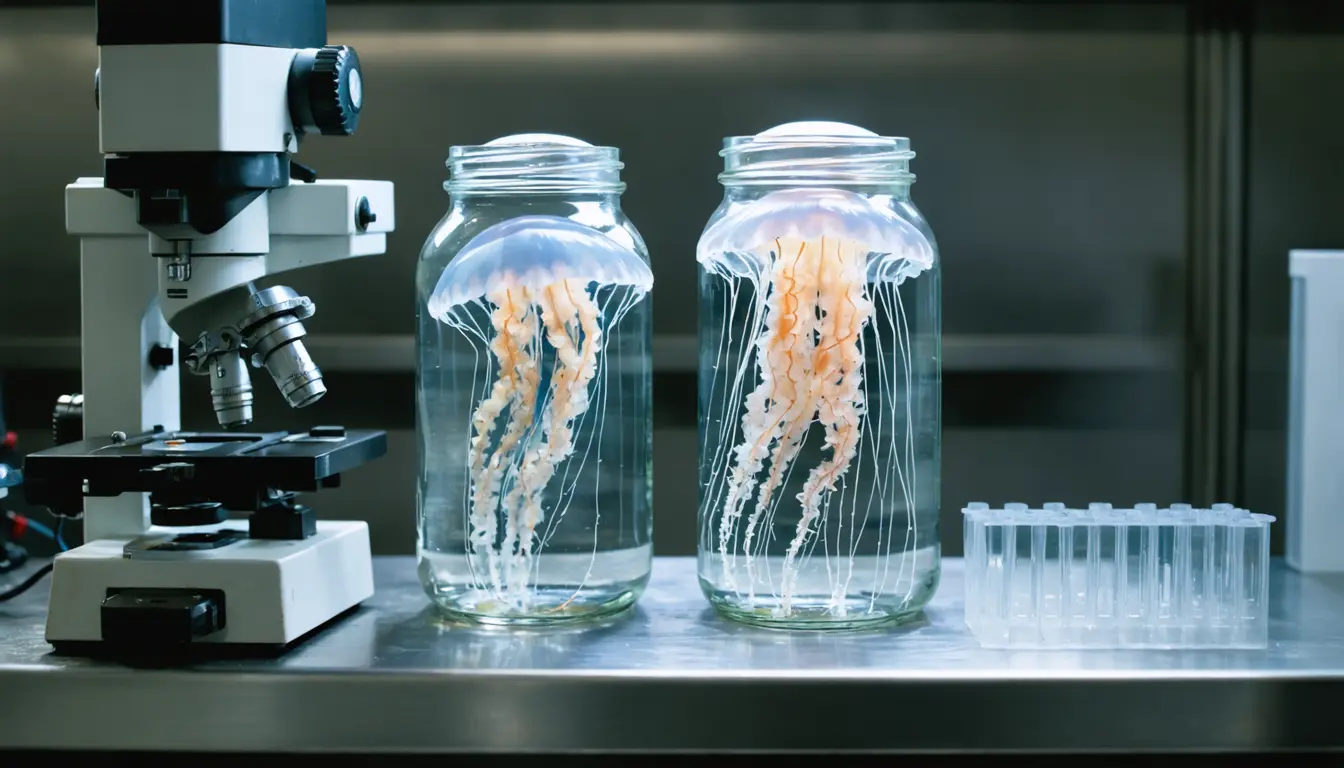
Bar comparison: Medusozoa, the clade of jellyfish and their relatives, emerged about 650 million years ago; lineages with identical genetic changes are more than 600 million years apart.
Duration in million years, Medusozoa history In million years
| Item | Value | Claim |
|---|---|---|
| Medusozoa clade age, about | 650 million years | 4 |
| Matched lineages apart, over | 600 million years | 14 |
What happened
- The group worked on Medusozoa, a clade that emerged about 650 million years ago and includes repeated origins of eyes and repeated losses of the free-swimming medusa stage.
- The authors describe the number of repeated molecular changes they found as "unexpectedly high".
- They say natural selection can drive the same change in distant species, but that molecular convergence reflects a more complex process shaped by how organisms interact with their environments.
- The paper appears in the Proceedings of the National Academy of Sciences, from teams at UC Santa Barbara, Kansas, Texas A&M and Nebraska.
Why it matters
- What's now possible capability If gene-level change repeats this often, evolutionary outcomes become a candidate for prediction, which Oakley names as the point of asking how repeatable evolution is.
- What it limits constraint A search for the genes behind repeated eyes or lost medusa stages cannot assume that convergent sites will mark those traits, because in this dataset they largely did not.
- What doesn't add up contradiction Oakley says evolution looks more predictable at the gene level while the gene-to-animal link stays mostly unknown, so repeatability and explanatory power have come apart.
The study starts from a hypothesis simple enough to fail. Cory Berger, a postdoctoral researcher in Todd Oakley's lab at UCSB, put it this way: "Maybe it's just the case that organisms that have phenotypic convergence who look similar to one another have convergent molecular changes." [10]
Testing it took two steps. The team first built an evolutionary tree from fossil and molecular data and used ancestral state reconstruction to infer where traits such as eyes arose more than once [5]. The tree fixes which lineages converged in appearance, so the gene comparison can ask whether the same lineages also converged in sequence. Oakley described the second step. The team sequenced all the genes expressed in the different jellyfish, at least in theory, and then looked at the patterns of change across those genes. When the same specific change had happened in distantly related species, they counted it as convergence [6].
The reported answer rules out the simple version of the hypothesis [8].
The time depth deserves a second look. The clade emerged about 650 million years ago [4], and the widest pairs in the comparison are more than 600 million years apart [1]. That puts the deepest comparisons within about 50 million years of the clade's origin [14].
The thing this doesn't tell you is how large "unexpectedly high" is [7]. Phys.org's account does not include a count of convergent changes or the chance expectation the authors set against it, so the size of the effect is not available here.
Oakley was careful about what follows. In his view, the degree of genetic similarity suggests that evolution may be more repeatable than expected at the genetic level, and perhaps therefore more predictable. He added that it also means a huge amount remains to be learned about how the genes function and how that plays out on the whole-organism scale [9].
We would carry the narrow finding forward. In this group, sharing a history of convergent traits did not predict sharing a gene change. The paper's title says convergence is "pervasive across deep time" [3], but the researchers sampled one clade, Medusozoa [13]. Whether the pattern holds in other animals is a separate experiment.
What to watch
- Whether the full paper reports a count of convergent changes and the chance expectation it was tested against.
- Functional tests of what the shared changes do in the animal, the gap Oakley says remains.
- Whether the same analysis on other animal groups finds a similar excess of repeated changes.
Clarity's read
What the record supports and how the coverage leans. The claims behind it follow.
Reality
- Evidence62
- Adoption
- Not scored
- Hype gap−10
- Incentives
- Not scored
- Confidence60
Claim ledger
Ranked by verification strength, evidence, and original report placement.
- [1]
By reconstructing and studying sections of jellyfish genomes from the deep past, researchers found evidence of identical genetic changes in multiple lineages separated by more than 600 million years.
- [2]
The work was conducted by researchers at the University of California, Santa Barbara, the University of Kansas, Texas A&M University and the University of Nebraska, and is published in the Proceedings of the National Academy of Sciences.
- [3]
The paper is titled 'Adaptive molecular convergence is pervasive across deep time and largely decoupled from phenotypic convergence' (Berger et al., PNAS 2026).
- [4]
Medusozoa, the clade that includes jellyfish and their relatives, emerged about 650 million years ago and includes members with convergent and repeated phenotypic evolution, including multiple origins of eyes and repeated losses of the free-swimming medusa stage.
- [5]
Using fossil and molecular data, the researchers created an evolutionary tree with ancestral state reconstruction to infer the convergent emergence of traits like eyes; it is one of the most comprehensive jellyfish phylogenetic trees to date.
- [6]
"We sequenced all the genes in these different jellyfish, all the genes that are expressed, at least in theory. And then we looked at the patterns of change across those genes. If the same specific change has happened in distantly related species, then we're calling that convergence."
- [7]
The researchers found an 'unexpectedly high' number of instances of repeated molecular evolution, represented by specific genetic changes across different species, some separated by more than 600 million years.
- [8]
According to the paper, the identical genetic changes were largely unassociated with the jellyfishes' phenotypic convergence, and the genetic convergences did not predictably relate to the physical convergences.
- [9]
"The amount of genetic similarity indicates that at the genetic level, evolution may be more repeatable and maybe therefore more predictable than we expected. But it also means that we still have a huge amount to learn about how the genes function, how that plays out on the whole-organism scale."
- [10]
"Maybe it's just the case that organisms that have phenotypic convergence who look similar to one another have convergent molecular changes."
- [11]
According to the researchers, while natural selection can promote the same genetic change in disparate species, molecular convergence is the result of a more complex process that reflects interactions of organisms with their environments.
- [12]
Oakley said the core question was how repeatable evolution is and under what time scales and circumstances; answering it would give insight into the predictability of evolution, which could help researchers predict evolutionary outcomes, including how genes underlie physical traits.
- [13]
To investigate, the researchers turned to Medusozoa, an ancient and diverse lineage that includes jellyfish and their relatives.
- [14]
Lineages more than 600 million years apart split within about 50 million years of the clade's emergence about 650 million years ago.
Get this ledger inside ChatGPT. Ask about any of our stories and the answer brings its figure, each claim’s verdict and the sources. Free, no account.
Sources
1 independent publisher whose own reporting we read for this story.
- phys.orgAdaptive molecular convergence more common than previously thought, distant jellyfish relatives reveal
1 article · October 16, 2026
Topics and entities
Follow any of these and your For You feed starts watching them — no settings page required.
Topics
- Molecular evolutionFollow
- Convergent EvolutionFollow
- Jellyfish biologyFollow