Science1 publisher2 min readPublished
Mismapped by 1,400 km: the brook lamprey was never where the range map said
An endangered Australian fish turned up in six tropical watersheds far north of its recorded range. The species did not move north; the record of it was wrong, and a fire survey found out by accident.
The Scientist · Science desk
Drafted by a language model from the sources cited here and checked against its claim ledger before publication. How we use AISend a correction
What happened
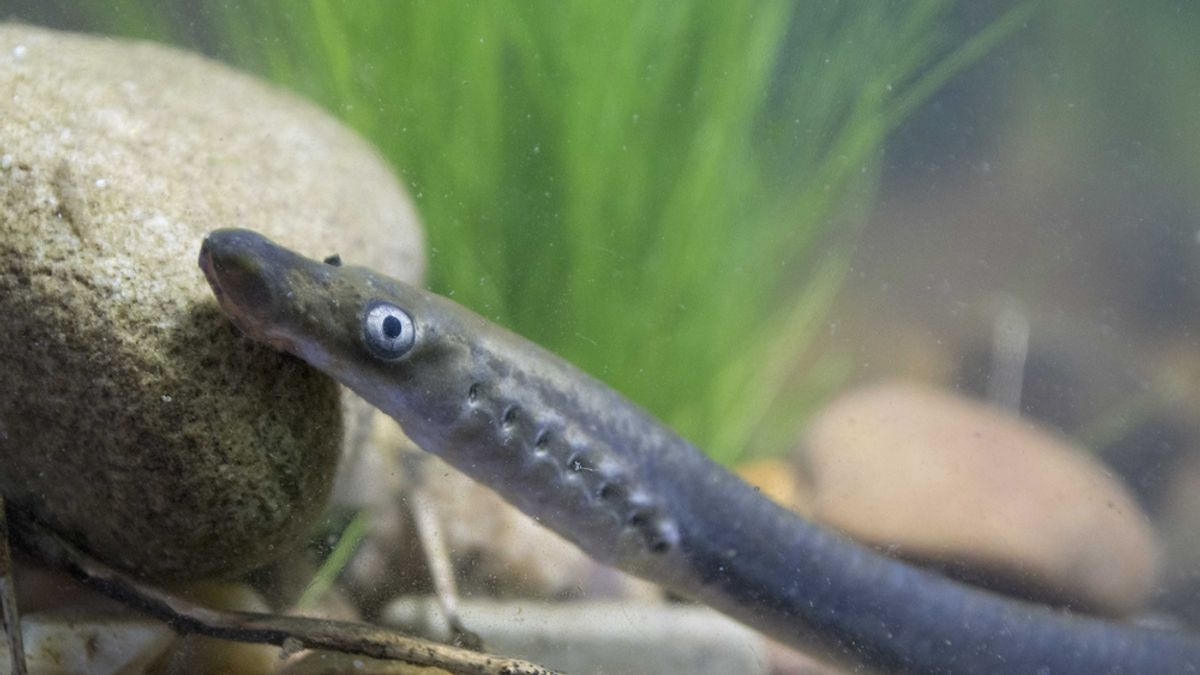
- While electrofishing a creek on K'gari in 2022, Luke Carpenter-Bundhoo pulled out an eel-like fish with seven gill openings and a toothed circular mouth.
- The island sits about 1,400 km north of the Australian brook lamprey's recorded range, in tropical water where no lamprey was expected and none had been documented.
- He and Queensland government scientist David Moffatt went on to document populations in six tropical and subtropical watersheds.
- The results appear in Endangered Species Research as an expansion of the known range of the Endangered Mordacia praecox.
- A $90,116 Queensland grant now funds range mapping plus tests of whether two smaller state lampreys are species new to science.
Compiled by The ScientistSomething wrong?How this is made
Why it matters
- constraint For roughly nine tenths of its life the fish is buried or not safely separable from a low-risk relative, so empty survey results in this group carry almost no evidence about absence.
- contradiction More locations usually reads as better news, but the researcher's account is that the southern populations are gone and Queensland may be all that is left, so the map grew while the species shrank.
- exposure The species' survival now rests on creeks that were never managed for it, open to fire, development, sediment inputs and saltwater intrusion where the streams are low-lying.
- decision Money can buy dots on a map or formal descriptions, and only the second unlocks recognition and naming for the two candidate lampreys, which forces a sequencing choice on the funded team.
A range map records where people have looked, and this animal is built to defeat looking. Mordacia praecox spends three to four years as a sightless larva under the creek bed filtering algae, then metamorphoses into an adult that stops feeding, breeds and dies within months [7]. Only in that short adult window can it be reliably told apart from the parasitic short-headed lamprey, Mordacia mordax, which is considered at low risk of extinction [9]. Taking the adult phase at a few months, the identifiable share of an individual's life is under about a tenth of it [14]. For the rest, a competent survey of an occupied creek can come back empty, or come back with the wrong name on the sheet.
The study's own title carries the qualifier that matters. It expands the known range, in Endangered Species Research [11]. Nothing about the fish changed. Six tropical and subtropical watersheds now hold documented populations of an animal that was not expected in tropical water at all [5], and the 1,400 km gap [3] is a measure of how much confidence had been placed in a boundary never tested against a method the species could not evade.
The correction does not read as good news. Carpenter-Bundhoo says the species was thought extinct in its original range, that Queensland may now be the only place it exists, and that this may be its last bastion [1]. Six new sites do not offset a lost south. They relocate the whole species' prospects onto creeks nobody was managing with it in mind, where fire, development and sediment entering the water can damage habitat and, in low-lying streams, sea-level rise can push saltwater in [10].
The $90,116 Queensland grant [6] buys two things that are easily conflated. One is more dots on the map: surveys of where each animal actually occurs. The other is taxonomy, comparisons at Griffith University to decide whether two smaller Queensland lampreys warrant formal description, without which neither can be recognised or named [12]. If both hold up, Australia's count goes from three lamprey species to five, three of them in Queensland [13], which puts 60 per cent of the national list in one state [15] for a group assumed until recently to stop well to the south.
Worth noting how the error surfaced. Carpenter-Bundhoo was on K'gari surveying Black Summer bushfire damage [4], not hunting lampreys, when he electrofished a seven-gilled, toothed, eel-like fish out of a creek [2]. No lamprey monitoring caught a 1,400 km mistake. A fire survey did.
What to watch
- Whether the Griffith University comparisons confirm one, both or neither of the two candidate Queensland lampreys, and how long a formal description takes after that.
- Whether the corrected distribution prompts a re-assessment of the brook lamprey's Endangered listing, or a re-check of old records logged as Mordacia mordax.
- Whether resurveys of the original southern range turn up any surviving population, which would undercut the 'last bastion' framing.