Science3 publishers3 min readPublished
A camera lowered off the Gold Coast captured the first documented humpback stillbirth
Newborn humpbacks lack the blubber to float, so a stillborn calf sinks out of sight almost at once. None of the roughly 20 humpback births in the literature was a stillbirth until a Gold Coast crew put a camera in the water.
The Scientist · Science desk
What happened
- At about 8am on 17 July 2025, a kilometre off the Gold Coast in Queensland, Andrew Mulville of the Sea World Foundation watched two adult humpbacks milling in one spot from a boat.
- By 8.30am he had recorded an amniotic membrane floating on the surface, a sign that a birth had happened, with no blood or placenta visible and no calf anywhere in view.
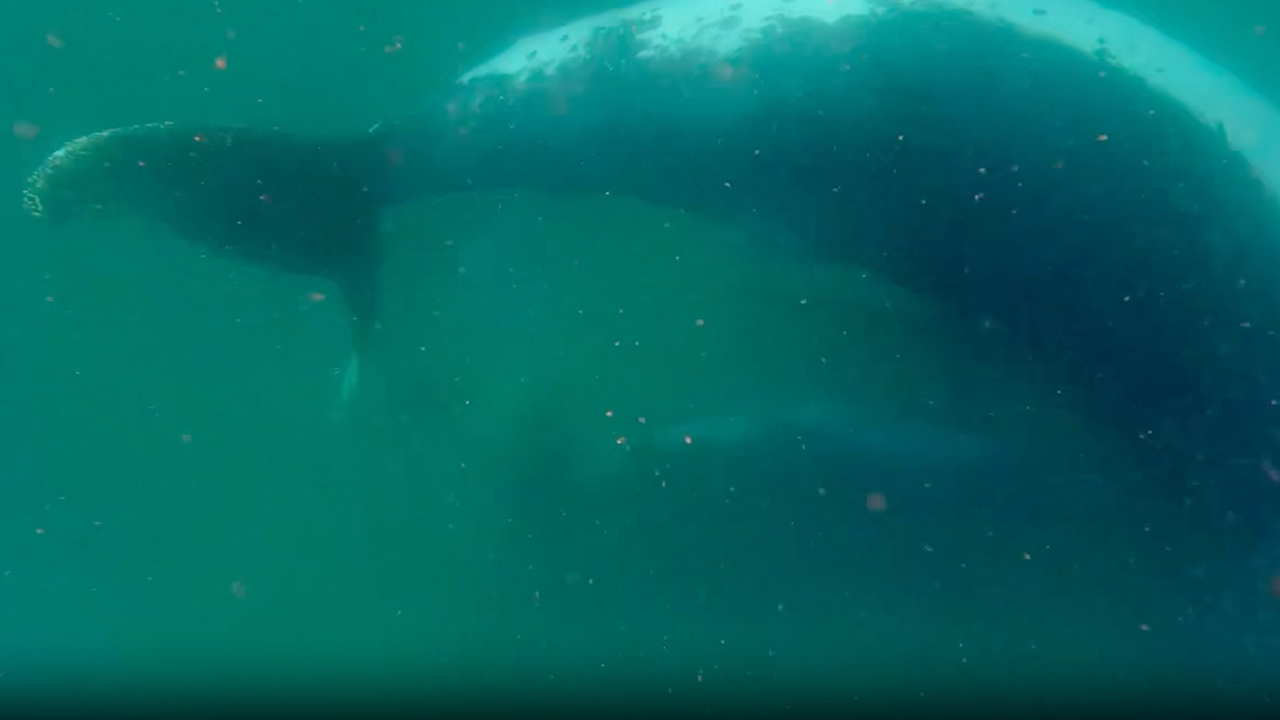
- A camera put into the water found the calf, less than 4 metres long, dead on the sandy seabed, and the mother kept returning to it, looking eye to eye and touching it with her head and pectoral fin.
- She never tried to push the body upward, the move humpback mothers make with a live newborn to help it breathe. The researchers took that absence of lifting as a sign she knew the calf was dead.
- Meynecke and Mulville wrote up the encounter as the first documentation of a humpback whale attending a stillborn calf, published in the journal Discover Animals.
Compiled by The ScientistSomething wrong?How this is made
Why it matters
- constraint The whole case rests on behaviour watched from a boat, with no physiological or neurological measurement available, so grief stays an interpretation that this observation cannot settle.
- capability The instrument was a camera lowered off a small boat. The rescue crews and tour operators already on the water when a birth goes wrong can reach the next case.
- exposure Meynecke says the mother's failure to deliver her placenta was itself extremely unusual and may have put her health at risk.
- precedent Meynecke wants systematic documentation of rare neonatal mortality events, and eight other dead young humpbacks turned up in the same region in the same month to document.
Stillbirth is common in mammals. Whale stillbirths are rarely observed, and Meynecke says that to his knowledge it had never been witnessed in humpbacks before [33]. Part of the reason is the newborn's body. Humpback calves do not carry enough blubber to float, so without an adult lifting them they sink, and Meynecke said a lifeless calf reaches the seabed immediately after birth, where it is almost impossible to spot from a distance [9].
From the surface there was not much to see. Two adults milled in one spot, diving, vocalising and rolling [4], and one went vertical with its tail pointing up [5]. Mulville, a rescue boat captain with the Sea World Foundation, said he was totally surprised once he worked out what was happening; at first sight he had thought it was just two whales resting on the surface, but their behaviour was unusual [30].
Underwater, the mother stayed close and kept returning. "She was repeatedly diving down for short times and swimming next to the calf, then resting next to it on the floor for about a minute, even moving the pectoral fin over the calf, then diving up again," Meynecke said [13]. The comparison group is the toothed whales, where postmortem attendance is well documented and where mothers have been seen raising dead calves to the surface [31][11]. "Unlike reports of toothed whales where mothers have been observed lifting their dead calves to the surface, this humpback whale mother showed prolonged postmortem behavior and attention toward her deceased calf under the surface," Meynecke said [12].
Duration limits what can be claimed from it. The behaviour was recorded for at least 90 minutes [14] inside an observation of about two hours, after which the crew left [15], so roughly three-quarters of the time anyone was watching [16]. It did not obviously end there: on each of the next two days, people on shore reported the same two adults in the same place [17]. The second animal was an escort, probably a female of similar age to the mother, though the researchers did not confirm that [18].
Meynecke is careful with the word grief. "It's really important to not humanise an encounter like this," he told New Scientist. "But then also to understand that it's a mammal, and we have evidence of, not necessarily grief, but the really dramatic change of behaviour that we see in other mammals such as elephants when they lose a member of their group or when they lose their calves." [19]
Rebecca Dunlop at the University of Queensland says descriptive case study reports such as this one "run the risk of anthropomorphising observed behaviours" [20]. She adds that the study "does present a balanced argument of how the observed behaviour could be interpreted" and notes that "grief", "emotion" and "distress" "must be used with caution since we cannot definitively assign these terms to the observed behaviour" [21]. Testing the emotional interpretation, she says, would take "more data and more occurrences" [22].
What to watch
- Whether the mother is re-identified from her fluke photos in the 16,000-whale catalogue in a coming season.
- Any explanation for the rising number of humpback births in southern Queensland, hundreds of kilometres south of the Great Barrier Reef.
- Any account of what killed the seven neonates found dead in the same region in the same month.