ScienceNot yet confirmed elsewhere1 publisher2 min readPublished
Four Congressional Space Medals of Honor close out the first crewed SLS and Orion flight
The Artemis II crew flew 252,756 miles from Earth, farther than anyone before them. The medals presented in Houston close the mission out institutionally, while its successor is scheduled to stay in low Earth orbit.
The Scientist · Science desk
What happened
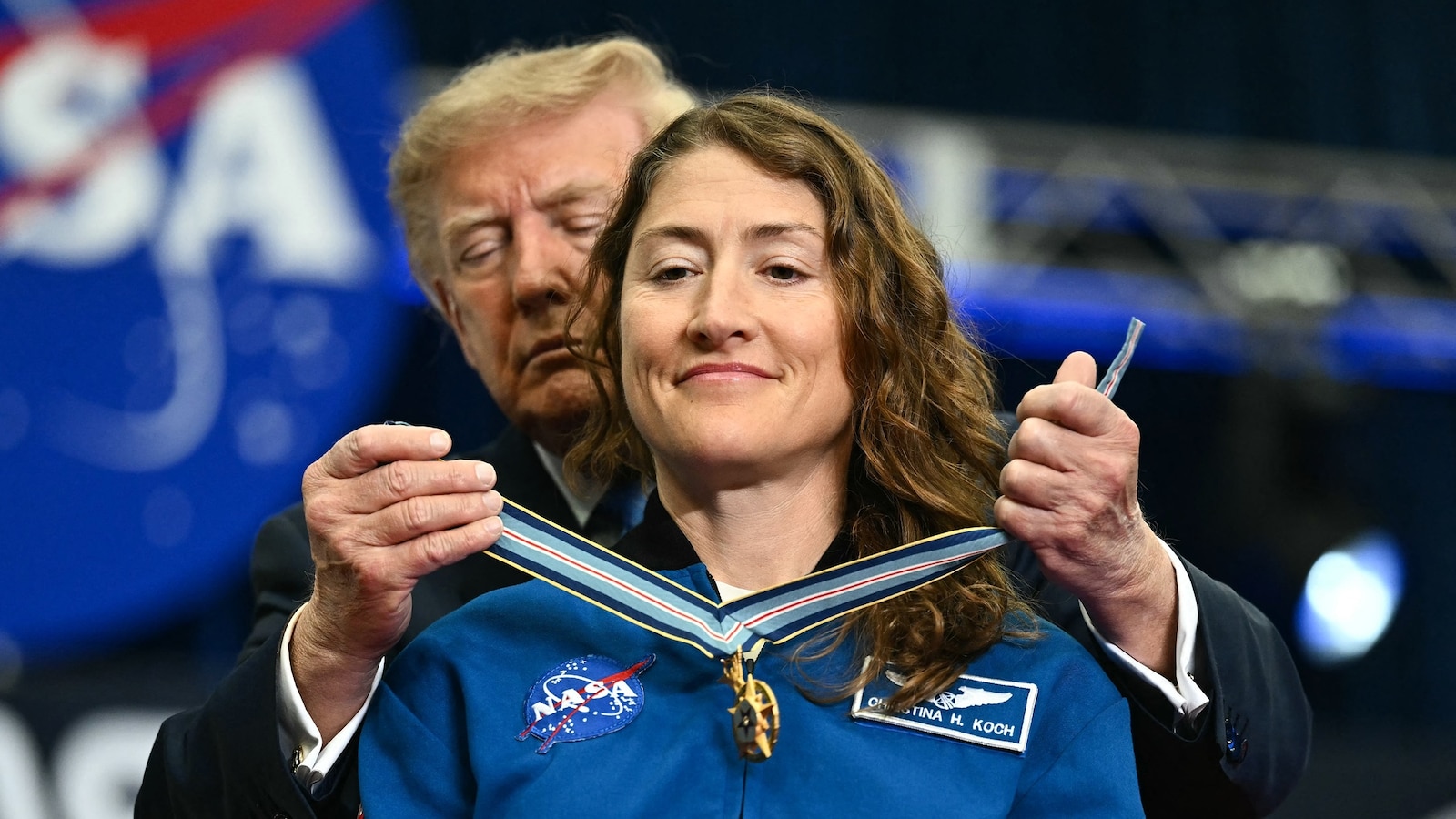
- President Trump presented the Congressional Space Medal of Honor to NASA astronauts Reid Wiseman, Victor Glover and Christina Koch and Canadian Space Agency astronaut Jeremy Hansen at Johnson Space Center in Houston.
- The four were the first astronauts to launch on the Space Launch System, flying an Orion spacecraft they named Integrity, which lifted off on April 1 and splashed down in the Pacific on April 10.
- NASA says the crew reached 252,756 miles from Earth, past the record Apollo 13 astronauts set in 1970, and logged 695,081 miles in total including a lunar flyby.
- The medal, authorized by Congress in 1969, now has 34 recipients, among them the Apollo 1, Challenger and Columbia crews honored posthumously, and these are the first awards since 2023.
- NASA's release places Artemis III in 2027 as a low Earth orbit test of rendezvous and docking between Orion and commercial human landing systems, with Artemis IV returning crew to the surface in 2028.
Why it matters
- constraint Distance is the wrong variable to forecast the program on: the 2027 flight will be judged on joining Orion to a lander in low Earth orbit, a manoeuvre the pairing has not flown, and no part of that difficulty shows up in a mileage record.
- decision Anyone budgeting or staffing against Artemis now has to plan across a two-flight gap, because the next crewed landing NASA names in this release is 2028, with an orbital demonstration in between.
- precedent Awarding four medals to the crew of a vehicle's debut flight sets an expectation that the next debut crew gets the same, which would grow a deliberately short list faster than its 57-year rate.
The two distance figures in NASA's release measure different quantities, and separating them is most of the story. One is a maximum: how far from Earth the spacecraft got, 252,756 miles [3]. The other is path length, 695,081 miles flown in total [11]. A straight run out to the farthest point and back would be twice the first number, 505,512 miles, which leaves 189,569 miles of the flown total as the part of the path that curved [17]. That is what a lunar flyby buys in distance, and it is why the total comes to about 2.75 times the maximum [18]. The record is a property of the trajectory the crew was assigned rather than of how fast Orion can go or how long it can stay out.
Average speed is harder to pin down, because the release gives dates and not clock times: launch on April 1, splashdown in the Pacific on April 10 [9]. Nine days by date arithmetic [19] puts the pace near 3,220 mph across the full 695,081 miles, and reading it as ten days drops the figure toward 2,900 [20]. Either way it is an average over a trajectory, not a speed anything held.
The thing this release does not tell you is the margin. It says the crew went farther than the record set by Apollo 13 astronauts in 1970 [3] without printing the Apollo 13 number [7], so how much farther cannot be worked out from the document in front of you.
On the medal, the denominator is the interesting part. Congress authorized it in 1969 to recognize exceptionally brave and meritorious service by an astronaut [4], and there are now 34 recipients across the whole program [5], which averages fewer than one a year over 57 years [15]. Four at once is 11.8 percent of that set, taking the list from 30 to 34 in a single afternoon [16]. The previous awards were made in 2023 [8], three years before this ceremony [21], which itself fell 140 days after splashdown [14].
NASA Administrator Jared Isaacman framed the flight as evidence that the United States is back on a path to lead in space [12], which is the reading a medal ceremony is built to produce. Wiseman, who commanded the mission [6], pointed forward instead, saying he could not wait to see his crewmates continue the work on Artemis III [13]. What the ceremony documents is that the first crewed flight of SLS and Orion [10] is now formally closed. It contains no hardware performance data, and hardware performance is what a 2027 flight date gets scheduled against.
What to watch
- Whether the Artemis III rendezvous and docking demonstration holds its 2027 date and stays in low Earth orbit.
- Any NASA readout of how Orion and SLS performed on the flight, which is the data a 2027 schedule rests on.
- Whether the Artemis III crew is nominated for the same medal, which would show the 2026 awards set a first-flight precedent.
Clarity's read
What the record supports and how the coverage leans. The claims behind it follow.
Reality
- Evidence58
- Adoption32
- Hype gap+24
- Incentives78
- Confidence68
Claim ledger
Ranked by verification strength, evidence, and original report placement.
- [1]
President Donald J. Trump awarded the Congressional Space Medal of Honor to NASA astronauts Reid Wiseman, Victor Glover and Christina Koch and CSA astronaut Jeremy Hansen for their service during the Artemis II mission, presenting the awards at a ceremony at NASA's Johnson Space Center in Houston.
- [2]
The medals were presented on Aug. 28, 2026.
- [3]
During the mission the astronauts traveled 252,756 miles from Earth, farther than any humans have traveled before, surpassing a previous record set by Apollo 13 astronauts in 1970.
- [4]
The Congressional Space Medal of Honor was authorized by Congress in 1969 to recognize an astronaut who in the performance of duties has distinguished himself or herself by exceptionally brave and meritorious efforts and contributions to the welfare of the nation and humanity.
- [5]
There are now 34 recipients of the Congressional Space Medal of Honor since the beginning of the space program, including the crews of Apollo 1, Challenger and Columbia, who received the award posthumously.
- [6]
Wiseman served as commander of Artemis II, Glover served as pilot of the Orion spacecraft, and Koch and Hansen served as mission specialists.
- [7]
NASA's release states that Artemis II surpassed a distance record set by Apollo 13 astronauts in 1970 but does not give the Apollo 13 distance figure.
- [8]
The Artemis II crew members are the first recipients of the Congressional Space Medal of Honor since 2023.
- [9]
Artemis II launched on April 1 and splashed down safely in the Pacific Ocean on April 10.
- [10]
The Artemis II crew members were the first astronauts to launch on NASA's Space Launch System rocket, flying aboard the Orion spacecraft, which the crew named Integrity.
- [11]
In total the Artemis II crew flew 695,081 miles, including a lunar flyby.
- [12]
NASA Administrator Jared Isaacman said President Trump's leadership has put America back on a path to lead the world in space, from creating the Artemis program to giving NASA the resources and mandate to win this new space race.
ReportedSupportedSource: NASA Administrator Jared Isaacman, quoted in NASA's releaseView cited source - [13]
Wiseman said it was the honor of his lifetime to fly on Integrity around the Moon and that he cannot wait to see his friends continue this legacy on Artemis III.
- [14]
The Aug. 28, 2026 ceremony took place 140 days after the April 10 splashdown.
- [15]
Across the 57 years from the 1969 authorization to 2026, the 34 recipients average fewer than one award per year (about 0.6).
- [16]
The four Artemis II awards are 11.8 percent of all 34 recipients and took the list from 30 recipients to 34.
- [17]
A straight out-and-back to Artemis II's farthest point would total 505,512 miles, so 189,569 miles of the flown total lie beyond a direct out-and-back path.
- [18]
Artemis II's total distance flown was about 2.75 times its maximum distance from Earth.
- [19]
The interval from the April 1 launch to the April 10 splashdown is nine days by date arithmetic; NASA's release gives no clock times, so elapsed mission time is not exactly determined.
- [20]
Dividing 695,081 miles by 216 hours (nine days) gives an average of about 3,220 mph; dividing by 240 hours (ten days) gives about 2,900 mph.
- [21]
The gap between the previous awards in 2023 and the Aug. 28, 2026 ceremony is three years.
- [22]
NASA says the first crewed Artemis mission paved the way for the 2027 Artemis III test flight in low Earth orbit, which is to demonstrate rendezvous and docking capabilities between Orion and commercial human landing systems.
- [23]
NASA says the Artemis IV mission in 2028 will return American astronauts to the lunar surface.
Sources
1 independent publisher whose own reporting we read for this story.
- nasa.govPresident Honors NASA’s Artemis II Crew with Highest US Space Award
2 articles · August 28, 2026
Topics and entities
Follow any of these and your For You feed starts watching them — no settings page required.
Topics
- U.S. Space PolicyFollow
- Human SpaceflightFollow
- Commercial Lunar LandersFollow
- Space Honors and AwardsFollow
- Artemis ProgramFollow
Entities
- NASA Johnson Space CenterFollow
- Reid WisemanFollow
- Jeremy HansenFollow
- OrionFollow
- Victor GloverFollow
- Artemis IVFollow
- Donald TrumpFollow
- Space Launch SystemFollow
- Artemis IIFollow
- Canadian Space AgencyFollow
- Congressional Space Medal of HonorFollow
- NASAFollow
- Artemis IIIFollow
- Jared IsaacmanFollow
- Christina KochFollow