Southern right whale calf deaths in Patagonia pass 300, nearly triple the 2012 record
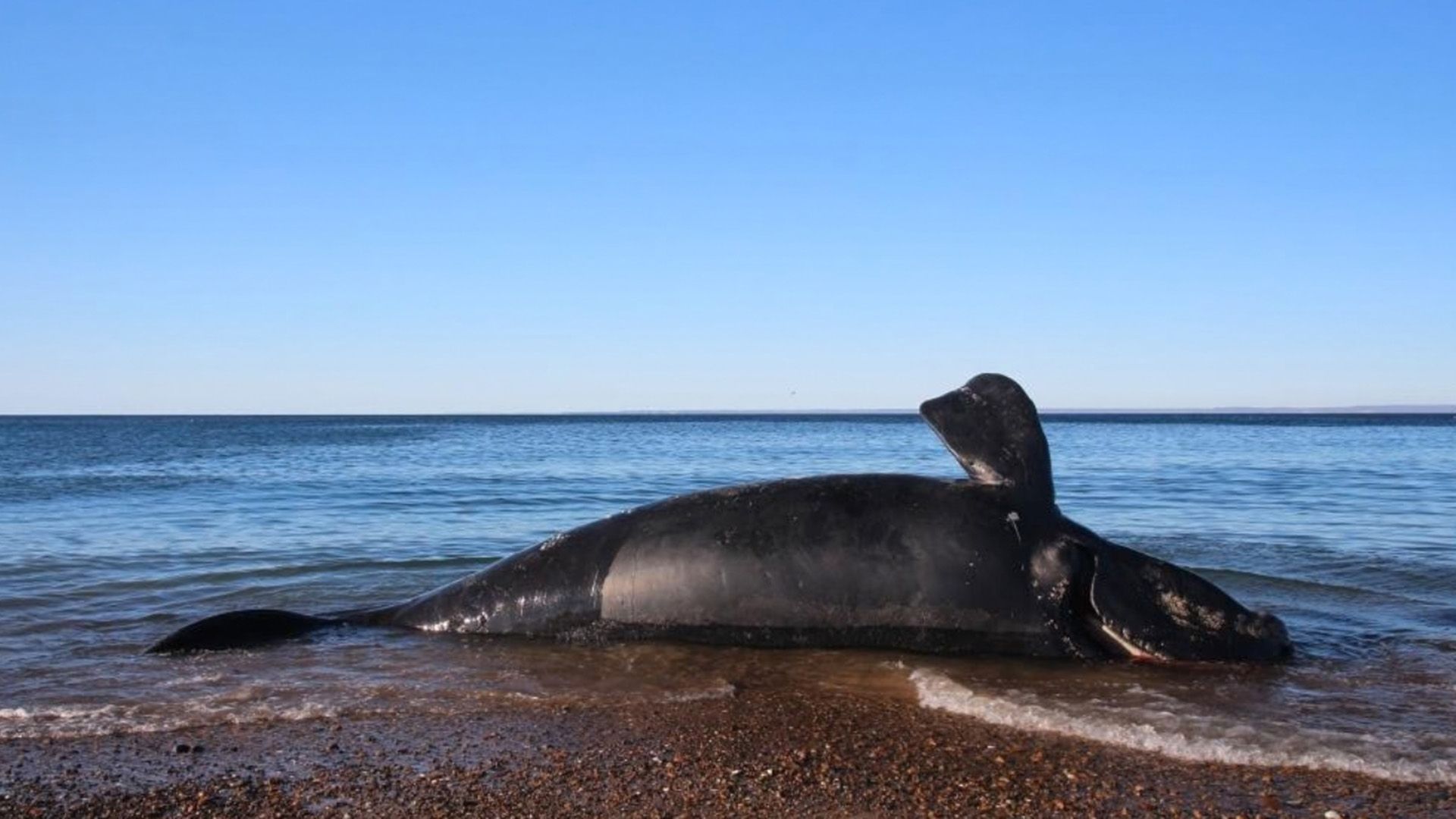
More than 300 southern right whale calves have died in Argentine Patagonia since June, against a previous record of 113 in 2012. Tests found the bacterium E. rhusiopathiae, known in these whales since 2013, but researchers cannot say what changed.
The Scientist · Science desk
Three figures. More than 300 southern right whale calves have died in Argentine Patagonia since June, a preliminary count. A September survey by CESIMAR's Marine Mammal Laboratory counted 409 calves. In a typical year, calf mortality reaches 20% to 30% of a cohort from various causes.
| Figure | Value | Note | Claim |
|---|---|---|---|
| Calf deaths since June, more than (preliminary) | 300 calves | 1 | |
| Calves counted in Sept. | 409 calves | 6 | |
| Typical-year calf mortality, at least | 20% of a cohort | up to 30%, from various causes | 5 |
What happened
- The first dead calves appeared on Península Valdés beaches in Chubut province in June, at the start of a breeding season that runs through December.
- Samples went to the laboratory earlier than the usual end-of-year schedule, according to Víctor Fratto of the Native Wildlife Rescue Program, because the mortality was a cause for concern.
- The Southern Right Whale Health Monitoring Program will release the final figure in December.
Why it matters
- contradiction Fratto says the samples show erysipelas deaths, yet the source notes the bacterium's presence does not necessarily mean disease.
- constraint Researchers lack serotype data, the bacterium's rate in healthy whales and other species, and environmental data, so they cannot yet identify which factor changed this year.
- exposure The bacterium lives in fish, crustaceans, birds and pigs, and humans can catch the E. rhusiopathiae form of the illness. Given that range of hosts, researchers want the ecosystem and human risk assessed quickly.
Reading the headline count as a rate requires a cohort size. In a typical year, calf mortality reaches 20% to 30% of a cohort, from all causes including infection [5]. A September survey by CESIMAR's Marine Mammal Laboratory counted 409 calves among 1,375 whales [6], and more than 300 deaths have been recorded since June [1]. Bracketing the rate takes two assumptions. If none of the dead were among the 409, the loss is about 42% of a pool of roughly 709 calves [21]. If all of them were, it is about 73% [22]. Either figure is above the usual range, but neither is a measured rate: the survey is a single count, the breeding season runs through December [4], and the Southern Right Whale Health Monitoring Program will not release a final figure until then [7].
Against the 2012 record of 113, the current count is about 2.7 times higher [13]. The figure is preliminary, so that multiple can only grow [2]. The 2012 peak also came a year before E. rhusiopathiae was first identified in right whale calves [14], so the comparison does not show whether the same pathogen drove the earlier record.
Victor Fratto, who directs the Native Wildlife Rescue Program and contributes to the monitoring program, told Live Science: "What those samples are showing is that the calves died from erysipelas" [9]. The account does not say how many of the carcasses were sampled.
The bacterium is not specific to whales. "It is a ubiquitous and opportunistic bacterium," said Carla Fiorito, a CESIMAR researcher who previously identified it in right whales [10]. Calves are the likely targets: their immune defenses are not yet mature, and because they stay at the surface longer than adults, gulls attack them more often [15]. "The working hypothesis is that the gull is the vector: Pecking causes wounds on the back, allowing the bacteria to enter," Fratto said [16]. A wound route explains how the bacterium gets in. Fiorito framed the open question as one of balance: "But for this to happen now, there must have been a shift in the balance between the agent, the host, and the environment" [18].
What to watch
- The final count from the Southern Right Whale Health Monitoring Program, due in December. It would turn the 300-plus floor into a rate against a stated cohort.
- Serotype typing of the bacterium and any survey of its prevalence in healthy whales, which Fiorito says is currently unknown.
- Evidence tying gull pecking wounds on the calves' backs to the infection. Such evidence would test Fratto's working hypothesis.
Clarity's read
What the record supports and how the coverage leans. The claims behind it follow.
Reality
- Evidence50
- Adoption
- Insufficient
- Hype gap−10
- Incentives
- Insufficient
- Confidence45
Claim ledger
Ranked by verification strength, evidence, and original report placement.
- [1]
Since June, more than 300 southern right whale calves have died in Argentine Patagonia in what scientists describe as an 'exceptional' die-off; the figure is preliminary.
- [2]
The preliminary figure far exceeds the previous annual record set in 2012, when 113 southern right whale calves died, the highest number documented for the species locally and globally.
- [3]
Laboratory analyses of specimens that died this year tested positive for the bacterium Erysipelothrix rhusiopathiae, environmental authorities in Chubut province told Live Science.
- [4]
The first dead calves appeared on the beaches of Península Valdés, in Chubut province, in June at the start of the breeding season, which runs through December.
- [5]
In a typical year, calf mortality reaches 20% to 30% of a cohort from various causes, including infections.
- [6]
In September, 409 calves were counted among a total of 1,375 southern right whales in a survey conducted by CESIMAR's Marine Mammal Laboratory.
- [7]
The final figure will be released by the Southern Right Whale Health Monitoring Program in December.
- [8]
Samples were sent for analysis earlier than usual, when they are typically analyzed at the end of the year, because the higher-than-usual mortality is a cause for concern, according to Víctor Fratto of the Native Wildlife Rescue Program.
- [9]
Fratto, director of the Native Wildlife Rescue Program and a contributor to the whale monitoring program, told Live Science: 'What those samples are showing is that the calves died from erysipelas.'
- [10]
E. rhusiopathiae is found in marine environments and in fish, crustaceans and birds, and pigs are a natural reservoir. Fiorito said: 'It is a ubiquitous and opportunistic bacterium.'
- [11]
The human illness called erysipelas is caused by Group A streptococcal bacteria, but humans can also catch the E. rhusiopathiae form of the illness.
- [12]
Researchers say they need to find the answer quickly to understand the changing threat to the species, the risk to the wider ecosystem and humans, and what can be done to manage it.
- [13]
The current count is about 2.7 times the 2012 record.
- [14]
The 2012 record year came one year before E. rhusiopathiae was first identified in right whale calves in 2013.
- [15]
Calves are especially vulnerable because their immune systems are still developing and they spend more time at the surface than adults, exposing them to more attacks by gulls, which can transfer the disease.
- [16]
Fratto said: 'The working hypothesis is that the gull is the vector: Pecking causes wounds on the back, allowing the bacteria to enter.'
- [17]
E. rhusiopathiae was first identified in southern right whale calves in 2013, but scientists do not know what might have changed this year to cause an infection-driven die-off of this magnitude.
- [18]
Carla Fiorito, a CESIMAR researcher who previously identified the bacterium in right whales, told Live Science: 'But for this to happen now, there must have been a shift in the balance between the agent, the host, and the environment.'
- [19]
The presence of E. rhusiopathiae does not necessarily mean an animal is diseased.
- [20]
Fiorito said: 'We don't know much about the bacterium itself; we don't know which serotypes are present in the whales, or how common it is in healthy animals or other species.' She added: 'There is also no data on the environment.'
- [21]
If none of the 300-plus dead calves were among the 409 counted in September, the loss is about 42% of a pool of roughly 709 calves.
- [22]
If all of the 300-plus dead calves were among the 409 counted in September, the loss is about 73% of that count.
Get this ledger inside ChatGPT. Ask about any of our stories and the answer brings its figure, each claim’s verdict and the sources. Free, no account.
Sources
1 independent publisher whose own reporting we read for this story.
Topics and entities
Follow any of these and your For You feed starts watching them — no settings page required.
Entities
- Live ScienceFollow
- CESIMARFollow
- Erysipelothrix rhusiopathiaeFollow
- Southern right whaleFollow