ScienceNot yet confirmed elsewhere1 publisher2 min readPublished
Sharp-force wounds on three men in a Latvian grave keep a Viking raid possible but unproven
A study co-authored at the University of Latvia finds sharp-force wounds on three of the six people in a ninth-century grave. A co-author says a Viking raid cannot be proved, though the date keeps it possible.
The Scientist · Science desk
Share chart: 3 of the 4 men in the grave, 75 percent, had sharp-force injuries; 3 of the 6 people in the grave, 50 percent, had sharp-force injuries.
- Men with sharp-force injuries, claim 18 3 men of 4 men 75%
Men with sharp-force injuries The rest of the 4
- People with sharp-force wounds, claim 18 3 of 6 people 50%
People with sharp-force wounds The rest of the 6
| Share | Part | Whole | Percent | Claim |
|---|---|---|---|---|
| Men with sharp-force injuries | 3 men | 4 men | 75% | 18 |
| People with sharp-force wounds | 3 people | 6 people | 50% | 18 |
What happened
- The boy was the son of one of the men, and another man was a third-degree relative, perhaps a first cousin or great uncle.
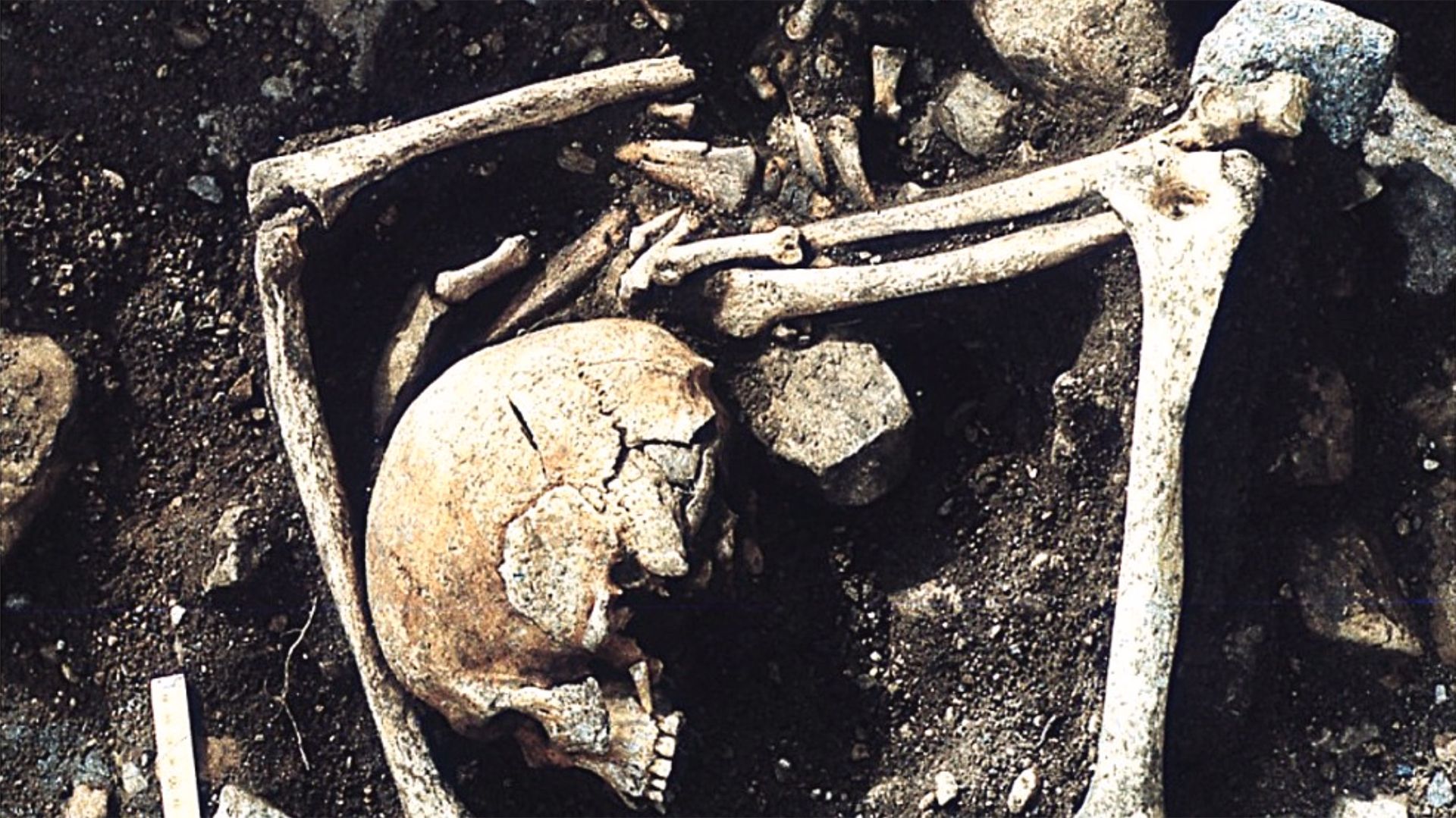
- Bone marks show one man with defensive cuts on his forearm and hand, another killed by a blow that shattered his jaw, and a third almost decapitated.
- Radiocarbon dating places the grave in the second half of the ninth century, which is considered the early Viking Age.
- The six were Semigallian, an Iron Age farming group of Indigenous Balts, in a Latvia that was then outside the Scandinavian Viking world.
Why it matters
- constraint A sharp-force wound does not name the attacker, so the neighboring-community battle the researchers list stays as open as a Viking raid.
- capability Pairing DNA with radiocarbon dating lets a team separate kin from fellow community members in a group buried together, which bone trauma alone cannot do.
- constraint Nothing in the dead's ancestry points to outsiders, so any Viking role has to be argued from the date and the wounds.
The genetics show that the dead were not a single family. Two of the men and the boy were related, but the other two men were not [12]. The researchers wrote in the September issue of the Journal of Archaeological Science: Reports [3] that this suggests the two unrelated men came from the same community or extended household and were killed in the same violent event [12]. DNA could not be extracted from the girl, so her place in the kin network is open [16].
Three of the six had sharp-force wounds. All three victims were men, which makes three of the four men in the grave [18]. The researchers do not know how the fourth man, the boy and the girl died [3]. That leaves the single-event reading resting partly on the burial itself, since the team wrote that interring six people together indicates they died at the same time [17].
The team calls it a "multiple burial" and not a "mass grave", because each body was laid out with traditional grave goods and local customs [8][7].
Most graves in the region hold one person, and this is one of hundreds at the cemetery [6][5]. Live Science did not report how many other multiple burials the cemetery contains.
On the Viking question, study co-author Elīna Pētersone-Gordina, an archaeologist at the University of Latvia, said: "We will never know if they were killed in a raid, but it remains a possibility because of the date of the grave." [14] The researchers also list a battle with a neighboring community as a possibility [15].
There is Scandinavian evidence in the wider area. Two boat burials dated to around 750 on the Estonian island of Saaremaa held men with battle wounds [11]. Those burials predate this grave by at least a century [19]. They establish a Scandinavian presence on Saaremaa, and the study as reported does not link it to this cemetery.
The wounds do not identify the attacker. We think the wounds, the date and the kin ties fit either account.
What to watch
- Any comparison with other multiple burials at Čunkāni-Dreņģeri, which would show whether this grave is unusual for the cemetery.
- Evidence tying outsiders, such as non-local ancestry or Scandinavian objects, to this event, which would move a raid from possible toward supported.
- Any account of how the fourth man, the boy and the girl died, since three of the six causes of death are still unknown.
Clarity's read
What the record supports and how the coverage leans. The claims behind it follow.
Reality
- Evidence66
- Adoption
- Insufficient
- Hype gap+20
- Incentives
- Insufficient
- Confidence62
Claim ledger
Ranked by verification strength, evidence, and original report placement.
- [1]
Six people were buried in a single grave in Latvia: four men, a boy and a girl.
- [2]
Genetic research found the boy was the son of one of the men, and another man was a third-degree relative, perhaps a first cousin or great uncle.
- [3]
The father, the relative and one other man died from sharp force injuries, possibly from an ax or a sword; how the other three individuals died is unknown. The study was published in the September issue of the Journal of Archaeological Science: Reports.
- [4]
Radiocarbon dating indicates the grave is from the second half of the ninth century, considered the early Viking Age.
- [5]
The grave is one of hundreds at the Čunkāni-Dreņģeri cemetery near the Gulf of Riga, which holds burials from the seventh to 11th centuries.
- [6]
Most graves in the region contain only a single set of remains.
- [7]
The group was buried with care, with traditional grave goods and according to local customs.
- [8]
The researchers stressed that this was not a 'mass grave' but a 'multiple burial', in which each body was properly laid out and accompanied by traditional grave goods.
- [9]
Genetic studies showed that all of the dead had Indigenous Baltic ancestry.
- [10]
In the ninth century Latvia was not part of the Scandinavian Viking world but was inhabited by descendants of Indigenous Balts; the six people were Semigallian, an Iron Age group of farmers.
- [11]
Two Scandinavian boat burials dated to around 750, found on the Estonian island of Saaremaa in 2008 and 2010, held the remains of men with battle wounds.
- [12]
Two of the men and the boy were related, but the two other men were not; the researchers wrote that this suggests the two unrelated men were from the same community or extended household as the other victims, rather than the same family, but were killed in the same violent event.
- [13]
Marks on the bones show one man had defensive cuts on his forearm and hand, another was killed by a blow that shattered his jaw, and the third was almost decapitated.
- [14]
Study co-author Elīna Pētersone-Gordina, an archaeologist at the University of Latvia, said: 'We will never know if they were killed in a raid, but it remains a possibility because of the date of the grave.'
- [15]
One possibility is that those in the grave were killed in a battle, maybe with a neighboring community.
- [17]
The researchers wrote that the burial of the six in a single grave indicates that they died at the same time.
- [18]
Three of the four men in the grave (75 percent) had sharp-force injuries, which is three of the six people (50 percent).
- [19]
The Saaremaa boat burials, dated to around 750, predate a grave from the second half of the ninth century (850 onward) by at least 100 years.
Sources
1 independent publisher whose own reporting we read for this story.
Topics and entities
Follow any of these and your For You feed starts watching them — no settings page required.
Topics
- Viking AgeFollow
- Ancient DNAFollow
- ArchaeologyFollow
Entities
- Live ScienceFollow
- Elīna Pētersone-GordinaFollow
- University of LatviaFollow
- Journal of Archaeological Science: ReportsFollow
- Čunkāni-Dreņģeri cemeteryFollow
- SemigalliansFollow
- Rimantas JankauskasFollow