Product1 publisherNot yet confirmed elsewhere3 min readPublished
Amazon's Panos Panay lets slip Neo, a design language meant to connect its Alexa devices
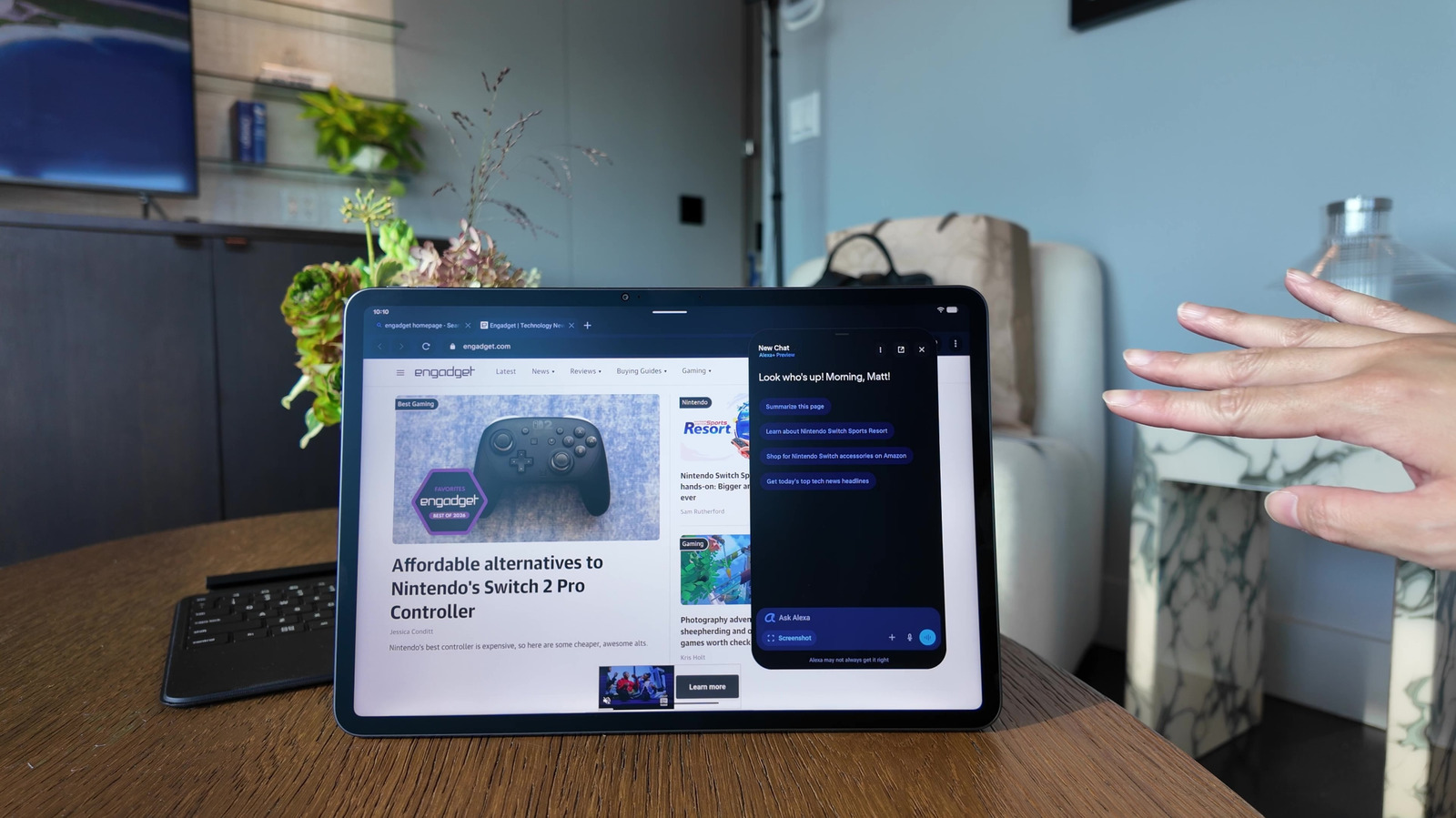
Amazon devices chief Panos Panay let slip Neo, a new design language, as the Alexa Tablet became the first Amazon hardware named for its assistant. The Alexa name now sits on a device while Alexa+ is still labelled a preview.
The Product Desk
What happened
- Panay described Neo as a "structure of how we're moving information" that lets customers get back to it depending on where they are.
- The new tablets can already continue conversations that users started on an Echo Show, according to Engadget.
- Panay said he would return later this month with more on Neo and on the Echo line of speakers and displays.
Compiled by The Product DeskSomething wrong?How this is made
Why it matters
- decision The assistant is now part of the hardware decision: choosing a tablet for a home or a team also means accepting an Alexa layer over Android.
- constraint Neo's pitch depends on moving between Amazon devices. A buyer with a single tablet gets little of the continuity Panay is describing.
- contradiction Panay's answer on more Alexa-branded hardware ran both ways, so anyone planning around Echo naming has no firm signal until he returns at month's end.
Someone pauses a Prime Video show in the living room, walks to the bedroom and asks Alexa to carry on. According to Engadget, the Ember Artline Fire TV can already tell where the show stopped and resume it on the other TV [12]. The new Alexa tablets can pick up a conversation started on an Echo Show [13]. The pitch goes further than those handoffs. Panos Panay, Amazon's senior vice president of Devices and Alexa, spoke to a small group of reporters at the tablet launch [4]. "Ralf [Groene, who leads design for Amazon Devices & Services] is developing what he calls a Neo design language. We don't talk about it, I'm not sure I should've said that out loud. It is Neo," he said [6]. He called it a "structure of how we're moving information. Not seeing it, but moving it to the customer in ways that they can get back to it, depending on where they are" [7]. "We have this frame that's meant to connect it all simply. I'm giving away a little too much," he said [9]. He shared little more about Neo, Engadget reported [18]. From the tablet interface and those remarks, Engadget's reporter concluded that Amazon is preparing a cross-device ecosystem with Alexa at its core [19]. Amazon's account of what users do came from Panay, describing answers scattered across AI apps. "You go into too many different places and you don't remember where you were, it's getting tricky for people," he said [8]. What users have actually been seen doing is narrower. Amazon's About You dossiers, announced in May, drew attention on social media after people found the deductions about themselves funny [15]. Posting a profile for laughs shows curiosity, and the report does not include usage or retention figures for Alexa+ or the tablets. Taken apart, the launch is at several stages at once. The name is settled. The Alexa Tablet series replaces the Fire family and puts the assistant front and center [1]. Engadget ran Panay through Echo, Fire TV, Kindle, Ring, Blink, Eero and the defunct Halo, and he confirmed this is the first Amazon hardware to carry Alexa as its brand [2]. The software is an Alexa layer on the tablets' Android operating systems [17]. The assistant underneath is the least settled part. Alexa+ remains in "preview," and About You is still in beta [16][15]. Asked whether more Alexa-named hardware would follow, Panay first said "No, it's just when it makes sense," before later adding "not that you've seen" [3]. Engadget wrote that the answer "did not reveal much" [5]. Echo is the line with a date attached. Its speakers and displays have not yet had their turn in Amazon's recent run of launches [11], and Panay said he would be back later this month on Echo and Neo [10]. Neo is pitched at moving between Amazon devices, so it is for households that already own several. The Alexa app also runs on iOS, Android and the web [14]. For anyone choosing these for a household or a team, sort each feature on two axes: whether it works today on hardware you own, and whether Amazon has taken it out of preview. Working and released, judge it on what you see. Working but in preview, buy for the hardware and count the assistant as upside. Released but not on your hardware, price the extra device it needs. Promised and in preview, you are paying for features Amazon has announced but not shipped. The Echo Show handoff sits in the second box [13][16]. Neo, which Panay said Amazon does not talk about [6], sits in the last. I'd buy an Alexa Tablet as an Android tablet and treat Alexa+ as a bonus.
What to watch
- Panay's promised end-of-month briefing: whether Echo speakers and displays take the Alexa name and whether Neo is shown running on hardware.
- Whether Alexa+ leaves preview and About You leaves beta before Amazon's next device round.
- Whether Amazon publishes any usage or retention data for Alexa+ on the new tablets.
Clarity's read
What the record supports and how the coverage leans. The claims behind it follow.
Reality
- Evidence45
- Adoption
- Insufficient
- Hype gap+25
- Incentives55
- Confidence40
Claim ledger
Ranked by verification strength, evidence, and original report placement.
- [1]
The new Alexa Tablet series replaces Amazon's Fire tablet family and places the company's AI assistant front and center.
- [2]
Engadget ran Panay through Amazon product names including Echo, Fire TV, Kindle, Ring, Blink, Eero and the now-defunct Halo; Panay confirmed the Alexa Tablet is the first Amazon hardware product with Alexa as its brand.
- [3]
Asked whether the Alexa tablet series was the beginning of a push into more hardware with the AI's name attached, Panay first said "No, it's just when it makes sense," before later saying "not that you've seen."
- [4]
Panos Panay, Amazon's Senior Vice President of Devices and Alexa, sat with a small group of reporters as part of the Alexa Tablet introduction.
- [5]
Engadget wrote that Panay's response on more Alexa-branded hardware "did not reveal much."
- [6]
"Ralf [Groene, who leads design for Amazon Devices & Services] is developing what he calls a Neo design language. We don't talk about it, I'm not sure I should've said that out loud. It is Neo."
- [7]
Panay described Neo as a "structure of how we're moving information. Not seeing it, but moving it to the customer in ways that they can get back to it, depending on where they are."
- [8]
"You go into too many different places and you don't remember where you were, it's getting tricky for people."
- [9]
"We have this frame that's meant to connect it all simply. I'm giving away a little too much,"
- [10]
Panay indicated he would be back later this month to share more on the Echo brand as well as Neo.
- [11]
Of the hardware brands Amazon has highlighted in the last few weeks, the Echo speakers and displays have yet to get their moment.
- [12]
Amazon's Ember Artline Fire TV can understand where a show was paused on Prime Video in one room and resume it on a TV in another room when the user asks Alexa.
- [13]
The new Alexa tablets can continue conversations started on an Echo Show.
- [15]
Amazon's About You dossiers were announced in May, gained widespread attention on social media after some users found it had come up with hilarious deductions about themselves, and the feature is still in beta.
- [17]
The Alexa tablets run Android operating systems with a software interface that adds an Alexa layer.
- [18]
Panay did not reveal much more about the Neo design language.
- [19]
Engadget's reporter, based on the Alexa tablets' interface and Panay's remarks, concluded that Amazon is preparing to introduce a cross-device ecosystem with Alexa at its core.
Sources
1 independent publisher whose own reporting we read for this story.
- engadget.comAmazon's Panos Panay teases more Alexa-branded devices and a new design language
2 articles · October 8, 2026
Topics and entities
Follow any of these and your For You feed starts watching them — no settings page required.
Topics
- Consumer hardware designFollow
- Smart homeFollow
- Voice AssistantsFollow