Science2 publishersIndependently confirmed2 min readPublished
Optogenetics Nobel adds millisecond control to a line of brain-tool prizes dating to 1906
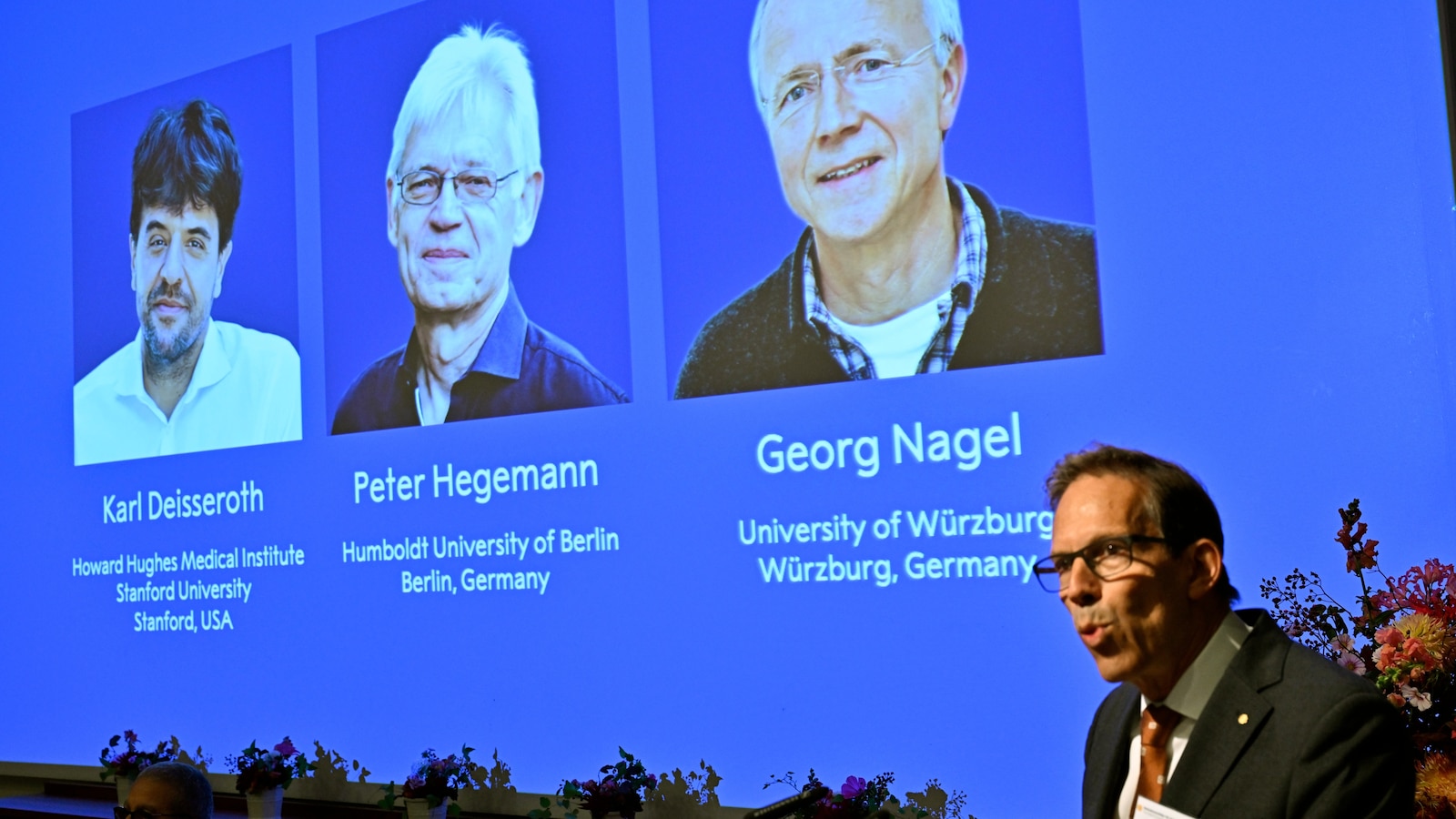
Optogenetics, the use of light to control neurons millisecond by millisecond, won its developers the 2026 Nobel Prize in physiology or medicine. A neuroscientist's account places it third, after tools for seeing and measuring the brain, and treats the therapies it may enable as projections.
The Scientist · Science desk
What happened
- Golgi's silver stain, and Cajal's paintings of the neurons it made visible, won the 1906 Nobel, the earliest prize in the account.
- Hodgkin and Huxley won the 1963 Nobel for capturing and measuring the electrical impulses neurons use to communicate.
- The 2003 Nobel went to the fast imaging sequences and spatial encoding behind functional MRI, which tracks blood flow across the whole brain.
- Today's probes record the electrical activity of hundreds of neurons from different brain areas at the same time.
- Studies published in 2025 found 95% of an animal's brain active during a decision, including areas not usually tied to decision-making.
Compiled by The ScientistSomething wrong?How this is made
Why it matters
- contradiction Neuron control predates the optogenetics prize by close to four decades and imaging won again in 2003, so a forecast built on a clean see-measure-control order starts from a sequence whose stages actually overlap.
- constraint If a decision draws on most of an animal's brain, a therapy that steers one region with light acts on only part of the activity behind the behaviour it aims to change.
- decision Backers of neurotechnology for eyesight, pain or epilepsy are backing what the author calls a 'could be', and the prize for a laboratory tool is no substitute for human data.
The author describes "a rough pattern" [3], and the dates in the account show how rough it is. Imaging won again in 2003, forty years after the prize for measuring neurons' electrical impulses [13]. Control is also older than the technique that won this year. Researchers have been able to control the activity of specific neurons since the late 1980s [10], close to four decades before the 2026 prize [14]. The stages overlap. Light adds timing, so researchers can change what neurons do millisecond by millisecond [1].
Recording has not kept up with that. A single cubic millimetre of tissue, about the size of a poppy seed, holds tens of thousands of neurons and support cells [4]. Today's probes pick up hundreds of neurons spread across several brain areas [8]. Put the two figures together at order of magnitude and a whole recording comes to about one percent of the cells in that one cube [15]. Mapping structure is further along. Expansion microscopy swells tissue with the same gel found in baby diapers. Paired with electron microscopy and AI algorithms, it lets scientists see the complexity inside a cubic millimetre [11].
The 2025 decision studies leave open what the 95% figure is a share of. The account gives it as 95% of the brain, in animals [9], and does not say whether it counts regions, recorded neurons or something else. Nor does it say whether the finding holds in human brains, the ones the proposed therapies would treat [16].
On therapy, the author states the hedge plainly. The piece says "the ability to therapeutically adjust brain activity in ways that previously sounded like fantasy could be on the horizon", and gives restored eyesight, pain relief, epilepsy and mental health disorders as examples [16]. The prize went to the laboratory tool that might one day reach those targets [2].
I think the next step in the sequence is closing the gaps between its stages, because control now runs ahead of recording. I'd expect the advances that matter for treatment to come from tools that record many neurons while controlling a few. That view holds on one condition: the 2025 finding of brain-wide involvement has to survive once its counting method is clear [9].
What to watch
- Published detail on the 2025 decision studies: what the 95% counts, and whether brain-wide involvement appears beyond the animals tested.
- Human data on optogenetic approaches to any of the author's listed targets: eyesight, pain, epilepsy or mental health disorders.
- Recording probes that reach well beyond hundreds of neurons at once, so millisecond control experiments can be read out across more of a circuit.