Science1 publisher3 min readPublished
Blue-light clustering of Aurora A rebuilds spindles in human cells stripped of centrosomes
Indian Institute of Science biologists switched on the division enzyme Aurora A with blue light, bypassing its scaffold Cep192, in living human cells. The result backs the idea that clustering is what activates the kinase, and it gives researchers a reversible, light-driven way to test what spindles need from the centrosome.
The Scientist · Science desk
Drafted by a language model from the sources cited here and checked against its claim ledger before publication. How we use AISend a correction
What happened
- The team fused Aurora A to the plant protein CRY2, which changes shape under blue light and binds its partner CIB1, pulling many copies of the kinase into clusters.
- An older method using Aurora A-coated beads also triggered microtubule nucleation, but it worked in frog egg extracts, where Cep192 was still required for activation.
- Lab head Sachin Kotak said the tool could help map Aurora A's targets, a drug-development interest because the kinase is overexpressed in many solid tumors.
Compiled by The ScientistSomething wrong?How this is made
Why it matters
- capability Because the trigger is reversible and works in living cells, researchers can switch Aurora A clusters on at a chosen point in mitosis, an experiment the extract-bound bead method was poorly placed to run.
- constraint The rescue depended on an engineered fusion protein in cultured cells activated by a lamp, so it shows that clustering is sufficient in a dish and is not yet a way to repair division in tissue.
- decision If Kotak's plan works, groups developing Aurora A inhibitors could separate the kinase's spindle-building targets from its other ones before choosing which to block.
As the IISc account describes it, the accepted model is that Aurora A becomes active when copies of it cluster, and that in cells the clustering is promoted by Cep192, a scaffold conserved across evolution [5]. The light experiment tests the central claim of that model. If clustering is the switch, clustering imposed by some other means should flip it. Blue light did flip it, and the clustered kinase nucleated microtubules without relying on Cep192 [7][11]. In my view that supports the clustering model. It shows that an engineered substitute can take over Cep192's role in activation [7].
In the account's own phrase, the clusters form "independently of Cep192" [7]. Whether a spindle can assemble with no Cep192 in the cell at all is a separate experiment: remove the scaffold, then shine the light.
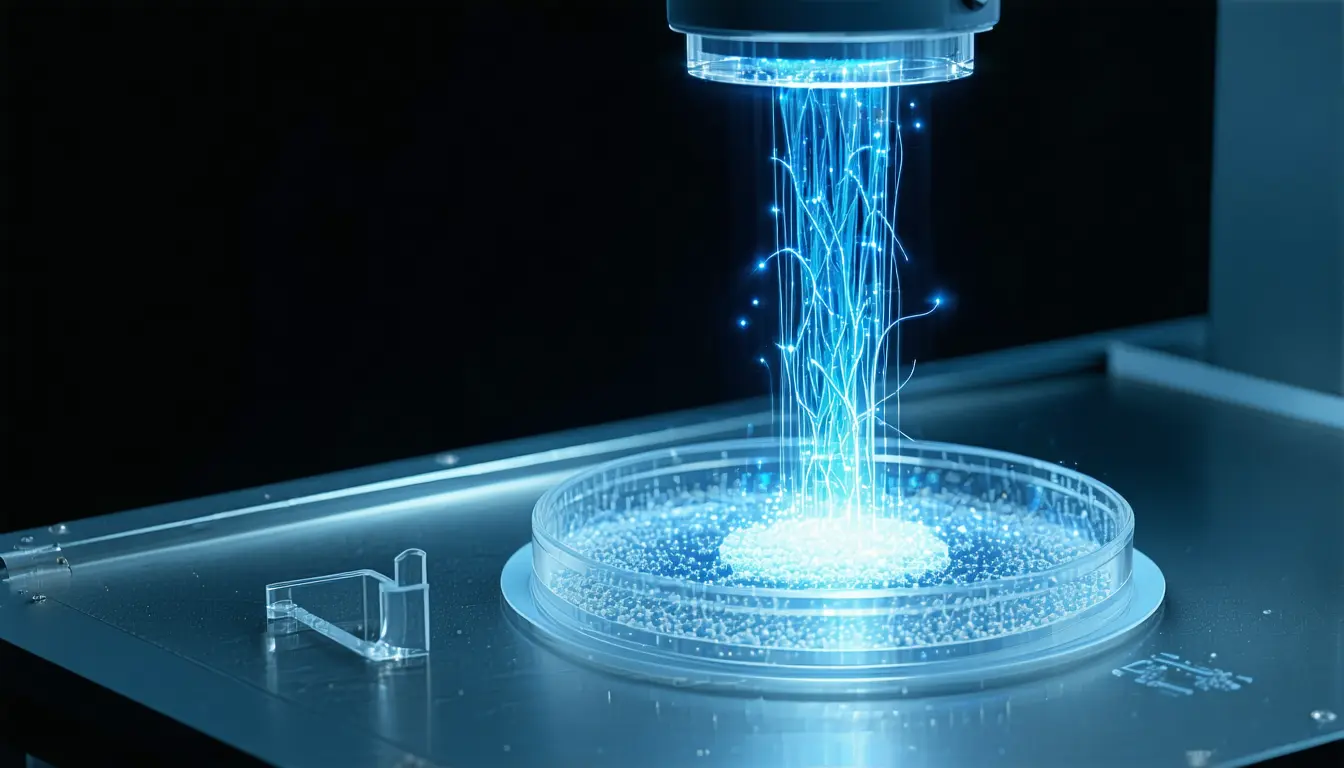
The method turns an existing tool around. LARIAT normally inhibits proteins by clumping them under light, using the plant proteins CRY2 and CIB1 [9]. Sachin Kotak, an associate professor in IISc's Department of Microbiology and Cell Biology, and his team used the same clumping to activate Aurora A instead [3][9]. They fused the kinase to CRY2 in engineered human cells. Under blue light CRY2 changes shape and binds CIB1, pulling many Aurora A assemblies together [10]. First author Vignesh Olakkal said the approach "provides a novel way to trigger and activate an artificial Aurora A kinase complex," made of "Aurora A fused to light-sensitive plant proteins, which is sufficient to induce microtubule nucleation" [11]. The study is published in EMBO Reports [4].
The rescue is the better-designed test. The centrosome has more than 200 components, and it has long been unclear which of them are necessary and sufficient to build a spindle [1][2]. Cells that lose their centrosomes often assemble faulty spindles and make errors when they divide [13]. The team chemically eliminated centrosomes from human cells and then applied light during mitosis. Aurora A clustered, microtubules nucleated, and spindle assembly and division were restored [12]. Removing the whole organelle and then supplying only clustered Aurora A asks whether that one step is enough to build a spindle. In these cells it was [12]. The earlier method, in which Aurora A-coated beads triggered nucleation in frog egg extracts, still needed Cep192 in that setting and is largely restricted to extracts [6][8].
The phys.org account says the light "efficiently stimulated" nucleation but does not report what share of centrosome-free cells were rescued, or how their divisions compared with those of untreated cells [12]. The rescued cells also depended on an artificial fusion protein [10]. The researchers raise the possibility of rescuing cell division when it fails [16], but so far the evidence comes from cultured human cells.
Kotak's nearer aim is pharmacological. "In many solid tumors, Aurora A kinase is overexpressed, and that's why there are drugs targeting it. But Aurora A kinase has multiple targets," he said [14]. "Now, with our strategy, we can find out what the Aurora A kinase-specific targets are, independent of the centrosome, as far as microtubule nucleation is concerned," he said. "Then we will hopefully be able to find other targets of Aurora A kinase and design drugs." [15]
What to watch
- An experiment that depletes Cep192 and then applies light, testing whether spindles form when the scaffold is absent from the cell altogether.
- Rescue rates in the EMBO Reports paper: the share of centrosome-free cells that divided correctly under light, compared with untreated cells.
- Kotak's lab naming Aurora A substrates tied to microtubule nucleation, the first step toward the drug targets he describes.