Science1 publisher2 min readPublished
Janelia maps every neuron in an adult fruit fly's central nervous system
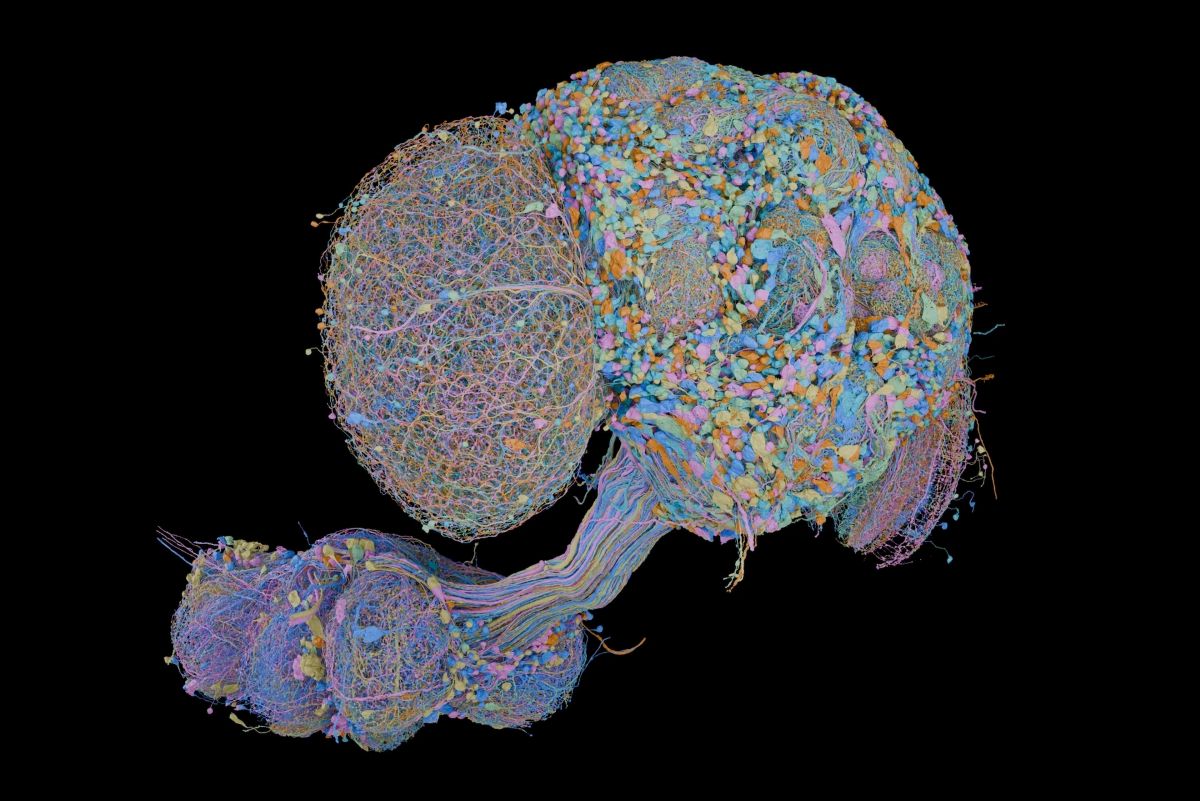
Two decades after Janelia proposed the project, the adult fly connectome is finished. The 1,000-fold efficiency gain credited with making it possible is measured against the institute's own 2008 forecast.
The Scientist · Science desk
What happened
- Janelia and its collaborators finished a wiring diagram of an adult male fruit fly's entire central nervous system: more than 166,000 neurons and millions of synapses across the brain, both optic lobes and the ventral nerve cord.
- The project was announced in 2008 and met with widespread skepticism from the neuroscience community, which considered an insect-scale reconstruction too slow and too expensive to attempt.
- Until now the only nervous system mapped in full belonged to the nematode C. elegans, 302 neurons that took more than a decade of manual tracing to reconstruct.
- The intermediate result was the 2020 hemibrain, a reconstruction of 25,000 neurons covering half the fly brain, which served as the proof that the imaging and segmentation approach would scale.
Compiled by The ScientistSomething wrong?How this is made
Why it matters
- capability The transferable asset is the microscopy-and-segmentation pipeline, which other groups can inherit without repeating the fly, so whole-nervous-system reconstruction becomes something a laboratory can schedule.
- constraint The vertebrate targets Janelia names are transparent fish, so mammalian-scale mapping stays an extrapolation from a demonstration on 166,000 neurons in an invertebrate.
- decision Groups that built circuit models on the half-brain data now face a choice about whether to re-anchor those results to the complete central nervous system, including the optic lobes and nerve cord they previously lacked.
The 1,000-fold figure needs a denominator. When the work began, Janelia's own calculation was that a fly connectome built with standard methods would require 500 specialists working for a decade [5]. That is 5,000 person-years of tracing [1]. Divide it by 1,000 and you get roughly five person-years [2]. The institute states the gain as a fold-reduction in the time and resources needed to generate whole-brain connectomes and does not report the hours the finished reconstruction consumed [16], so the comparison is with a 2008 projection. Nobody ever ran the 500-specialist version.
Gerry Rubin, Janelia's head of biology and its founding executive director, put the bet in those same terms [8]. "It was us having the leap of faith that we could assemble an interdisciplinary team who would develop ways to increase the efficiency of generating connectomes by more than 1,000-fold. That was our key contribution, and without that, we could still be waiting," he said [7].
Two bottlenecks had to move together. Harald Hess's group refined and scaled customised electron microscopy until it captured high-contrast images of individual neuronal membranes at nanoscale resolution [9], and computational teams working with Google Research built machine-learning models that segment dense neural tissue and read the resulting image volumes automatically [10]. The full central nervous system holds about 6.6 times the neuron count of the 2020 half-brain [3]. Against the older reference point the jump is larger: roughly 550 times the neuron count of the nematode [4].
What the dataset holds is which neurons contact which, in one animal, an adult male [14]. Nothing in it describes how wiring differs between individuals or between sexes. The evidence for what such a map buys sits downstream, in the hundreds of follow-up studies of sensory and cognitive processing that the half-brain reconstruction set off in laboratories worldwide [12].
Janelia's vertebrate step is transparent fish: larval zebrafish and adult Danionella, aimed at models of complex behaviour and of neurodegenerative disorders [13]. I would expect those reconstructions to arrive faster than the fly's did, because the microscopy and the segmentation models already exist [9][10]. Whether the same pipeline reaches a mammalian brain is a separate claim, and the fish are the first test of it.
What to watch
- Whether the zebrafish and Danionella reconstructions publish with reported person-hours, which would test the 1,000-fold claim against a measured run instead of a forecast.
- Whether groups outside the Janelia and Google Research collaboration run the segmentation models on their own electron microscopy volumes.
- Whether a second fly central nervous system is reconstructed, giving the first measure of how much wiring varies between individuals.