Science1 publisher2 min readPublished
Texas A&M's blue-light toolkit lets labs redirect and sever a cell's transport routes on demand
Researchers at Texas A&M built four blue-light switches that let a lab watch, redirect and sever the microtubule tracks inside a living cell, reversibly. Published in Cell Reports Methods, the set is built to test whether transport failures help drive cancer and dementia.
The Scientist · Science desk
Drafted by a language model from the sources cited here and checked against its claim ledger before publication. How we use AISend a correction
What happened
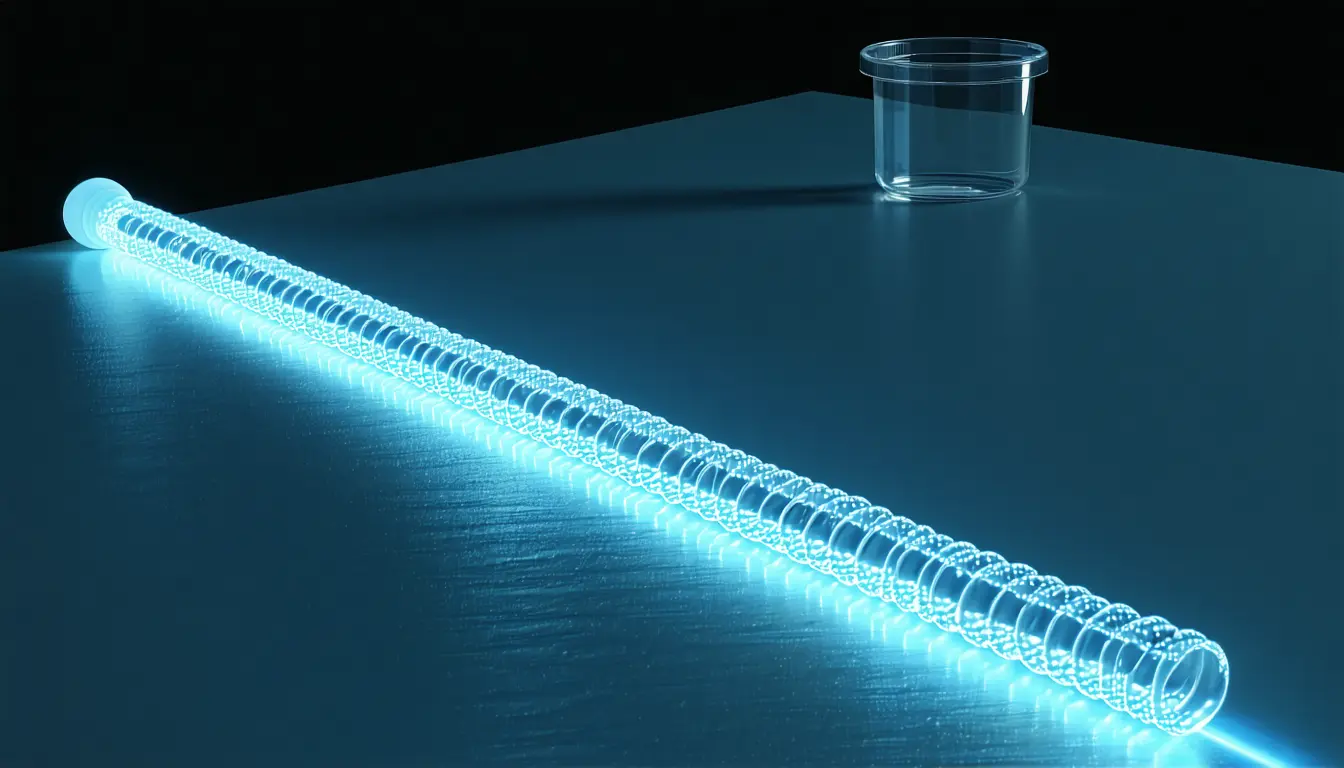
- Four tools split the work: OptoMT lights the network to watch cargo, OptoTIP tracks growing tips, OptoMotor drives cargo with molecular motors, and OptoSAW cuts a track and lets it rejoin.
- Every tool pairs CRY2, a light-sensitive plant protein, with a microtubule protein, so it stays inactive in the dark and acts only under blue light.
- The work was led by Yubin Zhou and Yun Huang at the Texas A&M Institute of Biosciences and Technology.
Compiled by The ScientistSomething wrong?How this is made
Why it matters
- capability Switching transport on or off at a chosen spot and moment lets a lab test whether a broken track causes a downstream failure or only accompanies one.
- constraint Because the tools were shown only in cultured cells, a claim about cancer or dementia stays a hypothesis to test, not a result in a living body.
- decision A researcher planning a microtubule experiment now has a reversible, spatially targeted alternative to the permanent drugs and gene edits used before.
CRY2 is a light sensor from plants. Zhou's team used one of its habits: shine blue light on it and copies of the protein cluster together within moments. Fuse CRY2 to a protein that acts on microtubules, and the result is a switch that sits idle in the dark and turns on only where the beam lands. [6][7]
The subtler piece is the tip tracker. Many tools that label the ends of microtubules also change the structure or chemistry of what they label. OptoTIP, the team reports, follows the growing ends without altering their behavior or stability. [10]
The older ways of studying these tracks are blunter. Genetic edits and drugs disturb the whole cell, are hard to reverse, and give little control over where and when a change happens. [5] "Microtubules are not simply structural scaffolds; they are dynamic information and transportation networks that help organize nearly every aspect of cellular life," Zhou said. [13] The goal, he said, was "to develop a unified way to control different dimensions of microtubule biology using something as simple and precise as light." [14]
The switches let the team do more than observe. "The exciting part is that we are no longer limited to observing where things go inside a cell," said Tien-Hung Lan, a postdoctoral fellow and one of the lead authors. [15][16] "We can now ask causal questions: What happens if we move this organelle here, modify this part of the cytoskeleton there or disrupt a local microtubule network at a precise moment?" [17]
The demonstrations are in cultured cells; the paper does not report the tools working in an animal or a person, and the team reports the switches leave no long-term effects. [1][18] Disrupted microtubules have been tied to cancer and to Alzheimer's and dementia. [4] Whether broken transport causes those diseases or only travels with them is the kind of question the toolkit is built to ask, and one it has not yet answered.
What to watch
- Whether other labs take the tools out of cultured cells and into animal models.
- Whether cutting local networks with OptoSAW yields evidence that transport failure causes cancer or dementia, not just accompanies it.
- Whether the four tools are shared for other groups to use, and on what platforms.