Across 85 studies, a mollusk's species shapes its microbiome more than its habitat does
University of Michigan researchers who reviewed 85 studies say a mollusk's species shapes its microbiome more than its habitat does. The authors do not know why, and most reviewed studies covered edible species in the United States, Europe and China.
The Scientist · Science desk
What happened
- The group's illustration is a pair of clams: two of one species, one in a Michigan lake and one in a European lake, have more similar gut microbiomes than two of different species in the same lake.
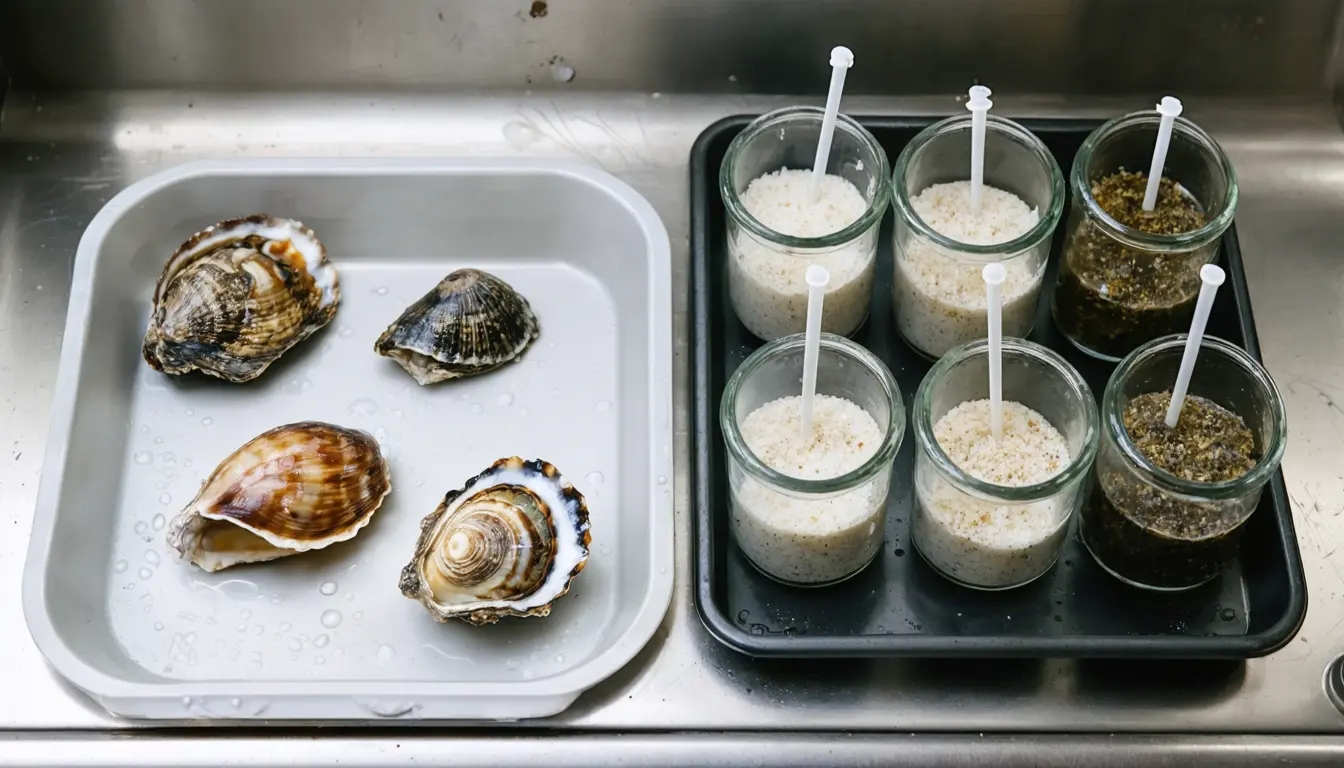
- The reviewed studies covered gastropods such as snails and slugs, cephalopods such as octopuses and squids, and bivalves such as clams, oysters and mussels.
- The paper in The ISME Journal is titled "Taxonomy, tissue, and habitat influence mollusk microbial communities", so it names tissue as a third factor alongside species and habitat.
Why it matters
- constraint On a single-species farm the species is constant, so a cross-species ranking cannot explain differences between its tanks or sites.
- decision Anyone designing a mollusk microbiome comparison has to record host species and compare like with like, or a contrast between habitats can mix in species differences.
- exposure Mollusks in polluted or warming water are exposed if their microbial communities change faster than the host can adapt, according to Vergara-Florez.
The margin is small by the lead author's own account. "Environment, diet and geographical variables matter, but DNA and family matter a bit more for these mollusks," said Vergara-Fl贸rez, the graduate student who led the review [4][3].
A ranking across species says little about variation inside one. On a farm that raises a single species, species is a constant, so it cannot explain why one tank does better than another. Habitat, diet and other conditions can. The thing this doesn't tell you is how large the habitat effect is within one species.
Vergara-Fl贸rez's own account of the risk is environmental. "If we make a little change in where the animal lives, let's say, if we pollute their environment or increase its temperature, it can create something we call dysbiosis," the researcher said [14]. Dysbiosis is a drop in beneficial gut bacteria and a rise in harmful ones, potentially leading to illness [12].
Host filtering is the working explanation. Vergara-Fl贸rez said microbes and their hosts have evolved together for a long time, and that under what the group calls "host filtering" the animal takes the microbes it needs from the environment [11]. If that holds, host and habitat are not independent variables, because the species decides which local microbes get in. In our view a review of existing studies cannot separate those paths by itself. Experiments that move animals of one species between habitats could.
The press summary does not report an effect size or say whether the 85 studies were pooled statistically. We think the defensible use is narrow: record host species in every mollusk microbiome study and compare like with like. Applying the finding to aquaculture is a further step, and the researchers themselves frame the work as a call for more research to predict how microbiomes respond to environmental change [9].
What to watch
- Vergara-Florez's work on cone snails from Cape Verde and the Pacific, a family of more than 1,000 venomous species, will test whether the pattern holds outside edible mollusks.
- Experiments that move animals of one species between habitats would separate a direct host effect from habitat effects that pass through host filtering.
- Whether the full ISME Journal paper reports an effect size for species versus habitat, and how the 85 studies were combined.
Clarity's read
What the record supports and how the coverage leans. The claims behind it follow.
Reality
- Evidence55
- Adoption
- Insufficient
- Hype gap+10
- Incentives
- Insufficient
- Confidence55
Claim ledger
Ranked by verification strength, evidence, and original report placement.
- [1]
University of Michigan researchers say the composition of a mollusk's microbiome depends less on the environment in which it lives and more on what species it belongs to.
- [2]
According to the review results, two clams of the same species will have more similar gut microbiomes, even if one lives in a lake in Michigan and one in a lake in Europe, than two clams of different species living in the same lake.
- [3]
Vergara-Florez said: "Environment, diet and geographical variables matter, but DNA and family matter a bit more for these mollusks."
- [4]
University of Michigan researchers led by graduate student Diana Vergara-Florez reviewed 85 studies to examine the making of mollusk microbiomes.
- [5]
Vergara-Florez said: "We don't know why microbiome composition seems to be tied to family, but we do know that microbes and their hosts have evolved together for a long time."
- [6]
The reviewed studies examined three groups of mollusks: gastropods (snails and slugs), cephalopods (octopuses and squids) and bivalves (clams, oysters and mussels).
- [7]
The researchers found that most of the studies focused on mollusks people eat, such as oysters, mussels and clams, and that most of the research was concentrated in the United States, Europe and China.
- [8]
The work is published in The ISME Journal under the title "Taxonomy, tissue, and habitat influence mollusk microbial communities" (2026), DOI 10.1093/ismejo/wrag092.
- [9]
The researchers say their study highlights the need for more research to better understand and predict the response of mollusk microbiomes to environmental change.
- [10]
Vergara-Florez is continuing to study mollusk microbiomes, focusing on cone snails from Cape Verde and the Pacific Ocean; cone snails are a family of venomous snails with more than 1,000 species.
- [11]
Vergara-Florez said microbes and their hosts have evolved together for a long time, and that the researchers call this "host filtering": the animal takes the microbes it needs from the environment.
- [12]
Dysbiosis occurs when beneficial bacteria in the gut decrease and harmful ones increase, potentially leading to illness.
- [13]
Vergara-Florez said: "Microbes can reproduce very fast and can adjust to different environments. But some of these mollusks may die because their microbial communities change too quickly for the mollusk to adapt."
- [14]
Vergara-Florez said: "If we make a little change in where the animal lives, let's say, if we pollute their environment or increase its temperature, it can create something we call dysbiosis."
Get this ledger inside ChatGPT. Ask about any of our stories and the answer brings its figure, each claim’s verdict and the sources. Free, no account.
Sources
1 independent publisher whose own reporting we read for this story.
- phys.orgMollusk family trees play a key role in shaping microbiomes, researchers find
1 article · October 14, 2026
Topics and entities
Follow any of these and your For You feed starts watching them — no settings page required.
Entities
- University of MichiganFollow
- Diana Vergara-FlórezFollow
- The ISME JournalFollow
- Phys.orgFollow