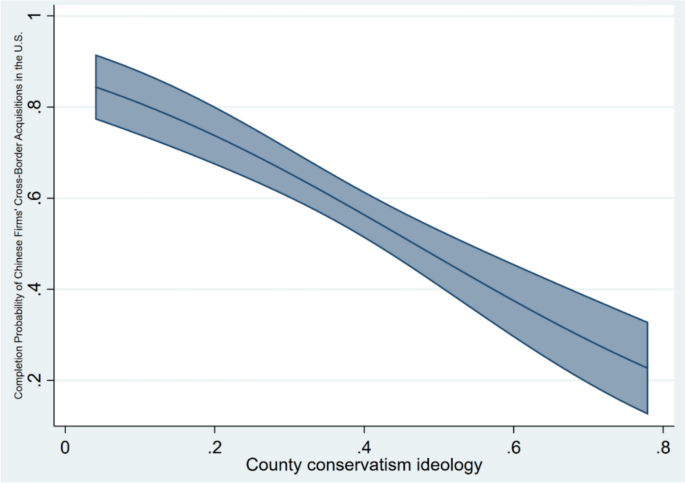
Chinese acquisitions in US counties one standard deviation more conservative completed about 20 points less often
Across 267 Chinese acquisitions in the US, a study found completion odds fell from about 62% to 42% per standard deviation of county conservatism. The result is an association and the outcome is completion, so the reason deals stalled is the authors' interpretation.
The Scientist · Science desk
What happened
- The deals were initiated by 173 publicly listed Chinese companies between 2002 and 2021.
- Communities with higher unemployment showed a stronger negative relationship between conservatism and completion.
- The paper, co-authored by Tang Yinuo of Peking University HSBC Business School, appeared in the Journal of International Business Studies.
Why it matters
- decision Acquirers screening US targets get a cheap early input in county vote share, though the gap describes a pattern across deals and forecasts no single one.
- constraint The outcome is completion, so the data cannot separate resident opposition from other reasons a deal fails; the opposition reading is the authors' interpretation.
- cost The engagement the authors recommend (local benefits, transparent operations, partnerships with local institutions) is a cost the acquirer bears up front, before any evidence it changes completion odds.
A fall from about 62% to about 42% [5] is 20 percentage points [10], or roughly a third of the starting probability [11]. The step behind it is one standard deviation of conservatism [5].
The denominator is modest. The 267 deals came from 173 listed Chinese companies [2], about 1.5 deals each [12], so some acquirers appear more than once.
In the paper by Tang Yinuo of Peking University HSBC Business School and co-authors [1], the effect is worded as an association [5], and the deals analyzed had already happened [2]. Republican presidential vote share stands in for conservatism [3], so the estimate carries anything else that varies with how a county votes. The authors attribute the pattern to perceived threats and uncertainties [13]. That is an interpretation. The outcome measured is whether a deal was completed [4], and a deal can fail to complete for reasons other than local resistance.
Two moderators give the threat account some support. The relationship was especially pronounced in industries under heightened CFIUS scrutiny, where national security concerns may amplify community resistance [6]. It was also stronger in communities with higher unemployment [7]. Both are conditions under which a threat story predicts a steeper gradient, though neither measures what residents thought.
We think the result supports a narrow use, because it describes a gradient across 267 deals and forecasts no single one. County vote share is easy to look up and the gap is large, so it belongs in the early screen of targets, the stage at which the authors say the findings help [8].
The authors' advice is to build trust: communicate benefits such as job creation and economic development, keep operations transparent and collaborate with local institutions [9]. The summary does not include an interval around the 62% and 42%, a county count or a test of whether those steps raise completion.
What to watch
- The full Journal of International Business Studies text, for the county count, the interval around 62% and 42%, and the controls behind them.
- Any test of whether community engagement raises completion odds in conservative counties.
- Whether the gradient appears in deals after 2021, the end of the sample window.
Clarity's read
What the record supports and how the coverage leans. The claims behind it follow.
Reality
- Evidence50
- Adoption
- Insufficient
- Hype gap+15
- Incentives
- Insufficient
- Confidence50
Claim ledger
Ranked by verification strength, evidence, and original report placement.
- [1]
The paper 'Global meets local: Community political ideology and Chinese cross-border M&As in the U.S.' was published in the Journal of International Business Studies and is co-authored by Tang Yinuo, a tenured associate professor at Peking University HSBC Business School.
- [2]
The study analyzes 267 acquisition deals initiated by 173 publicly listed Chinese companies between 2002 and 2021.
- [3]
The researchers used Republican presidential vote shares as a measure of local conservatism across U.S. counties.
- [4]
Chinese acquisitions were less likely to be completed in more conservative U.S. counties.
- [5]
A one-standard-deviation increase in community conservatism was associated with a decline in acquisition completion probability from approximately 62% to 42%.
- [6]
The negative relationship was especially pronounced in industries subject to heightened CFIUS scrutiny, where national security concerns may amplify community resistance.
- [7]
Communities experiencing higher unemployment showed a stronger negative relationship between conservatism and acquisition completion.
- [8]
The findings offer companies a more detailed perspective on political factors that can affect cross-border acquisitions, particularly during the early stages of investment planning.
- [9]
The researchers emphasize building trust with local communities: communicating benefits such as job creation and economic development, maintaining transparent operations and collaborating with local institutions.
- [10]
The drop from about 62% to about 42% is about 20 percentage points.
- [11]
A 20-point drop from a 62% starting probability is a relative decline of roughly 32%, about a third.
- [12]
267 deals from 173 companies is about 1.5 deals per company.
- [13]
According to the study, conservative communities in the U.S. are more likely to resist Chinese mergers and acquisitions due to perceived threats and uncertainties.
Get this ledger inside ChatGPT. Ask about any of our stories and the answer brings its figure, each claim’s verdict and the sources. Free, no account.
Sources
1 independent publisher whose own reporting we read for this story.
- phys.orgInternational business is influenced by local political climate, study finds
1 article · October 14, 2026
Topics and entities
Follow any of these and your For You feed starts watching them — no settings page required.
Topics
- Cross-border M&AFollow
- Political riskFollow
- US-China RelationsFollow