Science1 publisherNot yet confirmed elsewhere3 min readPublished
Illinois team sorts look-alike grass pollen by type to trace 25,000 years of grass diversity at one site
Illinois researchers paired super-resolution imaging with machine learning to track grass diversity and C3-C4 balance at one site over 25,000 years. That makes a plentiful fossil countable by type, though the evidence so far rests on one sediment record.
The Scientist · Science desk
What happened
- Pollen from different grass species looks remarkably similar under a standard light microscope, while other flowering plants' pollen differs in shape, spikes, grooves or pores.
- Light microscopes could not resolve the grains' surface features, and electron microscopes could, but only at high cost and with heavy labour.
- Former doctoral student Marc-Élie Adaimé trained a convolutional neural network to recognise subtle surface differences in pollen images.
- He added a statistical method that uses the network's learned patterns to estimate how many species are present in a mixed pollen sample.
- The model also separated C3 from C4 grasses, the two photosynthetic types that concentrate carbon dioxide in different ways.
Compiled by The ScientistSomething wrong?How this is made
Why it matters
- capability With thousands or more grass pollen fossils in a cubic centimetre of sediment, software sorting moves the limit on analysis from human counting to imaging time.
- cost Surface detail that once required expensive, labour-intensive electron microscopy now comes from imaging Punyasena calls much faster and easier, so labs can attempt whole cores for less.
- constraint One site cannot separate local vegetation change from regional trends, so any wider claim about grass history has to wait for cores from other places.
A sediment sample is always a mixture, so the test that counts is the one run on mixtures. The team checked its diversity estimates against samples whose species composition was already known, and the estimates closely tracked the real diversity, according to the phys.org account of the work, which was published in the Proceedings of the National Academy of Sciences [4][2]. A network can score well on single grains and still misjudge a sample once small errors add up across many grains. A known-answer mixture is how you catch that, and I'd call it the strongest part of the design as reported.
The account does not put an error figure on the diversity estimates or on the C3-C4 split [4][13]. The training images came from several identifiable grass species, and those are what the network learned from [12].
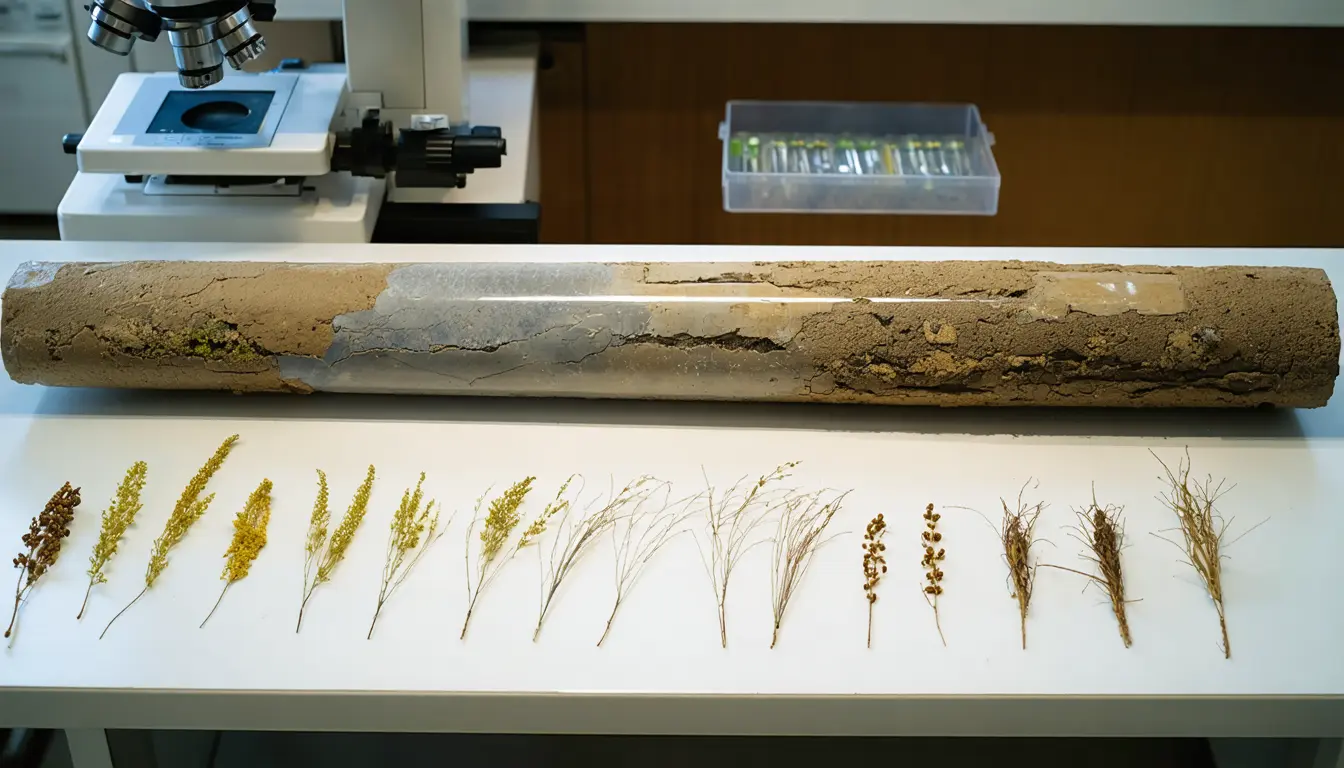
Surangi Punyasena, a plant biology professor at the University of Illinois Urbana-Champaign, led the study with Marc-Élie Adaimé, who is now a postdoctoral researcher at the Smithsonian's Office of Digital and Innovation [5]. "As paleobotanists and paleontologists, we're restricted to working with the morphology of pollen grains, which are one of the main parts of the plant that can be fossilized," Punyasena said [7]. "Within a small cubic centimeter of sediment, you could have thousands, potentially millions of pollen fossils," she said. "But the level at which we were able to analyze it before machine learning was limited by human ability." [8]
Earlier work by her group used super-resolution microscopy to expose some of the hidden features of grass pollen [17]. "You get close to electron microscopy quality, but the process is much faster, much easier," she said [10]. In those images, Adaimé "recognized that there were small differences in both the patterning and the complexity of the patterning on the surface of the pollen grains, and also the cell wall thickness," Punyasena said [11].
The network only has to be trained once, but imaging has to be repeated for every grain in every core. Punyasena's comparison with electron microscopy is qualitative [10].
The C3-C4 result has the wider reach. C4 grasses use carbon dioxide more efficiently, with higher photosynthetic capacity and water-use efficiency [18]. Earlier research found that C4 species put more biomass into roots and grow less dense leaves than C3 species [14]. If pollen carries the same split, one count of fossil grains yields both diversity and the C3-C4 balance through time [1].
The record runs 25,000 years at a single site [1]. "Open grasslands are a relatively recent ecosystem in Earth's history, with open-habitat grasses present in the Eocene, about 40 million years ago," the researchers wrote [15]. Against that span, 25,000 years is about one part in 1,600 [19]. It is a little over twice the 12,000 years or so since grasses may first have been domesticated, by the researchers' account [16][20].
What to watch
- Error rates for the diversity estimates and the C3-C4 classification, if the PNAS paper or its supplement reports them.
- The same method applied to sediment cores from other sites or older intervals, which would show whether the 25,000-year pattern is local.
- Growth of the reference image set beyond several grass species, which governs what the network can recognise in fossil samples.