ScienceIndependently confirmed2 publishers3 min readPublished Updated
Mars's two faces run deep, and the tidy impact story now owes a harder answer
A Nature paper puts the boundary between stiff and soft Martian mantle directly beneath the surface dichotomy. The authors still keep a giant impact on their list of causes.
The Scientist · Science desk
What happened
- A Nature paper reports that Mars's interior is thermally lopsided, with the southern half around 200 to 400 degrees Celsius warmer than the north and partially molten.
- The result came from reprocessing 16 years of radio tracking from three Mars orbiters using tidal tomography, applied to Mars for the first time.
- The tidal signal departed from a symmetric-interior prediction by up to 300 percent.
- Simulations place the deep boundary between harder and softer rock directly under the surface dichotomy, following it where the surface line wanders.
Why it matters
- constraint Interior models that assumed one set of rocks at one temperature at every depth now carry an error the size of a hemisphere, and the reference interiors that InSight-derived numbers lean on were...
- capability Interior structure can be extracted from decades of archived spacecraft tracking rather than from new landers, which is Berne's stated argument for gravity data as a mission-design tool.
- contradiction A deep boundary shadowing the surface one reads as an inside-out origin, yet the paper's own hypothesis list still includes an impact, so the finding constrains the debate without closing it.
- decision Siting the next Martian seismometer becomes a choice about which hemisphere's mantle you want to hear, rather than a matter of repeating the north.
The stiffness contrast is what was measured; the temperature is an interpretation laid on top of it. Berne's team found the Martian mantle must differ in stiffness by more than 20 percent between hemispheres, rigid in the north and softer in the south [14]. Read as a springy, purely elastic response, that gap implies a north-south temperature difference above 1,000 degrees C, which Berne discards because the whole southern half would then be molten and visibly is not [15]. The published figure of 200 to 400 C instead assumes the tidal flexing creeps slowly across the Martian year rather than snapping back [16]. That substitution is doing a factor of 2.5 to 5 of work [21]. Anyone using the temperature number downstream is also buying the creep model.
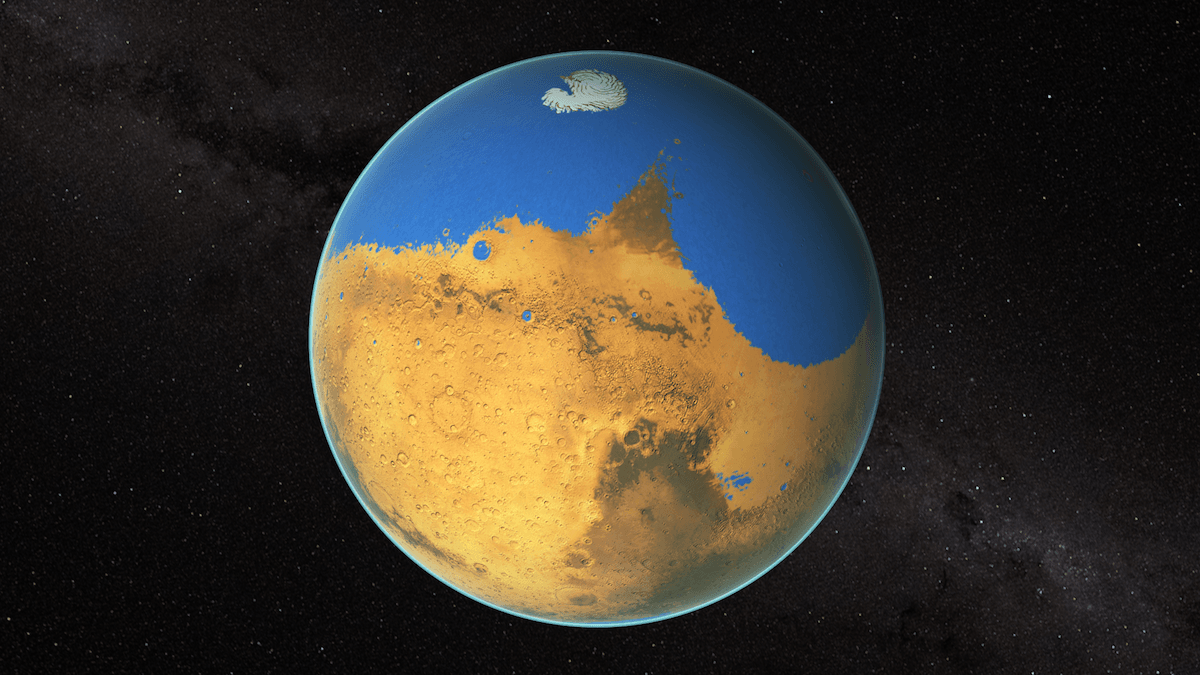
The alignment is what changes the argument. Southern warmth on its own was already in circulation: a 2024 study of marsquakes recorded by InSight floated it to explain why seismic energy dies away faster in the south [7]. What the new simulations add is geometry, with the deep stiff-soft boundary tracing the surface boundary even where that line wanders north or south [17]. A crustal feature 25 kilometres deep in average thickness contrast [3] whose deep counterpart follows its wiggles is not easily read as damage done from outside.
Not easily, but not impossibly, and this is where the clean story stops. Phys.org, reporting the same paper, says the cause of the anomaly remains unclear and lists a giant impact releasing heat from the north alongside past spontaneous convection in the southern mantle and thick geological features trapping heat [9]. Depth does not kill the impact hypothesis. It hands it a worse exam question: why an impact-generated thermal anomaly would still be registered against the topographic boundary, contour for contour, after four billion years, and why fifty years of debate [4] has not settled it.
The other thing worth noticing is how thin the seismic base is. Almost everything known about Mars's deep interior comes from InSight, a single station in the northern lowlands operating from 2018 to 2022 [18], roughly four years of listening from the cold, stiff side [22]. One station cannot tell north from south, so most later interior models simply assumed the same rocks at the same temperature at any given depth, all the way around [19]. The gravity route gets around that with archive material: velocity wobbles of Mars Global Surveyor, Mars Odyssey and Mars Reconnaissance Orbiter [6], 16 years of radio tracking [5], which is about eight and a half Martian years of tidal cycles [23].
If the structure holds, it becomes answerable for more than topography. The team suggests a hot southern mantle could account for the magnetic anomalies in southern iron minerals, implying a field once strong enough to imprint a north-south difference [10]. Co-author Amirhossein Bagheri, a Caltech postdoc and former InSight team member, ties the dichotomy to Martian hydrology and the formation of basins that may have held water [11]. One structure carrying several observations is efficient, and also fragile: a better anelasticity measurement could take all of it down at once.
What to watch
- An independent estimate of Martian mantle anelasticity: the 200 to 400 C range depends on the creep assumption, and a different one moves the number by a factor of a few.
- Any seismic station in the southern highlands, which would test the temperature contrast directly instead of through the gravity field.
- Whether the southern magnetic anomalies and water-bearing basins can be modelled quantitatively against this thermal structure, or only gestured at.
Clarity's read
What the record supports and how the coverage leans. The claims behind it follow.
Reality
- Evidence58
- Adoption
- Insufficient
- Hype gap+20
- Incentives
- Insufficient
- Confidence60
Claim ledger
Ranked by verification strength, evidence, and original report placement.
- [1]
Based on gravitational measurements, Mars's southern interior is around 200 to 400 degrees Celsius warmer than the planet's northern half and partially molten.
- [2]
The study is Alexander Berne et al, "Tidal tomography reveals a thermal anomaly beneath Mars's crustal dichotomy," Nature (2026), DOI 10.1038/s41586-026-10893-x. Berne is a Caltech PhD ('26) now a postdoctoral associate at the University of Arizona.
- [3]
The crustal dichotomy is Mars's largest single feature, with crust on either side differing in average thickness by some 25 kilometres.
- [4]
Scientists have debated the origin of the crustal dichotomy for half a century.
- [5]
To isolate the gravitational signal the team reprocessed 16 years of radio tracking data from three Mars orbiters, using tidal tomography, a technique previously applied to Earth and Earth's moon but never to Mars.
- [6]
The team used data from Mars Global Surveyor, Mars Odyssey and Mars Reconnaissance Orbiter, measuring tiny variations in the spacecraft's velocities to reconstruct the gravitational field around Mars.
- [7]
A separate 2024 study of marsquakes based on InSight data suggested underlying warmth as a possible reason seismic energy in the south dissipates faster than in the north.
- [8]
Mars travels a lopsided path around the sun with a tilted axis, so the solar tug shifts over the 687-day Martian year, creating a tidal force that changes Mars's shape and rearranges its gravity field enough to alter the motions of orbiting spacecraft.
- [9]
It is still unclear what created the thermal anomaly; hypotheses include a giant impact releasing heat from the north, past spontaneous convection in the Martian southern mantle, and thick geological features trapping excess heat from escaping.
- [10]
A thermal anomaly in the southern mantle could mean a magnetic field existed strong enough to cause the magnetic differences seen between north and south, including magnetic anomalies found in iron minerals in the south.
- [11]
Amirhossein Bagheri, a Caltech postdoctoral scholar, co-author and former InSight team member, says the north-south dichotomy gives information about processes that may have influenced Martian hydrology, including the formation of basins that may have held water.
- [12]
Mars's northern hemisphere is a smooth, low-lying plain while its southern hemisphere stands several kilometres higher, rugged and densely cratered; Berne's team argues the two-faced appearance extends all the way down to the core.
- [13]
The tidal readings deviated from the symmetric-interior scenario by up to 300 percent.
- [14]
Based on how much the planet flexed, the team calculated that Martian mantle stiffness should vary by more than 20 percent between hemispheres: rigid in the north, softer in the south.
- [15]
Berne says a naive interpretation of the 20-percent stiffness change would translate to a temperature difference of more than 1,000 degrees C, which is impossible because "the whole southern half would be molten, which is not what we observe."
- [16]
If Mars's tidal flexing is more gradual, stretching across its year, the result is a more plausible north-south difference of a few hundred degrees; Berne calls it "a deformation that creeps over time."
- [17]
Numerical simulations reconstructing the division between harder and softer rocks put that line directly beneath the surface dichotomy, following even the places where the surface boundary wanders north or south; Berne calls it "a happy surprise."
- [18]
Almost everything known about Mars's deep interior comes from seismic waves recorded by NASA's InSight lander, which operated in the northern lowlands from 2018 to 2022.
- [19]
One seismic station in one place cannot tell north from south, so most subsequent models of Mars's interior assumed the planet was uniform, with the same rocks at the same temperature at any depth all the way around.
- [20]
Berne says scientists usually assume planetary interiors are spherically symmetric, that more gravity data allows the three-dimensional intricacies of an interior to be determined, and that such inferences give a blueprint for designing future missions.
- [21]
The published 200 to 400 C contrast is 2.5 to 5 times smaller than the naive elastic reading of more than 1,000 C, so the creep assumption accounts for a factor of a few in the headline temperature.
- [22]
InSight's operating span of 2018 to 2022 is roughly four years.
- [23]
Sixteen Earth years of radio tracking covers about 8.5 Martian years of tidal cycles.
Sources
2 independent publishers whose own reporting we read for this story.
- phys.orgThermal anomaly discovered below Mars' south pole
1 article · August 26, 2026
- scientificamerican.comMars may be two-faced to its core
1 article · August 26, 2026
Topics and entities
Follow any of these and your For You feed starts watching them — no settings page required.