InvestNot yet confirmed elsewhere1 publisher2 min readPublished
Lee Jae Myung went from reassuring farmers on CPTPP to restarting the discussion from scratch in seven days
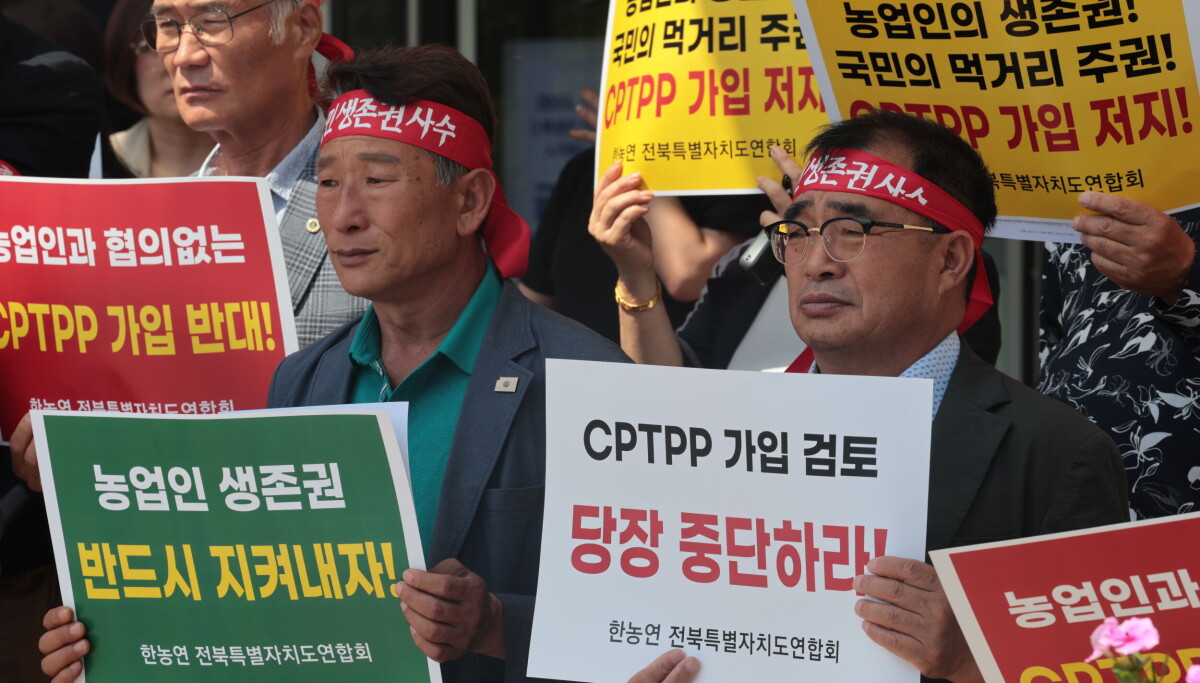
President Lee told officials on Oct. 8 not to file a CPTPP application this year, 10 days after estimates showed a 6 trillion won annual manufacturing gain. The Korea Herald blames policy reversals for the stall; the farm-sector loss in the same estimates is 14% of that gain.
The Investor · Invest desk
Key figures: estimated farm, forestry and fisheries output loss of 850 billion won a year; manufacturing output gain averaging 6 trillion won a year; net gain of about 5.15 trillion won a year; trade with CPTPP members of $341 billion last year, above China and the US.
- 850 billion won Est. yearly loss: farming, forestry, fisheries, claim 3
- 6 trillion won Manufacturing output gain, claim 2 average a year, preliminary estimate
- 5.15 trillion won Net output gain a year, about, claim 15 estimated annual net gain
- 341 billion US$ Trade with CPTPP members, claim 11 last year, above China and the US
| Figure | Value | Note | Claim |
|---|---|---|---|
| Est. yearly loss: farming, forestry, fisheries | 850 billion won | 3 | |
| Manufacturing output gain | 6 trillion won | average a year, preliminary estimate | 2 |
| Net output gain a year, about | 5.15 trillion won | estimated annual net gain | 15 |
| Trade with CPTPP members | 341 billion US$ | last year, above China and the US | 11 |
What happened
- On Aug. 27 the government made a formal announcement that it would seek CPTPP membership and started asking the public for input.
- Its Sept. 28 preliminary estimates put the annual output loss in agriculture, forestry and fisheries at 850 billion won.
- On Sept. 29 Lee posted "Please don't worry too much" on X to allay concerns about damage to farming and fishing.
- At a Cabinet meeting on Oct. 6, Lee called for restarting discussions from scratch instead of rushing toward a predetermined conclusion.
- The government has set no new timetable. Cheong Wa Dae promised farmers and fishers plenty of chances to raise their concerns.
Why it matters
- cost If the averages hold from accession, each year of delay defers up to 5.15 trillion won of net output, nearly all of it in manufacturing.
- decision Seoul has to decide how much of the farm loss the gainers will cover before it can file, since Lee has already said they could contribute.
- constraint A postponement with no date sits beside two earlier tries, in 2013 and 2021, that never reached a formal application.
On the government's preliminary figures the ratio of gain to loss is about 7 to 1 [16]. Both are annual averages of output, according to the Korea Herald, and the editorial does not say what period, method or partner mix produced them [2]. Output is not profit, and any contribution from the winners would be paid out of profit.
The sequence was fast. Lee's turn from reassurance to restart took seven days [22], inside the 10 days between publication of the estimates and the instruction not to apply [18], and the whole run from the Aug. 27 announcement to that instruction took 42 days [19]. The Korea Herald's explanation is trust. It says the government was struggling to win support from farmers and fishers, whose trust the nationwide farmland survey had already eroded [23]. It lists three earlier retreats: the survey itself, a delisting push halted after businesses objected and a court intervened, and a real estate tax change scaled back a month after announcement [c10, c11, c12]. From these it concludes that policies are announced before their costs and political consequences are fully assessed [25]. The CPTPP case fits that conclusion imperfectly, because the costs were estimated and published first, on Sept. 28 [2].
The trade at stake is large. Korea's trade with CPTPP members totaled $341 billion last year, 25% more than with China ($273 billion) and 74% more than with the United States ($196 billion) [c13, d6, d7]. Seoul already has free trade agreements with every member except Japan and Mexico [13], so we'd expect much of the new access, and much of the 6 trillion won, to sit with those two. The Korea Herald adds that the US-China tariff war is raising the pact's value [14].
Our view is that the bid stalled on a distribution question, and that the reversals are how that dispute surfaced. The Korea Herald puts the cause the other way round: reversals first, distrust second. The two readings predict different things. If the restarted discussions produce a farm loss estimate well above 850 billion won [3], the problem is substance and we are wrong about the cause. If the government publishes a date and a funding source for farm support and farmers and fishers still decline to engage, the editorial is right and trust is the binding limit. A third outcome is drift. The editorial says the bid could fail if the government keeps wavering [26].
What to watch
- Whether Cheong Wa Dae attaches a date to the farmer and fisher consultation it promised.
- Whether the restarted discussions revise the 850 billion won farm-sector loss estimate up or down.
- Whether the government names a funding source for farm support, since Lee has said beneficiaries could contribute.
Clarity's read
What the record supports and how the coverage leans. The claims behind it follow.
Reality
- Evidence50
- Adoption
- Insufficient
- Hype gap
- Insufficient
- Incentives
- Insufficient
- Confidence45
Claim ledger
Ranked by verification strength, evidence, and original report placement.
- [1]
The government formally announced on Aug. 27 that it would pursue CPTPP membership and began soliciting public input.
- [2]
On Sept. 28 the government released preliminary estimates showing CPTPP membership would boost manufacturing output by an average of 6 trillion won ($4.5 billion) a year.
- [3]
The same preliminary estimates showed CPTPP membership would reduce output in agriculture, forestry and fisheries by 850 billion won annually.
- [4]
In a Sept. 29 post on X, President Lee Jae Myung, seeking to allay concerns about potential damage to agriculture, forestry and fisheries, said, "Please don't worry too much."
- [5]
Lee added in the Sept. 29 post that those who benefit from the policy could contribute to supporting those who lose out.
- [6]
At a Cabinet meeting on Oct. 6, Lee called for restarting discussions from scratch rather than rushing toward a predetermined conclusion.
- [7]
On Oct. 8, Lee instructed the government not to apply for CPTPP membership this year.
- [8]
The government has set no new timetable for the CPTPP application, and Cheong Wa Dae said it would give farmers and fishers ample opportunity to voice their concerns.
- [9]
The government recently sought to delist companies that failed to meet a market-capitalization threshold but halted the process after businesses objected and a court intervened.
- [10]
A real estate tax reform plan to reduce deductions for nonresident owners of a single home was scaled back just a month after its announcement as public opposition mounted.
- [11]
South Korea's trade with CPTPP members totaled $341 billion last year, exceeding its trade with China ($273 billion) and the United States ($196 billion).
- [12]
South Korea first pursued CPTPP membership in 2013 and revisited the idea in 2021, but never submitted a formal application, held back by other concerns and opposition from farmers.
- [13]
South Korea has free trade agreements with all CPTPP members except Japan and Mexico.
- [14]
The Korea Herald says that as the US-China tariff war erodes the foundations of free trade, the CPTPP is becoming increasingly valuable.
- [15]
The estimated annual net gain is about 5.15 trillion won (5,150 billion won).
- [16]
The manufacturing gain is about 7 times the agriculture, forestry and fisheries loss.
- [17]
The 850 billion won loss is about 14% of the 6 trillion won manufacturing gain.
- [18]
Ten days separated the Sept. 28 release of the estimates from the Oct. 8 instruction not to apply.
- [19]
Forty-two days separated the Aug. 27 announcement from the Oct. 8 instruction not to apply.
- [20]
Trade with CPTPP members was about 25% larger than trade with China.
- [21]
Trade with CPTPP members was about 74% larger than trade with the United States.
- [22]
Seven days separated Lee's Sept. 29 X post from his Oct. 6 call to restart discussions.
- [23]
The Korea Herald says the government was struggling to win support for CPTPP membership from farmers and fishers, whose trust had already been eroded by its nationwide farmland survey; it calls the survey and CPTPP separate issues but says the former has become an obstacle to the latter.
- [24]
The nationwide survey of farmland use began after Lee criticized poor farmland management at a February Cabinet meeting; the government pressed ahead without adequately considering elderly farmers who lease out their land, fueling discontent and eventually forcing a retreat.
- [25]
The Korea Herald says the repeated reversals suggest policies are being announced before their costs and political consequences have been fully assessed.
- [26]
The Korea Herald says that if the government continues to waver on its trade strategy, the CPTPP bid could fail.
Sources
1 independent publisher whose own reporting we read for this story.
- en.yna.co.kr(EDITORIAL from The Korea Herald on Oct. 13)
1 article · October 12, 2026
Topics and entities
Follow any of these and your For You feed starts watching them — no settings page required.
Entities
- CPTPPFollow
- Lee Jae-myungFollow
- The Korea HeraldFollow
- Yonhap News AgencyFollow