Science1 publisherNot yet confirmed elsewhere3 min readPublished
Microbes in dark sediment under Larsen C Ice Shelf point to a sunless route to Snowball Earth's iron deposits
Korean researchers found iron-oxidizing bacteria in dark seafloor sediment 324 metres down at Antarctica's Larsen C Ice Shelf. A protein the bacteria make offers Snowball Earth's banded iron a way to form without sunlight.
The Scientist · Science desk
What happened
- The team rebuilt the genome of a keystone bacterium from sediment DNA, a new chemolithotrophic lineage provisionally named Candidatus Mariimomonas ferrooxydans.
- In sediment layers resembling banded iron, two microbial groups tied to that bacterium took turns dominating, a cycle the team offers as a possible cause of banding.
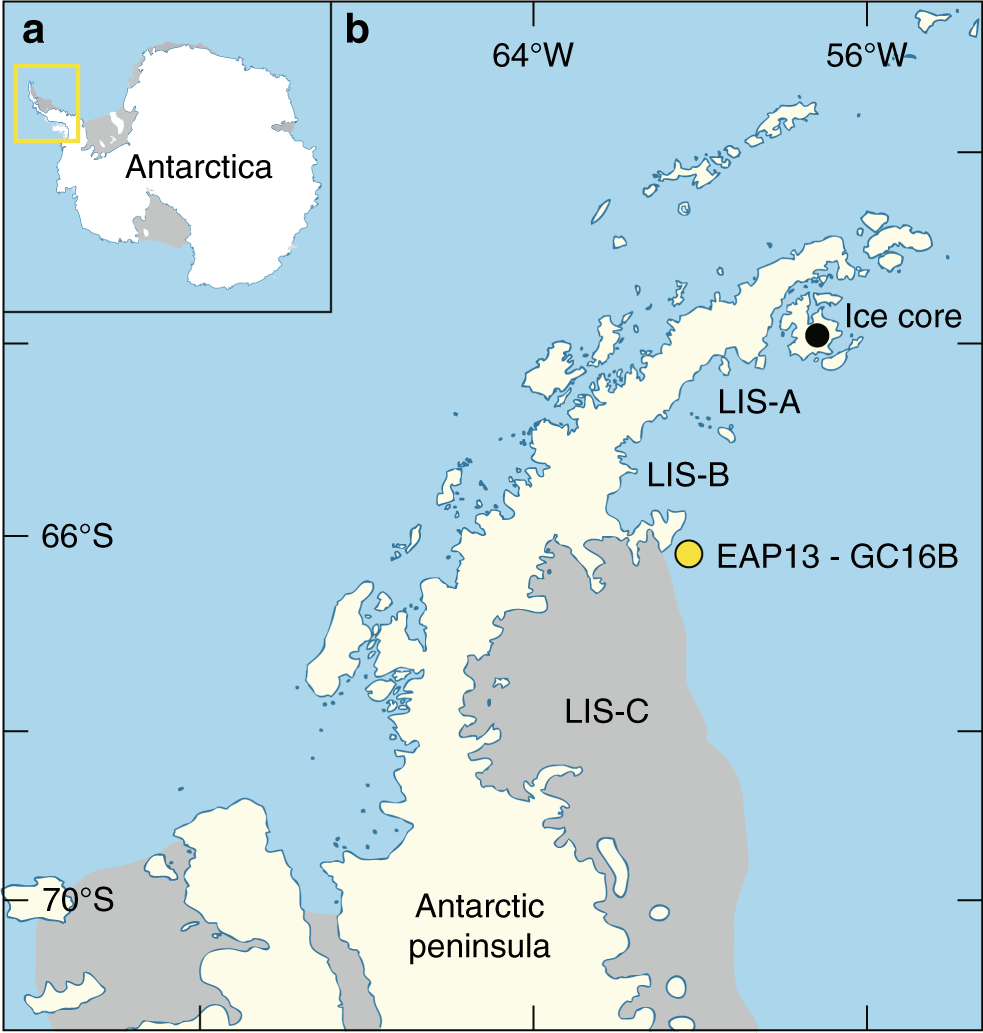
- The 2.4-metre core, GC16B, was collected in 2013 by the icebreaking research vessel Araon and contains Holocene sediment.
Compiled by The ScientistSomething wrong?How this is made
Why it matters
- constraint The organisms come from sediment covering roughly the last 12,000 years, so the work shows the route can operate under ice; showing it built Cryogenian deposits will need evidence from rock of that age.
- constraint The banding explanation rests on which microbes rose and fell together, an association that stays a hypothesis until community shifts are matched to individual iron and silica layers.
- precedent Expressing a gene from a genome rebuilt out of sediment DNA in E. coli turns a gene annotation into measured activity, a standard other claims about ancient metabolisms can now be held to.
Photosynthesis needs light, and that has always been the weak point in explaining Snowball Earth's iron. Banded iron formations are alternating layers of iron and silica. They have long been credited to photosynthetic bacteria that oxidized dissolved iron until it precipitated and piled up in the oceans [6][1]. The Snowball Earth examples formed in the Neoproterozoic, when the planet is believed to have been under ice hundreds of metres thick, and they have been a standing problem for that model [7].
The team includes Jihyun F. Kim of Yonsei University, with colleagues at Sungkyunkwan, Seoul National and Gyeongsang National universities and the Korea Polar Research Institute [3]. They worked from environmental DNA preserved in the sediment [3]. Metagenomic sequencing turned up a new clade of chemolithotrophic bacteria able to oxidize iron(II) where light and oxygen are scarce [4]. To pick which bacterium to follow up, the team looked for the ones sitting at the hubs of the community's network in layers that resemble banded iron [10]. They rebuilt that keystone genome, confirmed the organism was present in the samples, and found a gene for Cyc2, a protein already suspected of a role in iron oxidation [11].
I find the next step the most convincing. Cyc2 is a porin-cytochrome fusion protein that sits in the bacterial outer membrane [5]. With the gene cloned into E. coli, iron(II) oxidized rapidly to insoluble iron(III) and fell out of solution [12]. Iron(III) is far less soluble in water than iron(II), so that activity, kept up on a seafloor over time, could build up as iron minerals [13]. The report does not describe the assay's controls, including whether the E. coli test ran without oxygen. Oxygen-free conditions are what the whole argument is about [2].
The thing this doesn't tell you is whether any of it happened during Snowball Earth. The core is Holocene, a record of about 12,000 years running from the last glacial period of the Quaternary to the present [9]. What the team has is a modern organism from a modern setting cut off from light and oxygen [2]. That shows a biological route to iron(III) exists without sunlight, and that its key enzyme works [5][12]. It is not evidence that the route laid down the Neoproterozoic deposits [9]. Nor can a 12,000-year record say whether iron oxidation of this kind came before photosynthesis, a possibility phys.org's write-up raises in a section headed "A pathway potentially predating photosynthesis" [9][15].
The banding claim is weaker still. Two microbial groups closely tied to the hub bacteria took turns dominating, and the account presents that cycle as a possible biological explanation for the repeated bands [10]. Hub status and alternating dominance are patterns of co-occurrence [10]. Turning them into a cause would mean matching shifts in the community, layer by layer, to the iron and silica chemistry.
In my view the study does weaken the argument that photosynthesis was required to build banded iron under thick ice, because it supplies a working, light-independent enzyme from a sunless seafloor [14]. The condition is that this is an argument from possibility, resting on a Holocene stand-in for a Cryogenian ocean [9].
What to watch
- Whether the peer-reviewed paper reports oxygen-free controls for the E. coli Cyc2 assay.
- Detection of Cyc2-type genes or related iron oxidizers in other sub-ice sediments, or chemical traces of them in Cryogenian banded iron rocks.
- A laboratory culture of Candidatus Mariimomonas ferrooxydans, so iron oxidation can be measured in the organism itself instead of in E. coli.