Science1 distinct publisher2 min readPublished
Aksel Samuelsberg's group at Tromso put precipitating sea salt into a simple climate model and watched the freeze settle into the colder of two Snowball states, on the strength of a reflectance value measured in a lab.
The Scientist · Science desk

science
NASA's two Sun papers ask paleoclimate to carry an astrophysical term2 distinct publishers
science
What you expect from your own old age shows up a decade later in who you still see1 distinct publisher
science
Researchers trace a third of Central Valley groundwater loss to 122 named producers1 distinct publisher
science
The sharp crystal seed was never there: 8,000 nuclei imaged atom by atom, all gradients1 distinct publisher
Compiled by The ScientistSomething wrong?How this is made
An albedo number does its work through the part it leaves behind. A salt crust at 93 percent reflectance passes 7 percent of incoming sunlight into the surface; fresh snow passes 17 percent, and melting bare sea ice passes 33 [15]. Swap snow for salt and the absorbed shortwave falls to roughly two fifths of what it was; swap melting ice for salt and it falls to about a fifth [15]. That is why ten points of albedo adds up to a real swing in an energy budget.
Getting the crust at all requires a surface losing ice to vapour rather than gaining snow. Brine trapped inside cooling sea ice concentrates until salts crystallise, and when the ice above sublimates those crystals stay behind as a thin bright layer [4]. Hence the tropical belt in the model, prescribed as a place where evaporation outpaces snowfall [9]. Bare, sublimating ice is the prerequisite; without it, there is no crust.
What kind of model it is matters for how far the result travels. This is a simplified setup whose purpose is to find the stable states a climate can settle into [8], so its output is an inventory of equilibria and which one the system falls into, not a rate. The case that salt hastens a freeze is an argument about ordering: the earliest salts precipitate some 28 degrees Celsius above the temperature at which seawater would be frozen almost through [16], so the brightening is available while ice is still spreading rather than only after the planet has arrived. How many years that saves is left open.
Whether the crusts were ever actually there is a separate question. The physical anchor is a laboratory crust on very cold sea ice [5], the dynamical anchor is an equilibrium model [8], and the paper appears in Climate of the Past as modelling rather than as a report of a preserved Neoproterozoic salt layer [3]. I would still put this mechanism in the class of things a deep-time sea-ice scheme ought to represent, conditional on the tropical bare-ice belt surviving contact with a model that computes its own circulation instead of assuming it [9]. Bright ice replacing dark ocean has been the standard account of how the glaciations of roughly 700 million years ago ran away [1][14]. If salt behaves the way this model says, that account is the conservative one.
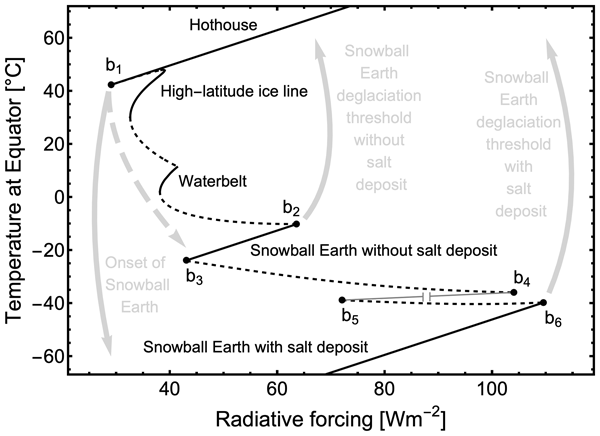
Ranked by verification strength, evidence, and original report placement.
With the process included, the model produced two possible stable Snowball Earth states, one with salt deposits and one without; the salt-covered state was substantially colder, and under the model's conditions a transition from a warm, ice-free climate into a Snowball Earth tended to lead directly to the colder, salt-covered state.
Around 700 million years ago Earth entered periods of extreme glaciation known as Snowball Earth, when ice is thought to have spread across much or potentially all of the planet's surface.
Aksel Samuelsberg of the University of Tromso, The Arctic University of Norway, and colleagues identified salt crystals accumulating on the surface of sea ice as another possible feedback that could have amplified Snowball Earth cooling.
The study was published in the journal Climate of the Past.
As sea ice forms and cools, dissolved salt becomes increasingly concentrated in the remaining liquid trapped within the ice; at sufficiently low temperatures some of it crystallises, and if surface ice sublimates the salt crystals are left behind as a thin surface layer.
In previous laboratory experiments, a salt crust formed on very cold sea ice reflected about 93% of incoming sunlight, compared with around 83% for fresh snow and roughly 67% for melting bare sea ice.
Distinct publishers with included, body-backed reporting in this cluster.
phys.org
1 article · September 3, 2026
Follow any of these and your For You feed starts watching them — no settings page required.
Evidence-backed comparisons of source perspectives and observed adoption signals. Read the methodology
Which Builder, Operator, and Investor concerns the observed source mix emphasized—not a truth score.
Evidence, demonstrated adoption, hype gap, incentives, and confidence are assessed independently, each on its own current evidence. How these are measured.
One outlet, one paper, one bench measurement
The chain is short and every link is visible: a Climate of the Past paper, relayed by phys.org, resting on a 93% reflectance figure that came out of earlier laboratory work rather than this study. The named journal, named lead author and specific temperature thresholds are what hold the number up; what keeps it from scoring higher is that a simplified stable-state model with no sea-ice motion is doing the planetary reasoning, and no one outside the group has weighed in.
Nothing here is the kind of thing that gets taken up yet
A week-old paleoclimate hypothesis has no uptake to measure, and our coverage reports none: no replication, no other modelling group adopting the salt term, no geological search for Neoproterozoic surface salt. Scoring this would mean inventing a signal the reporting does not contain.
Mildly overstated, mostly by the brightness number
The prose is careful — 'may have helped', an additional feedback, an open question about what started the freeze — but a single crust reflecting 93% in a laboratory is carrying a claim about a whole frozen planet, and that asymmetry is where the slight tilt comes from. The gap stays small because the reporting spends real space on dust, clouds, drifting ice and wind before anyone else can raise them.
Ordinary publication interest, visibly hedged
The only pressure on view is the everyday one — a research group wanting a new feedback noticed, an outlet wanting a surprising headline about salt. Against that, the piece closes on limitations and refuses the bigger claim, which is not how promotional science writing behaves. What is missing is any independent voice, so the framing is the researchers' own throughout.
Coherent, uncorroborated
Every figure we have traces to one write-up of one paper, and the numbers inside it are internally consistent — the -8 C first precipitation sits comfortably above the -36 C near-total freeze, and the reflectance trio is arithmetically clean. Consistency is not corroboration, though, and until a second account or a second model touches this, the middle of the range is honest.