Science2 publishers2 min readPublished
An extinct Red Sea brine pool kept the metal signature of a living one
Morgan Chakraborty and colleagues sampled an active Red Sea brine pool, a depression they suspected was a dead one, and three ordinary seafloor sites. The sediments of both pools carried the same metal enrichment.
The Scientist · Science desk
What happened
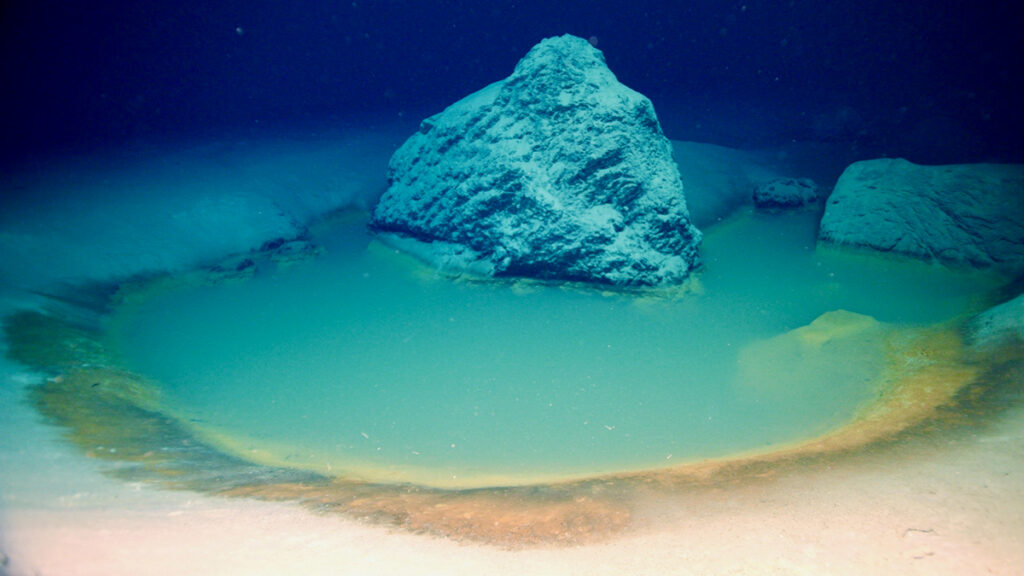
- Researchers compared sediment and organic matter from an active Red Sea brine pool, three ordinary seafloor sites, and a depression they suspected was an extinct pool from its mineral rings and its dead marine organisms.
- The active pool, 1,770 meters down, was teeming with bacteria and archaea, and the sediment beneath its microbial mat was enriched in manganese, iron, molybdenum and copper.
- The suspected extinct pool, nearly 1,400 meters below the sea surface, showed similar enrichment patterns despite holding dead organisms instead of a living community.
Compiled by The ScientistSomething wrong?How this is made
Why it matters
- capability Sampling for pre-oxygen chemistry no longer needs a living extremophile mat to aim at; a depression with mineral rings and no community becomes a testable target in its own right.
- constraint With one extinct site and three baseline sites, the 100-fold figure describes patches of two Red Sea depressions, and a coring program that lands off those patches will not reproduce it.
- precedent Geologists reading metal-rich ancient sediments now have a chemotrophic brine-pool explanation to rule out before crediting oxygenic photosynthesis for the enrichment.
The two depressions sit in the same sea. One has a living microbial mat over metal-rich mud; the other has mineral rings and a floor of dead marine organisms [4]. The sediment enrichment pattern is similar in both [8], and the dead one lies about 370 meters shallower [16].
How the dead site was picked matters for how much the match proves. The mineral rings and the dead organisms are what made the team suspect an extinct brine pool in the first place, and the geochemistry then agreed with the suspicion [4][8]. Neither published account gives an age for the site. The result shows that a depression which looks like a dead pool contains what an active pool contains, and not yet how long such a signature survives.
The effect is large and uneven. Some areas of the active pool's sediment ran upward of 100 times the metal concentrations of their non-brine counterparts, and three ordinary seafloor sites set that comparison [7][4]. Together with the two pools, the study covers five locations [17]. A core dropped outside the enriched patches would return a smaller ratio.
The pre-oxygen part of the argument rests on a modern organism. Metagenomes from the active pool contained manganese oxidizers such as Nitrospira [10], and the authors pair that with oxidized iron-manganese phases in the sediment as some evidence that microbial oxidation of Mn(II) to manganese oxides could have produced energy before atmospheric oxygen rose during the Great Oxidation Event, 2.4 to 2.2 billion years ago [11]. A modern anoxic basin with a modern community is an analogy for the Archean ocean, not a sample of it. The authors note that more research is needed, and state the finding as support for hypotheses that early-ocean metal enrichment could have happened independently of oxygenic photosynthesis or photoautotrophy [12].
Brine pools were long presumed lifeless, and the reversal is what makes the graveyards interesting: dark, salty, oxygen-free water turned out to be an oasis for certain extremophiles, whose bacteria and archaea leave geochemical signatures long after they are gone [2][3].
The immediate use is calibration. Oxidized manganese and molybdenum-enriched organic matter turned up in the sediments of both the active and the extinct pool, and the authors expect that to improve interpretations of similar patterns in the rock record [9]. The paper, "Brine Pool Microbes Enrich Metalliferous Sediments in Salt Giant Basins," is in AGU Advances [14]. The phys.org version is a republication of Rebecca Dzombak's Eos spotlight, so the two accounts are the same text [15].
What to watch
- Whether follow-up work dates the extinct pool, which would show how long the geochemical signature survives after the community dies.
- Whether metatranscriptomics from the extinct site finds any residual activity or only relict chemistry.
- Whether other salt giant basins show the same manganese and molybdenum pattern in depressions with no living mat.