InvestReports disagree2 publishers2 min readPublished
South Korea's first Arctic container round trip set out from Busan less than a third full
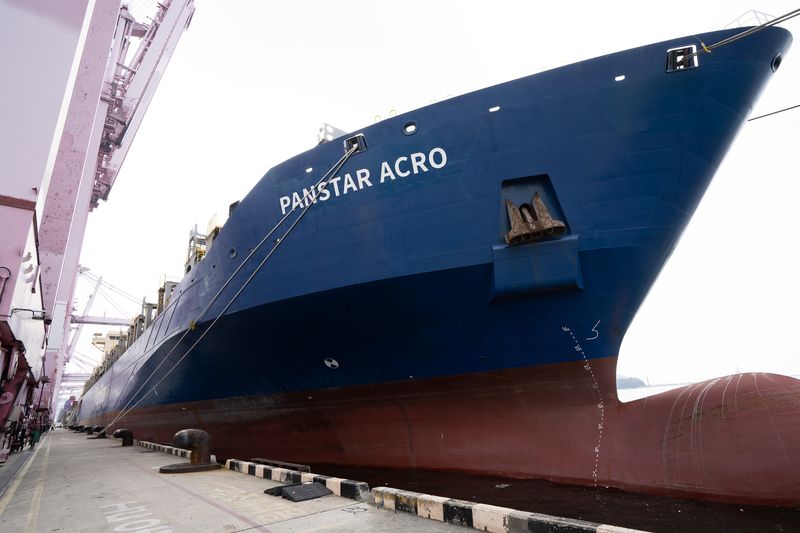
South Korea's first Arctic container round trip to Europe ended in Busan after 50 days at sea. The ship sailed with a light load, so for now the route gives Seoul a small hedge against Hormuz disruption while it gathers cost data for a regular service.
The Investor · Invest desk
Bar chart of the outbound sailing from Busan in TEU: ship capacity 2,758; PanStar's cargo target of about 1,300; load the ship left port carrying 837.
Outbound sailing from Busan, in TEU
| Item | Value | Claim |
|---|---|---|
| Ship capacity | 2,758 TEU | 22 |
| PanStar cargo target (about) | 1,300 TEU | 7 |
| Load leaving port | 837 TEU | 22 |
What happened
- The ship docked six days after its scheduled Oct. 5 return, having called at Felixstowe, Rotterdam and Gdansk by way of Russia's Arctic coast.
- The 2,758-TEU vessel left Busan on Aug. 22 carrying 837 TEU, Seoul Economic Daily reported.
- Before departure, operator PanStar told Reuters it was seeking about 1,300 TEU of cargo for the sailing.
- Seoul consulted Moscow about the voyage, including whether the ship would need help if it got stuck in ice.
Why it matters
- contradiction Seoul Economic Daily and Reuters differ by 100 TEU on the outbound load, a gap the government's cost study has to settle before any per-box figure from this voyage means much.
- constraint Even the higher count reached only about 64% of what PanStar set out to book, so the first limit this sailing hit was shipper demand.
- cost Operators would have to pay for slower running in ice, special insurance and extra fuel out of any time saving, and Reuters reported those costs will set the route's value.
- exposure A regular service would depend on Russian cooperation along that coast, which exposes Seoul to friction with Western allies who want Moscow isolated over Ukraine.
The ministry's timetable had the ship back in Busan on Oct. 5 [9], which made the plan a 44-day round trip from its Aug. 22 departure [21]. It took 50 [1]. That is an overrun of about 14% [21], on a voyage the Seoul Economic Daily said went close to plan without incident [9]. Outbound, the ship needed 21 days from Busan to Felixstowe, 12 of them after it entered the Arctic on Aug. 31 [19]. The return from Gdansk took 23 [20]. Authorities say the route could cut typical voyage times by around a third [25]. Neither report compares this ship's days with a conventional routing, so that saving is still the government's estimate.
Cargo is the weaker result. On Seoul Economic Daily's figure of 837 TEU [22], the ship left about 30% full [15]. Reuters counted 737 TEU of cargo plus empty containers [23]. If the larger number includes those empties, paying freight filled nearer 27% of the ship [16]. Even PanStar's own pre-departure goal of about 1,300 TEU [7] would have used only 47% of the slots [18].
Seoul's next step is a study. The government will analyze the voyage's distance, course, time, costs and fuel consumption, then build operating experience toward a regular route by 2030 and larger container ships around 2035 [6]. Until then, its plan puts data collection ahead of scheduled capacity or bigger tonnage [6]. That pace is slow for a project President Lee Jae Myung has made a priority [10], and one that officials hope will help turn Busan into a global maritime hub [13].
There are other ways this could go. The study could show the time saving holds once fuel and other costs are counted [6][25]. If it does, Seoul has a case for bringing 2030 forward. Western allies could object to Seoul's coordination with Moscow, and that could cap the route whatever the study finds [11][14]. Or shippers may have held back from the first load because no timetable had been published, which would say little about their interest in the lane itself.
We think the trial shows that a container ship can make the Arctic round trip [5], in late summer and early autumn [3][1], at small scale. Seoul Economic Daily presents the route as an alternative to the Strait of Hormuz since the war in Iran [8]. So far, that alternative amounts to one sailing of a 2,758-TEU ship that left under a third full [15]. We would change that view if a later sailing books more than PanStar's 1,300-TEU target and arrives on its scheduled date [7].
What to watch
- Publication of the ministry's fuel and cost data for the Arco, which will show whether the claimed one-third time saving survives slower ice running and insurance.
- Any Western government objection to Seoul's coordination with Moscow over Arctic sailings along Russia's coast.
Clarity's read
What the record supports and how the coverage leans. The claims behind it follow.
Reality
- Evidence60
- Adoption12
- Hype gap+30
- Incentives65
- Confidence60
Claim ledger
Ranked by verification strength, evidence, and original report placement.
- [1]
The Pan Star Arco, the first South Korean container ship to make a trial voyage along the Arctic route, returned to Busan on the morning of Oct. 11 after 50 days at sea, the Ministry of Oceans and Fisheries said.
- [2]
The ship departed Busan on Aug. 22.
- [3]
After leaving Busan, the ship entered the Arctic Ocean on Aug. 31, passed through the Chukchi, East Siberian, Laptev, Kara and Barents seas, called at Felixstowe on Sept. 12 and arrived at Rotterdam the next day.
- [4]
The ship called at Gdansk, Poland, on Sept. 18, then crossed the Arctic Ocean and returned to Busan.
- [5]
It is the first round-trip voyage along the Arctic route by a container ship.
- [6]
The government plans a comprehensive analysis of the Arctic route's economics, including the ship's sailing distance, course, time, costs and fuel consumption, then aims to accumulate operating experience and data to open a regular route by 2030 and achieve economies of scale around 2035 by deploying larger container ships.
- [7]
Before the departure, PanStar told Reuters it was seeking about 1,300 twenty-foot equivalent units of cargo.
ReportedSupportedSource: Reuters, via Korea Herald2 sources— create a free account to open themView cited source - [8]
The Arctic route is the shortest path linking Asia and Europe and has drawn attention as an alternative to the Strait of Hormuz since the war in Iran.
- [9]
The arrival came six days later than the originally scheduled date of Oct. 5, but the voyage proceeded close to plan without incident.
- [11]
The project risks friction with Western allies hoping to keep Russia isolated during its war in Ukraine.
- [12]
Industry experts have said the route's value will depend on reliable schedules, the costs of slowing to avoid ice, special insurance premiums and extra fuel use.
- [13]
Authorities are banking on the route helping turn the port of Busan into a global maritime hub.
- [14]
The route runs along Russia's Arctic coast, and Seoul consulted with Moscow about the journey, including whether the ship needed help to tackle problems such as getting stuck in ice.
- [15]
On 837 TEU aboard a 2,758-TEU ship, the vessel left about 30% full.
- [16]
On Reuters' 737 TEU of cargo, paying freight filled about 27% of the 2,758-TEU ship.
- [17]
The voyage booked about 57% (737 TEU) to 64% (837 TEU) of PanStar's roughly 1,300-TEU cargo goal.
- [18]
PanStar's 1,300-TEU goal equals about 47% of the ship's 2,758-TEU capacity.
- [19]
The outbound leg from Busan to Felixstowe took 21 days, 12 of them from Arctic entry on Aug. 31 to Felixstowe on Sept. 12.
- [20]
The return leg from Gdansk to Busan took 23 days.
- [21]
The planned round trip was 44 days (Aug. 22 to Oct. 5); the actual trip took 50 days, a six-day overrun of about 14% on the plan.
- [22]
The 2,758-TEU container ship left port carrying 837 TEUs and handled unloading and loading at its ports of call.
- [23]
The ship left with 737 TEU of cargo plus empty containers.
ReportedContestedSource: Reuters, via Korea Herald2 sources— create a free account to open themView cited source - [24]
The two outlets' outbound load figures differ by 100 TEU.
- [25]
Authorities say the Arctic route could cut typical voyage times by around a third.
Sources
2 independent publishers whose own reporting we read for this story.
- en.sedaily.comPan Star Arco Returns to Busan After First Arctic Container Voyage
1 article · October 10, 2026
- koreaherald.comS. Korea completes 1st Arctic-Europe commercial voyage, eyes regular service despite risks
1 article · October 10, 2026
Topics and entities
Follow any of these and your For You feed starts watching them — no settings page required.
Topics
- Shipping ChokepointsFollow
- Container shippingFollow
- Arctic ShippingFollow
- Russia Sanctions RegimesFollow
Entities
- Ministry of Oceans and FisheriesFollow
- Port of BusanFollow
- Strait of HormuzFollow
- Northeast PassageFollow
- Pan Star ArcoFollow
- Lee Jae-myungFollow
- PanStarFollow
- Hyundai GlovisFollow