InvestIndependently confirmed2 publishers3 min readPublished
Bipartisan permitting bill would speed power lines and pipelines alike for the AI build-out
Capito and Whitehouse's bipartisan permitting bill has fossil fuel and renewable industries on the same side while environmental groups split. Fortune reports votes are unlikely before the Nov. 3 midterms, so the weeks before January decide how fast AI data centers can get power lines and pipelines approved.
The Investor · Invest desk
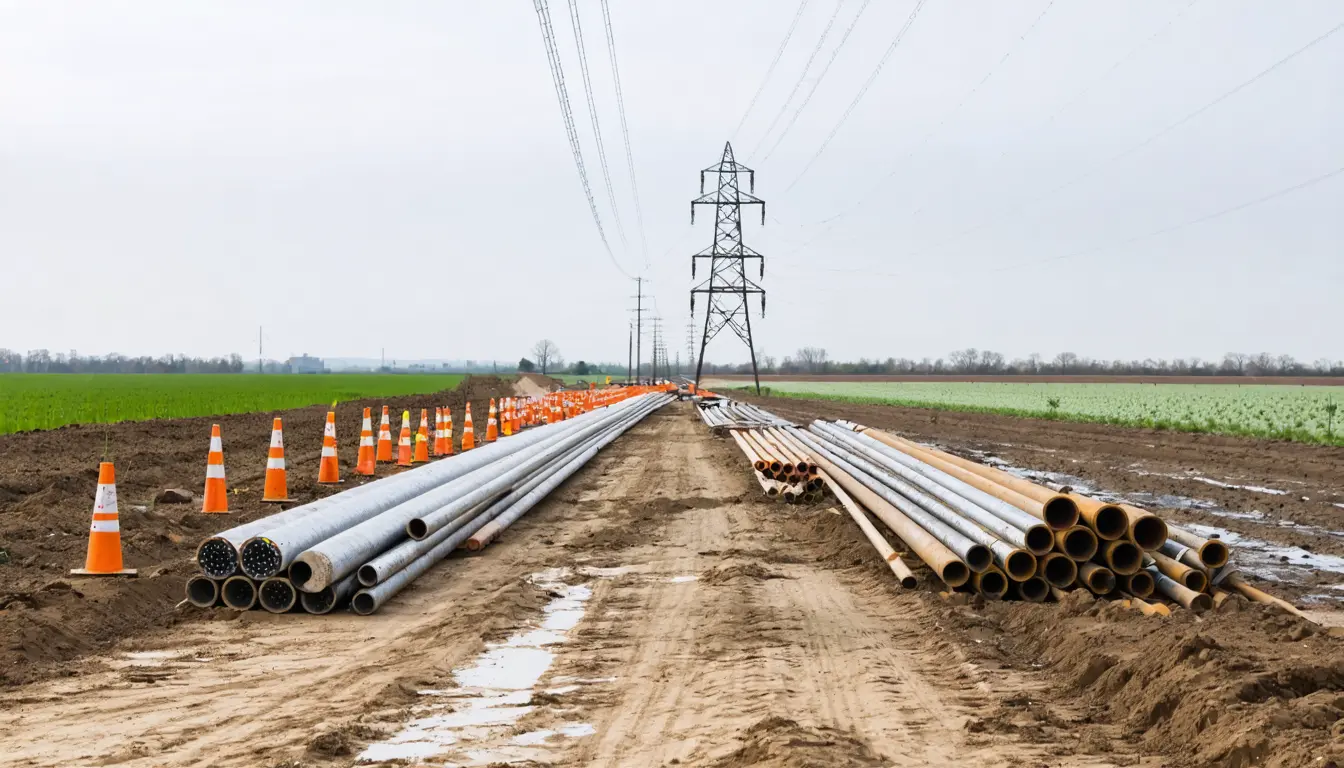
Solar farms and oil and gas pipelines get faster permitting timelines. Large transmission lines would be among the biggest beneficiaries. Presidential administrations would find it harder to yank permits. Earthjustice Action President Abigail Dillen says the bill's tradeoffs are too large.
- capability Solar farm developers Faster permitting timelines for solar farms, claim 6
- capability Oil and gas pipeline builders Faster permitting timelines also cover oil and gas pipelines, claim 6
- capability Transmission line developers Among the biggest beneficiaries; power lines are exceedingly hard to build through property owners' lands, claim 12
- constraint Presidential administrations Harder for administrations to yank permits, claim 7
- contradiction Earthjustice Action President Abigail Dillen said the bill's tradeoffs are too large, claim 3
| Who | How | Kind | Claim |
|---|---|---|---|
| Solar farm developers | Faster permitting timelines for solar farms | capability | 6 |
| Oil and gas pipeline builders | Faster permitting timelines also cover oil and gas pipelines | capability | 6 |
| Transmission line developers | Among the biggest beneficiaries; power lines are exceedingly hard to build through property owners' lands | capability | 12 |
| Presidential administrations | Harder for administrations to yank permits | constraint | 7 |
| Earthjustice Action | President Abigail Dillen said the bill's tradeoffs are too large | contradiction | 3 |
What happened
- The bill would speed permits for solar farms, power lines and oil and gas pipelines, narrow environmental reviews and limit litigation outside federal courts.
- Its authors are Republicans Mike Lee and Shelley Moore Capito and Democrats Sheldon Whitehouse and Martin Heinrich, who call themselves the "Four Corners."
- Ben Norris of the Solar Energy Industries Association called the bill's bundling of streamlining proposals into one package balanced, Fortune reported.
Why it matters
- constraint A future president would have less power to pull permits, and the limit would protect pipelines from a Democratic administration as much as it protects wind farms from this one.
- cost Opponents of a specific line or pipeline pay for the speed, with narrower environmental reviews to contest and fewer courts outside the federal system to sue in.
- precedent If the Texas pattern repeats nationally, interstate lines approved under the bill would come first and wind and solar at scale would follow, as it did after Texas authorized lines to Houston and Dallas.
For a company building data centers, we think the most valuable clause is the one that makes it harder for a presidential administration to yank a permit [7]. Faster approval only helps a project that survives the next election. Fortune describes wind and solar projects today as "held hostage" by the Trump administration [11].
Fortune names transmission as one of the bill's biggest beneficiaries, because power lines are exceedingly hard to build across the land of property owners [12]. The case could also fail at that point. According to Fortune, some Republicans fear increasing federal authority over local permitting matters [14]. If the final text gives way to that concern, a faster federal review may do nothing for the hardest part of building a line, which is getting it across private land. Fortune's account does not say how many months the bill would cut from any approval, or how far it reaches into state and local siting.
The calendar is short. From the Nov. 3 midterms to Jan. 1 is 59 days [18] [9], and Fortune calls permitting reform possibly the most important decision Congress makes before January for the tech boom and energy affordability [20]. The bill's four authors need 56 more senators to reach 60 votes [19].
A lame-duck vote is the quick path. Democrats could instead wait for a possible majority next year and draft a version more to their liking. That version would still need 60 votes, and it could meet staunch Republican opposition or a Trump veto [10]. The third risk is environmental opposition, since many groups lean toward opposing the bill [4]. Abigail Dillen, president of Earthjustice Action, opposes it but still called it a "genuine policy breakthrough" [5].
The solar industry wants this text passed. "The amount of new clean energy, new transmission capacity that's going to be unlocked under this bipartisan-negotiated language is well worth the tradeoffs that are made in other places," Ben Norris, senior vice president of regulatory affairs at the Solar Energy Industries Association, told Fortune [15]. "The bill goes a long way to getting lots of different sources of new electricity online, which is going to put downward pressure on prices," he said [16].
We think the bill matters more to the pace of the AI build-out than any single power contract, because every contract still depends on lines and pipelines that need permits. Two things would change that view: negotiators stripping out the limits on revocation, or transmission provisions that leave the fights over private land where they are. Crypto Briefing reported that market pricing points to a lower chance of a North Carolina data center moratorium, which it called consistent with favorable regulatory conditions [21]. The moratorium is a state matter, and that pricing does not measure this bill.
What to watch
- Whether Senate leaders schedule a floor vote on BAAJA in the weeks after the Nov. 3 midterms.
- Whether the final text keeps the limits on revoking permits, and how far its transmission provisions reach into state and local siting.
- Whether Democrats, if the midterms give them a Senate majority, choose to wait and draft their own version.
Clarity's read
What the record supports and how the coverage leans. The claims behind it follow.
Reality
- Evidence55
- Adoption
- Insufficient
- Hype gap+20
- Incentives70
- Confidence55
Claim ledger
Ranked by verification strength, evidence, and original report placement.
- [1]
The bipartisan permitting legislation has united the fossil fuel industry with renewable energy, while some environmental groups are pitted against the green power sector.
- [2]
The bill, supported by Senators Shelley Moore Capito and Sheldon Whitehouse, aims to expedite infrastructure projects needed for rising electricity demand driven by AI data centers; environmental groups are divided, and the bill has not yet been voted on.
ReportedSupportedSource: Crypto Briefing2 sources— create a free account to open themView cited source - [3]
Earthjustice Action President Abigail Dillen said the bill's tradeoffs are too large.
- [4]
Many environmental groups are torn on the bill but still lean toward opposing it.
- [5]
Dillen described the bill as a "genuine policy breakthrough" while saying its tradeoffs are too large.
- [6]
The legislation accelerates permitting timelines for solar farms, power lines and oil and gas pipelines, narrows environmental reviews, and limits litigation outside of federal courts.
- [7]
The legislation makes it harder for presidential administrations to yank permits.
- [8]
The Bipartisan American Affordability and Jobs Act (BAAJA) is coauthored by Sens. Mike Lee (R-Utah), Sheldon Whitehouse (D-R.I.), Martin Heinrich (D-N.M.) and Shelley Moore Capito (R-W.V.), who call themselves the "Four Corners."
- [9]
Votes are unlikely to begin until after the Nov. 3 midterm elections.
- [10]
Democrats could wait for a possible congressional majority next year to craft a version more to their liking, which may meet staunch GOP opposition; waiting would still require 60 Senate votes, and a too-liberal version could be vetoed by Trump.
- [11]
Fortune describes wind and solar projects as "held hostage" by President Donald Trump's administration.
- [12]
One of the biggest beneficiaries of the bill would be large electric transmission systems, power lines that are exceedingly hard to get built through the lands of property owners.
- [13]
Renewable energy in Texas did not take off until the Legislature helped authorize transmission lines hundreds of miles from the windy western parts of the state to cities such as Houston and Dallas; Texas now leads the country in utility-scale wind and solar power.
- [14]
Some Republicans fear increasing federal authority over local permitting matters.
- [15]
"The amount of new clean energy, new transmission capacity that's going to be unlocked under this bipartisan-negotiated language is well worth the tradeoffs that are made in other places," Ben Norris, senior vice president of regulatory affairs for the Solar Energy Industries Association, told Fortune.
- [16]
"The bill goes a long way to getting lots of different sources of new electricity online, which is going to put downward pressure on prices," Norris said.
- [17]
Ben Norris of the Solar Energy Industries Association said the legislation takes a balanced and unprecedented approach to bundling streamlining proposals into a single bill.
- [18]
59 days separate the Nov. 3 midterms and Jan. 1.
- [19]
The bill's four co-authors need 56 more senators to reach 60 votes.
- [20]
Permitting reform could be the most important decision Congress makes from now until January for the future of the tech boom, the environment, and energy affordability.
- [21]
Market pricing suggests a reduced likelihood of a North Carolina data center moratorium, consistent with favorable regulatory conditions for energy projects.
Sources
2 independent publishers whose own reporting we read for this story.
- cryptobriefing.comUS energy permitting bill unites fossil fuels, renewables; divides environmentalists
1 article · October 11, 2026
- fortune.comThe new energy permitting bill to feed the AI boom unites fossil fuels and clean power while dividing green energy and environmentalists
1 article · October 11, 2026
Topics and entities
Follow any of these and your For You feed starts watching them — no settings page required.
Topics
- AI Data Center Power DemandFollow
- Electric transmissionFollow
- Energy permitting reformFollow