Invest2 publishers2 min readPublished
Kelsier Ventures' LIBRA wallets shrink to $2 million from a stash that included $100 million in USDC and SOL
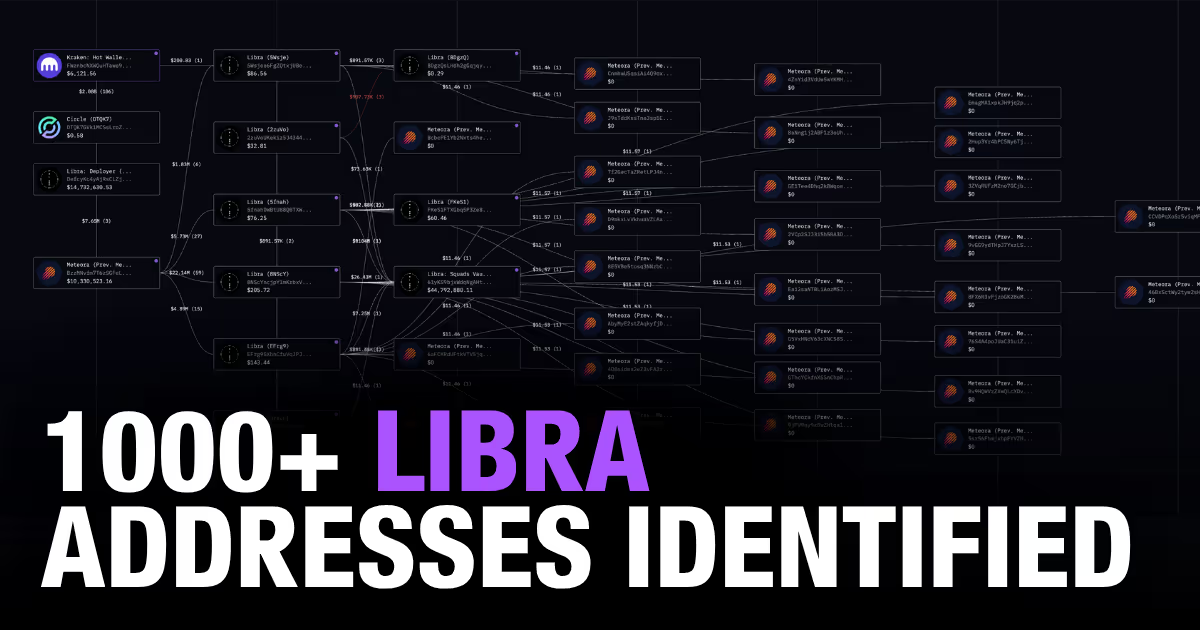
Arkham Intelligence says wallets tied to LIBRA's Kelsier Ventures now hold about $2 million, down from nearly $300 million in February 2025. Because about $100 million of that was USDC and SOL, a falling LIBRA price cannot explain the drop on its own.
The Investor · Invest desk
Drafted by a language model from the sources cited here and checked against its claim ledger before publication. How we use AISend a correction
What happened
- LIBRA, a memecoin Argentine President Javier Milei promoted, hit a multi-billion-dollar market cap before falling about 95% amid insider-trading and liquidity-extraction allegations.
- Kelsier Ventures is a Delaware-registered firm founded in 2021 and run by Hayden Davis, with his father Tom and brother Gideon in significant roles.
- Kelsier pitched itself as a Web3 venture capital firm, while Crypto Briefing reports it operated more like a market maker and token-launching shop.
- In October 2026, Judge Jennifer L. Rochon of the Southern District of New York dismissed investors' class action, rejecting its fraud and RICO claims.
Compiled by The InvestorSomething wrong?How this is made
Why it matters
- constraint With the class action dismissed, investors have no reported claim against the $2 million still visible; any recovery now depends on new legal or regulatory action.
- exposure Any further move of the remaining funds shows up on Arkham's public dashboards across about 1,200 tagged addresses, so investors and regulators can see it.
- precedent Crypto Briefing argues the gap between Kelsier's venture-fund pitch and its market-maker conduct gives policymakers a ready-made example for disclosure rules.
Most of the nearly $300 million Arkham counted on February 19, 2025 was LIBRA itself, the token Kelsier helped bring to market [2][3]. Take out the USDC and SOL and roughly $200 million of the headline figure was a mark on that token [10]. That portion could lose most of its value without a single transfer.
The other leg is different. About $100 million sat in USDC and SOL pulled from liquidity pools at launch [4], and Arkham now puts the whole Kelsier-linked entity at around $2 million [5]. That is 2% of the non-LIBRA leg on its own [11]. The headline loss is more than 99% [9], or rather, the version that matters for recovery: even if every remaining dollar is USDC or SOL, about $98 million of value from that leg is gone from the addresses Arkham attributes to Kelsier [12].
The reported snapshot does not show whether that value left by transfer or shrank inside the set. The two answers lead to different places. Funds sent to addresses Arkham has not yet tied to Kelsier would still be on-chain and findable, and the tagged set has already grown by about 200 addresses since the first count [19]. Money that left through venues converting crypto to cash would leave a visible exit, and recovery would then depend on whoever received it. A swap inside the set into assets that later lost most of their value would leave little to chase anywhere.
In my view the evidence supports the claim that little is left to recover from the tagged wallets, and it stops there. The average tagged address held roughly $300,000 at the first count and holds about $1,700 now [13]. Saying the money has left the chain altogether goes further than one balance snapshot can show. That view would be wrong if Arkham attributes a new cluster holding a large share of the missing $98 million [12].
Crypto Briefing concludes that Arkham can show where money is sitting but cannot force anyone to give it back [8]. Following the $98 million is a job for analytics. Collecting any of it would need a legal theory different from the fraud and RICO counts a New York court has already rejected [7][15].
What to watch
- Whether Arkham attributes new addresses to Kelsier that hold a meaningful share of the roughly $98 million in USDC and SOL value no longer in the tagged set.
- Whether the remaining roughly $2 million moves out of the approximately 1,200 tagged addresses, and where it goes.
- Any appeal, new complaint or regulatory action following Judge Rochon's October 2026 dismissal of the fraud and RICO claims.