Invest2 publishers3 min readPublished
Bitcoin's 32% loss a year past its peak is less than half what each earlier cycle lost
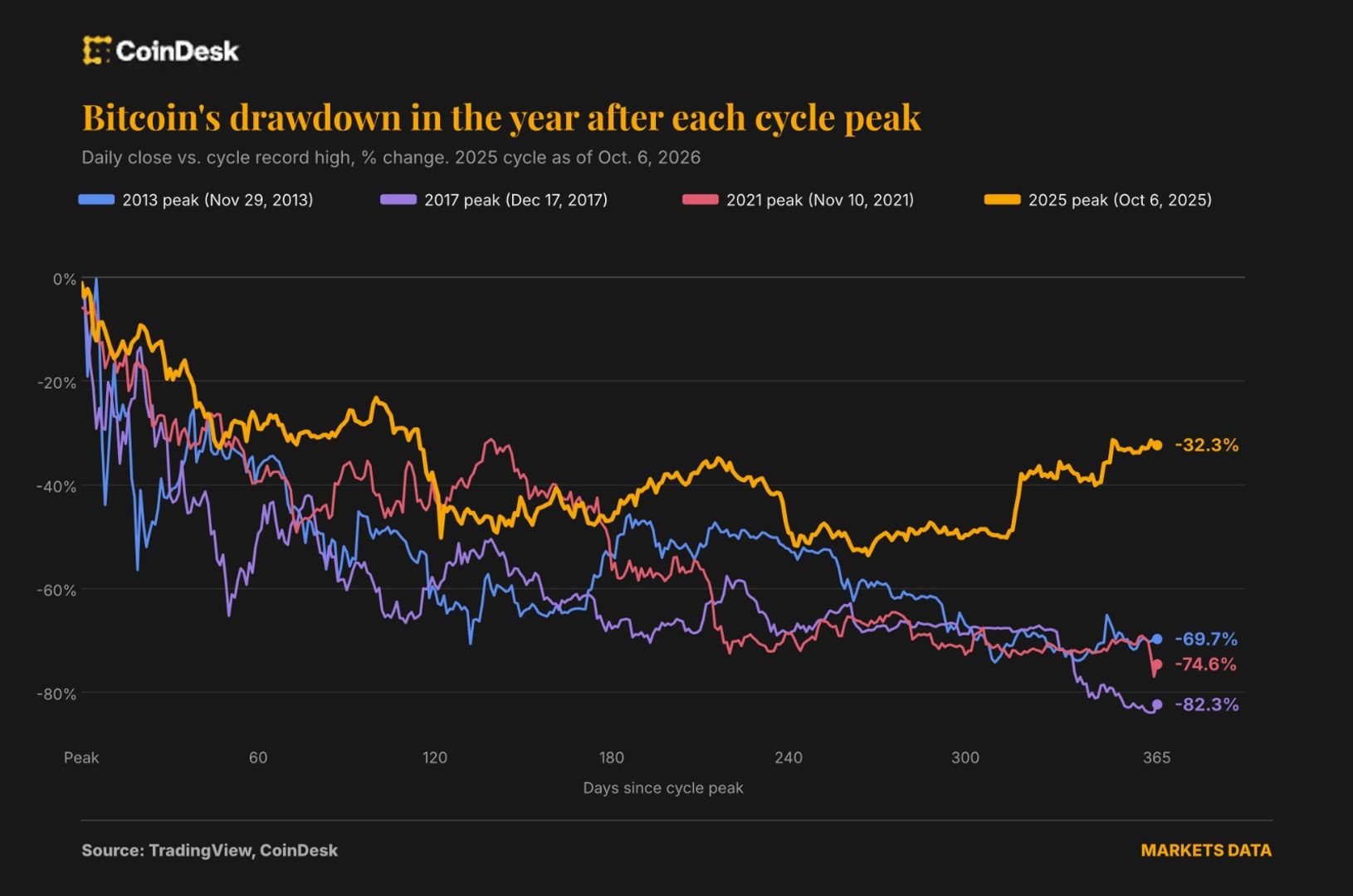
Bitcoin is down 32% at $85,453 a year after its record high above $126,000, against one-year losses of 70% to 82% in its three previous cycles. Analysts credit ETF allocators and thin leverage, forces that would also cap the rallies.
The Investor · Invest desk
Drafted by a language model from the sources cited here and checked against its claim ledger before publication. How we use AISend a correction
What happened
- Bitcoin's low came on June 30 just below $59,000, a drawdown of more than 53%, where past bear markets fell 77% to 85% from their highs.
- The trough arrived after about nine months; earlier cycles tended to bottom around the one-year mark or later, and the recovery since has been fast.
- Most leverage was unwound on Oct. 10, 2025, when a macro-driven sell-off set off more than $19 billion of liquidations across crypto derivatives markets.
- Bitcoin's volatility has declined steadily since U.S. spot ETFs debuted in early 2024, according to CoinDesk.
Compiled by The InvestorSomething wrong?How this is made
Why it matters
- decision Sizing a bitcoin position for a past-cycle crash now means planning for a further 66% fall from $85,453, a loss this cycle's buyers have not come near producing.
- cost If lower volatility also brings lower peaks, as Anderson argues, upside targets drawn from earlier cycles overstate what a holder should expect to collect.
- exposure Holders counting on ETF rebalancing to cushion falls depend on the same allocators whose withdrawals CoinDesk says drove this downturn.
Had this bear market matched the mildest of its predecessors, a 77% fall from the high [9], bitcoin would have bottomed near $29,000. Matching the harshest, 85%, would have meant about $19,000 [19]. Instead the price has risen about 45% from its June low [21].
Tim Sun, senior researcher at HashKey Group, puts as much weight on timing as on depth. "The most notable changes are the significantly shortened duration of the drawdown and the reduced time spent at the bottom," he told CoinDesk [11]. He tied it to the buyer base, saying buyers this cycle "increasingly stem from outside the crypto market, including ETFs, asset management giants, family offices, and even corporations" [2]. As a result, he said, "the market did not trigger the persistent negative feedback loops seen in the past" [4].
Griffin Ardern, co-founder of Primal Fund and a portfolio manager on its volatility desk, said ETF allocation money "rebalances to target weights" and "buys weakness by construction" [5]. He said leverage was cleared out right at the top and never properly came back [12]. "Hence nine months to grind out a 53% decline, rather than a few months of cascading liquidations taking it down 80%," Ardern said [13].
"As bitcoin evolves and more participants come to market, the realized volatility of the asset will decrease. This means shallower drawdowns and lower peaks," said Jeff Anderson, head of U.S. at market-making firm STS Digital [15]. Ardern's rule points the same way. Money that rebalances to a target weight buys bitcoin when it falls below that weight and, by the same rule, sells when it rises above it. In a sizing model the two effects pull against each other. A smaller expected loss supports a bigger position; a smaller expected peak supports a smaller one. Which wins depends on which tail compresses more, and the record has one post-ETF cycle to set against three earlier ones [7].
This could go differently in at least two ways. Leverage that Ardern says never properly came back can rebuild during a rally, so a later sell-off would again force liquidations. Allocators can also withdraw money instead of rebalancing toward their weights. CoinDesk describes this downturn as a macro-led reversal of the institutional ETF inflows that drove the 2023-25 rally [1]. Sun said it was largely caused by capital outflows after changes in the macroeconomic environment and in asset allocation [3]. I think the evidence supports a narrower range in both directions for this cycle, with ETF allocators as the likeliest reason. It does not establish a floor. CoinDesk's summary of the analysts' warnings adds that a shallow correction does not rule out sharper downside ahead [17].
What to watch
- A break below the June 30 low near $59,000 would mean a deeper bear market with a later trough, the shape of earlier cycles.
- Sustained U.S. spot ETF outflows during a falling market would show allocators cutting weights instead of rebalancing toward them.
- Rising leverage in crypto derivatives would remove the condition Ardern credits for this cycle's slow, shallow decline.