ScienceNot yet confirmed elsewhere1 publisher3 min readPublished
Bones from Scandinavian hearths and floors record injuries in 12 of nearly 200 people
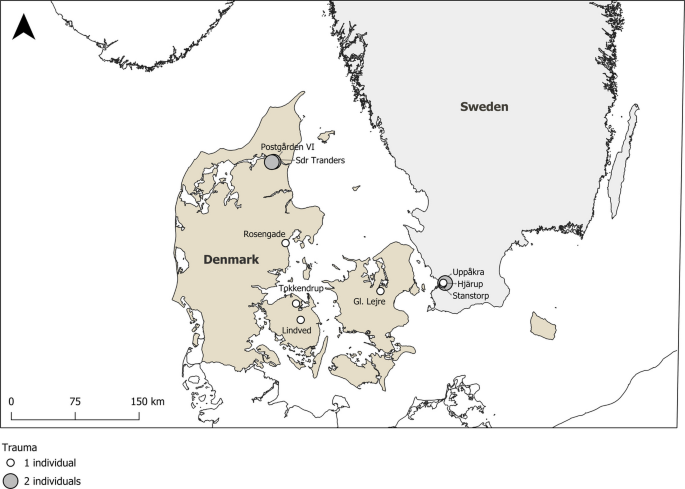
Researchers on the BODY-POLITICS project found traumatic injuries on 12 of nearly 200 people whose remains were left in Scandinavian homes over 1,500 years. At least eight were hurt deliberately, though who struck them, and where, the bones leave open.
The Scientist · Science desk
What happened
- The team re-examined bones in museum collections alongside earlier excavation reports, and published the results in the Journal of Archaeological Method and Theory.
- The individuals did not receive conventional cemetery burials, and some of their remains show cutting and other modifications made after death.
- Some remains also show fractures, dental problems and signs of chronic physical stress, which the authors link to long-term hardship.
Compiled by The ScientistSomething wrong?How this is made
Why it matters
- constraint Because the sample is drawn only from remains kept out of cemeteries, its roughly 6 percent injury rate cannot be applied to Iron and Viking Age Scandinavians as a whole.
- constraint Injured people found in settlements cannot yet be cited as evidence of household violence in particular while community fights, clashes between groups and ritual killing stay open as explanations.
- capability Museum collections and old excavation reports held enough material to build a trauma dataset, so other settlement archives can be rechecked for injuries and cut marks without new digging.
Nearly 200 individuals is the denominator, and the 12 injured people in it come to roughly 6 percent [2][16]. At least eight show deliberate violence [5]. That is about 4 percent of the set [17] and two-thirds or more of the injured [18]. These are small counts. The phys.org report on the study does not give a trauma rate for conventional cemeteries from the same periods, so there is no control against which to call 6 percent high or low.
The sample is selected by its own definition. Much of the evidence for violence in Iron and Viking Age Scandinavia comes from sagas and other written records, and from burial mounds and mass graves where skeletons show severe trauma [15]. This set comes from elsewhere. It is made of remains, whole or partial, placed in hearths and under floors [1] or in wells and feasting halls [10], from people who did not get a conventional cemetery burial [9]. The paper's title calls it "an atypical mortuary dataset" [11]. Whatever decided who ended up under a floor could also be linked to who had been hurt, so the group cannot stand in for the wider population.
The design is a re-reading of old material. Marianne Hem Eriksen and colleagues on the international BODY-POLITICS project [11][14] went back to bones held in museum collections and to earlier excavation reports [3], looking for injuries and for healing [4]. Four people carried multiple injuries picked up over their lives [6], a third of the injured [19]. One Viking Age man had survived three separate blows to the skull, plus fractures of the forearm and collarbone, before he died [6]. The opposite case is a skull fragment from a child aged 2 to 4, found beneath a floor, who may have suffered a weapon injury around the time of death [7].
The domestic setting records where the remains ended up. Where the injuries happened is an open question. The authors give several possible explanations, including violence within the home, fights in the local community, clashes between communities and ritual violence such as human sacrifice [20]. Some remains also show fractures, dental problems and signs of chronic physical stress [8], and the authors suggest some of these people lived with hardship and violence throughout their lives [12]. I think the bones support a narrower reading: people who had been hurt, sometimes more than once, were later handled and placed inside homes. Household violence is one of several explanations on the authors' list [20].
The firmest finding concerns what happened after death. Some remains show signs of cutting and other modification after death [9]. "Whatever the logic, these bodies were purposefully processed and transformed in and after death," the researchers said [13].
What to watch
- A trauma rate for conventional Iron and Viking Age cemetery populations from the same regions, set against the roughly 6 percent found in this settlement dataset.
- Further BODY-POLITICS results on how bodies were placed in domestic spaces, which could show whether injured people were singled out for that treatment.
Clarity's read
What the record supports and how the coverage leans. The claims behind it follow.
Reality
- Evidence55
- Adoption
- Insufficient
- Hype gap+15
- Incentives
- Insufficient
- Confidence50
Claim ledger
Ranked by verification strength, evidence, and original report placement.
- [1]
Fragmented bones and skull pieces were found in hearths, beneath floors and in other domestic settings in early Scandinavian settlement sites.
- [2]
The scientists identified 12 people with traumatic injuries out of a data set of nearly 200 individuals.
- [3]
In the study, published in the Journal of Archaeological Method and Theory, researchers examined bones held in museum collections alongside earlier excavation reports.
- [4]
The researchers were looking in particular for evidence of injuries and healing.
- [5]
Among the 12 people with traumatic injuries, at least eight show evidence of deliberate violence.
- [6]
Four individuals suffered multiple injuries over the course of their lives, including one Viking Age man who had survived three separate blows to his skull as well as fractures to his forearm and collarbone before his death.
- [7]
A skull fragment from a child aged 2 to 4 was found beneath a floor; he may have suffered a weapon injury around the time of his death.
- [8]
Some of the remains had fractures, dental problems and signs of chronic physical stress.
- [9]
After death, these people did not receive conventional burials in cemeteries; some of the remains showed signs of cutting and other modifications after death.
- [10]
People placed human bodies, or at least parts of them, in homes, wells and feasting halls.
- [11]
The paper is Marianne Hem Eriksen et al, 'Broken bodies in Domestic Spaces: Direct and Structural Violence in an Atypical Mortuary Dataset from Iron and Viking Age Scandinavia', Journal of Archaeological Method and Theory (2026).
- [12]
The study authors suggest that some of these people may have experienced ongoing hardship and violence throughout their lives.
- [13]
"Whatever the logic, these bodies were purposefully processed and transformed in and after death."
- [14]
A team from the BODY-POLITICS project, an international research initiative examining human remains found in settlement sites, examined human remains spanning 1,500 years found in nontraditional settings.
- [15]
Some evidence for violence in Iron and Viking Age Scandinavia comes from sagas and other written records, and from burial mounds and mass graves where skeletons bear signs of severe trauma.
- [16]
Twelve injured people out of nearly 200 is roughly 6 percent of the dataset (slightly above 6 percent, since the denominator is just under 200).
- [17]
At least eight individuals with deliberate violence out of nearly 200 is about 4 percent of the dataset.
- [18]
At least eight of the 12 injured people, two-thirds or more, show deliberate violence.
- [19]
Four of the 12 injured people, one third, had multiple injuries over their lives.
- [20]
The authors suggest several possible explanations for the injuries, including violence within the home, fights within the local community, clashes between different communities, or ritual violence such as human sacrifice.
Sources
1 independent publisher whose own reporting we read for this story.
- phys.orgBroken bones in ancient homes shed new light on Viking violence
1 article · October 9, 2026
Topics and entities
Follow any of these and your For You feed starts watching them — no settings page required.
Topics
- BioarchaeologyFollow
- Mortuary archaeologyFollow
- Viking Age ScandinaviaFollow
Entities
- BODY-POLITICSFollow
- Journal of Archaeological Method and TheoryFollow
- Marianne Hem EriksenFollow