Science1 publisherNot yet confirmed elsewhere2 min readPublished
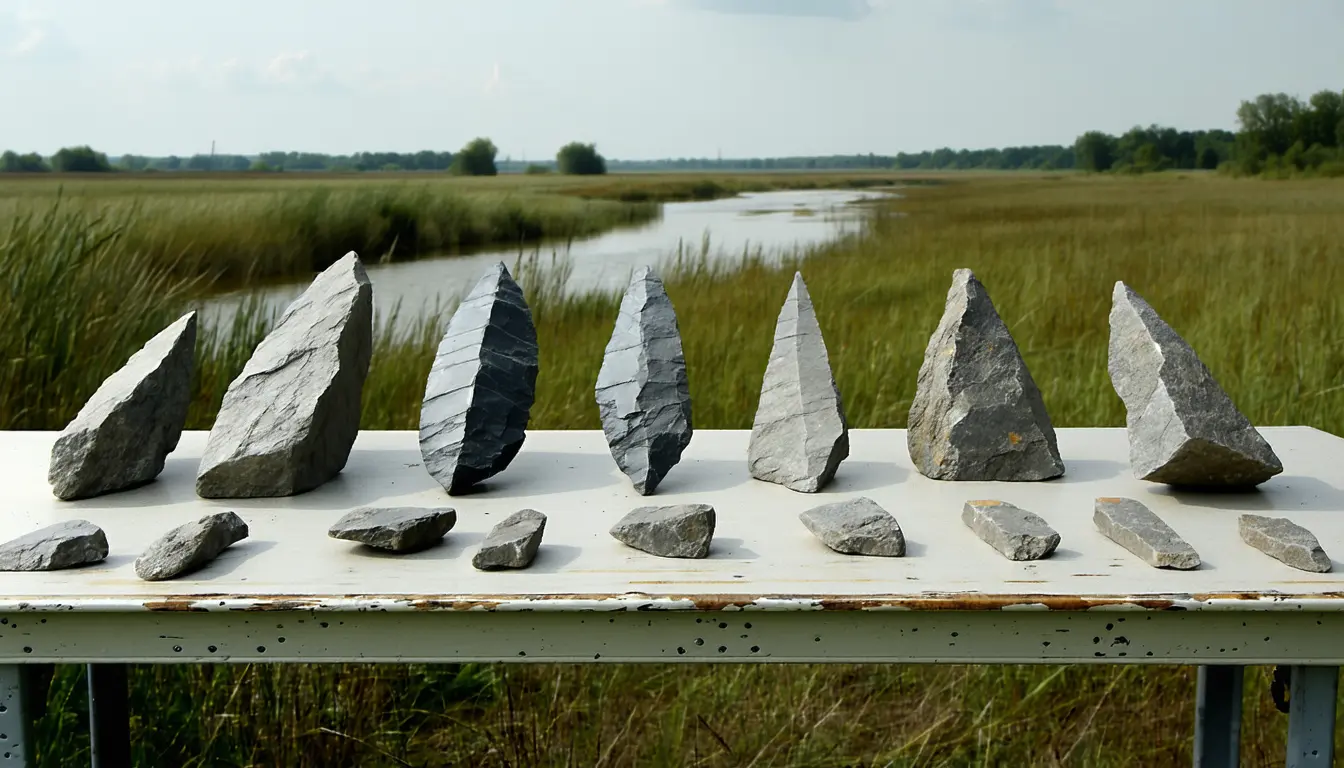
Wear on 500 Tennessee Valley spear points suggests Ice Age hunters learned where to find stone
Jesse Tune and Shane Miller's study of some 500 Tennessee Valley spear points finds Clovis hunters resharpened them more than their Cumberland successors. The pair read that thrift as caution by newcomers who did not yet know where to find good stone.
The Scientist · Science desk
What happened
- Clovis groups, thought to be among the region's first inhabitants, left their earliest evidence there around 13,200 years ago.
- Cumberland people arrived several hundred years later and inherited knowledge of where chert deposits and other resources lay.
- Cumberland points show repeated use, yet Tune said they were rarely broken beyond use by the time they were thrown away.
- The study, in the Journal of Archaeological Method and Theory, argues chipped stone points can show how people adapted to unfamiliar environments.
Compiled by The ScientistSomething wrong?How this is made
Why it matters
- capability Where few sites survive to excavate, large collections of found points can still be used to test how first settlers behaved, because resharpening and discard leave marks on the stone.
- constraint The points themselves supply the dating, and Tune claims only 'roughly the time period' from them, so the method can separate Clovis from Cumberland but is unlikely to order behavior finely within either group.
- precedent The reading turns a usable point in a discard pile into evidence of what its owner knew about the land, an interpretation that point collections from other regions can now be tested against.
The study relies on what the valley has plenty of. "There aren't that many archaeological sites for these people that we can dig, but what we have instead are lots and lots of points that people have found in this region," Miller said [10]. Tune described the team as trying "to see the rest of their behaviors through the lens of these spear points because that's what we have" [13].
Resharpening tells you something because the object was cheap. "Spear points were designed to be disposable objects, and that makes what the Clovis were doing interesting," Tune said [2]. Reworking a throwaway tool costs time and stone, so a hunter who does it has a reason. The authors tie that reason to how much a person could carry. "When you think about a people who are moving around a lot, understand that they didn't have any pack animals," Miller said [11]. He added: "You really don't want to be carrying around a bag of rocks, and so you're going to be judicious about balancing what you need versus what you can carry" [12].
On that account, a group unsure where the next chert deposit lies has reason to stretch the stone it already carries. A group that knows can drop a working point and make another. The researchers put the Cumberland discards in that second case, as evidence that the later hunters had learned where to resupply and were more comfortable in their surroundings [9]. I think the design suits the question. It compares one kind of object, in one region, across two populations, and the difference the authors care about is how long people had known the place [c2, c7].
The thing this doesn't tell you is how large the difference is. The phys.org account does not report how the roughly 500 points divide between Clovis and Cumberland, or what share of each shows resharpening [4]. Without those figures, "more likely" could mean a wide gap or a narrow one [1]. The inference is also correlational. Period tracks wear, and landscape knowledge is the explanation the authors offer to connect the two. The account itself says only that the Clovis resharpening possibly signals concern about managing resources [1]. Anything else that changed between the two groups over several hundred years would also leave marks on the same stone [7].
Tune takes the idea further than the points can. "There really is no difference between Ice Age hunter-gatherers and the people sending missions and rovers to Mars," he said [14]. The evidence under that sentence is resharpening and discard on stone points from one river valley [4].
What to watch
- The full paper's resharpening rates and the Clovis-Cumberland split of the roughly 500 points, which set how large the difference actually is.
- Whether excavated Clovis and Cumberland deposits with independent dates show the same shift from reworking points to discarding usable ones.
- Whether raw-material sourcing shows Clovis points drawing on more scattered or distant chert than Cumberland points, a direct test of the landscape-knowledge explanation.
Clarity's read
What the record supports and how the coverage leans. The claims behind it follow.
Reality
- Evidence45
- Adoption
- Insufficient
- Hype gap+25
- Incentives
- Insufficient
- Confidence40
Claim ledger
Ranked by verification strength, evidence, and original report placement.
- [1]
Tune and Miller found that Clovis groups were more likely to resharpen spearheads, possibly signaling that they were concerned about managing their resources.
ReportedSupportedSource: phys.org, describing the researchers' finding2 sources— create a free account to open themView cited source - [2]
"Spear points were designed to be disposable objects, and that makes what the Clovis were doing interesting."
ReportedSupportedSource: Jesse Tune, quoted by phys.org2 sources— create a free account to open themView cited source - [3]
A new study published in the Journal of Archaeological Method and Theory argues that chipped stone projectile points, among the few surviving traces of the Tennessee River Valley's earliest settlers, can indicate how humans adapted to unfamiliar environments.
- [4]
Jesse Tune, associate professor of anthropology at the University of Mississippi and director of its Center for Archaeological Research, and Shane Miller, assistant professor of anthropology at the University of Alabama, studied some 500 spear points recovered from the Tennessee River Valley region to learn about the Clovis and Cumberland people.
- [5]
The Clovis people are thought to be among the earliest inhabitants of the Tennessee River Valley region, with the earliest evidence of the group dated to around 13,200 years ago.
- [6]
Being in a new landscape meant the Clovis did not know where to find resources such as chert, a sedimentary rock ideal for making weapons.
- [7]
The Cumberland people came along several hundred years after the Clovis and inherited from their predecessors knowledge of where chert deposits and other resources were located.
- [8]
"When we look at the Cumberland points, we can see where they got the raw material, roughly the time period that they lived and that they've used the point multiple times. But (the point) was rarely completely broken to the point that it couldn't be used anymore."
- [9]
The researchers said that being more knowledgeable about the landscape allowed the Cumberland people to discard points that were still usable, evidence that they had learned where to gather new resources and were more comfortable in their surroundings.
- [10]
"There aren't that many archaeological sites for these people that we can dig, but what we have instead are lots and lots of points that people have found in this region."
- [11]
"When you think about a people who are moving around a lot, understand that they didn't have any pack animals."
- [12]
"You really don't want to be carrying around a bag of rocks, and so you're going to be judicious about balancing what you need versus what you can carry."
- [13]
"we're trying to see the rest of their behaviors through the lens of these spear points because that's what we have."
- [14]
"There really is no difference between Ice Age hunter-gatherers and the people sending missions and rovers to Mars."
ReportedInsufficientSource: Jesse Tune, quoted by phys.org2 sources— create a free account to open themView cited source
Sources
1 independent publisher whose own reporting we read for this story.
- phys.orgAncient spearheads reveal how Ice Age humans learned the land
1 article · September 28, 2026
Topics and entities
Follow any of these and your For You feed starts watching them — no settings page required.
Topics
- Paleoindian peoples of the AmericasFollow
- ArchaeologyFollow