Science1 publisher2 min readPublished
Researchers read a long echo in an Etruscan tomb as evidence of sensory design
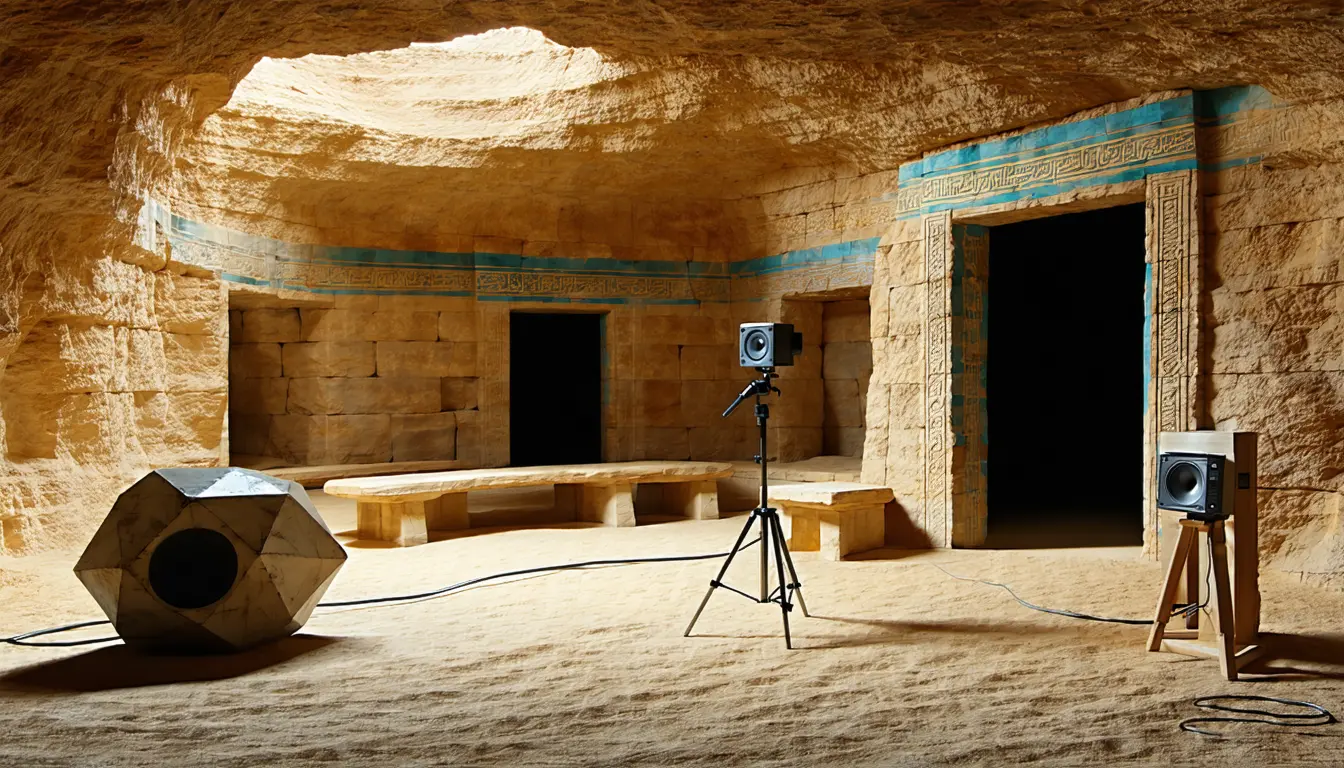
Researchers say two fifth-century BC Etruscan tombs were built for sensory effect, citing exceptionally long reverberation in the Tomb of the Blue Demons. Intent stays an interpretation until the team publishes reverberation times measured against comparable chambers.
The Scientist · Science desk
What happened
- The team combined acoustic, visual and AI methods, drawing on Oxford's Sounds of Silence soundscape project and Duke University's Neuroartifact project on how artifacts affect cognition.
- The authors say the Blue Demons tomb induces perceptual disorientation, while the Tomb of the Rooster directs visual attention through what they call the architectural discipline of gaze.
- According to the researchers, the painted tombs were built for Etruscans of higher socioeconomic and political status.
- Their reconstructions support the idea that some painted tombs were reused for family or clan rituals and may have stayed open throughout the year.
Compiled by The ScientistSomething wrong?How this is made
Why it matters
- capability Measuring sound alongside images lets archaeologists describe a painted tomb as visitors experienced it, where earlier work mostly analysed the paintings as flat pictures.
- constraint With the echo reported only in words, the study cannot yet distinguish a builder's acoustic choice from a by-product of cutting a room underground.
- precedent If the reuse reading holds, how a tomb sounded becomes part of Etruscan ritual history even where nobody engineered the echo.
Of the two chambers, only the Blue Demons tomb is described in acoustic terms [1]. The authors write of "the exceptionally long reverberation and echoes inside the Blue Demon tomb" and say those effects gave the visit "a dramatic soundtrack" [4]. From there they make a larger claim. The tombs, they write, were built "not simply to house the dead, but to affect the living through a sensorily immersive environment similar to a modern 3D film experience" [6].
The account on phys.org is written by the researchers themselves [13]. It describes the echo in words only, and does not report measured reverberation times, a comparison chamber, or what the AI models contributed [7].
In my view the published evidence supports atmosphere, and design intent is still a hypothesis. A long echo in an underground chamber could be something the builders chose. It could also be what they got by cutting a room into rock, with the painters then working inside it. Separating the two needs a control: chambers of similar size and shape, cut without paintings or for other purposes, measured the same way. If the Blue Demons tomb holds sound far longer than those, intent becomes a fair inference. If it behaves like the rest, the echo belongs to the room type. The authors also pair the echo with a tomb they say induces perceptual disorientation [5]. That is a co-occurrence in a single room, and one room cannot show that either feature was planned for the other.
The authors are alert to one modern distortion. One of them, identified in the piece as Jacqueline, wrote that on her first visit the paintings "seemed to confront me wherever I turned" [15]. "My experience, though, was shaped by modern LED lighting," she wrote [8]. Ancient viewers would have relied on beeswax and tallow candles, torches and incense burners, and the dim light would have constrained how they moved through the tomb [9]. Any acoustic reading taken in the chamber today raises the same question about conditions.
The reuse reading is where the sensory approach adds most, because it puts living visitors back in these rooms over and over [10]. Archaeologists have tended to analyse the paintings as two-dimensional images [12]. The authors say theirs is the first study to treat Etruria's underground funerary spaces as "transitional spaces" between life and death [11].
What to watch
- Publication of the full paper's methods, including reverberation times for the Blue Demons chamber and what the AI modelling was used for.
- Whether the Rooster tomb, described so far in visual terms, turns out to share the Blue Demons chamber's long reverberation or to differ from it.