ScienceNot yet confirmed elsewhere1 publisher2 min readPublished
Halzen's physics Nobel for IceCube follows a century of Antarctic work aimed at space
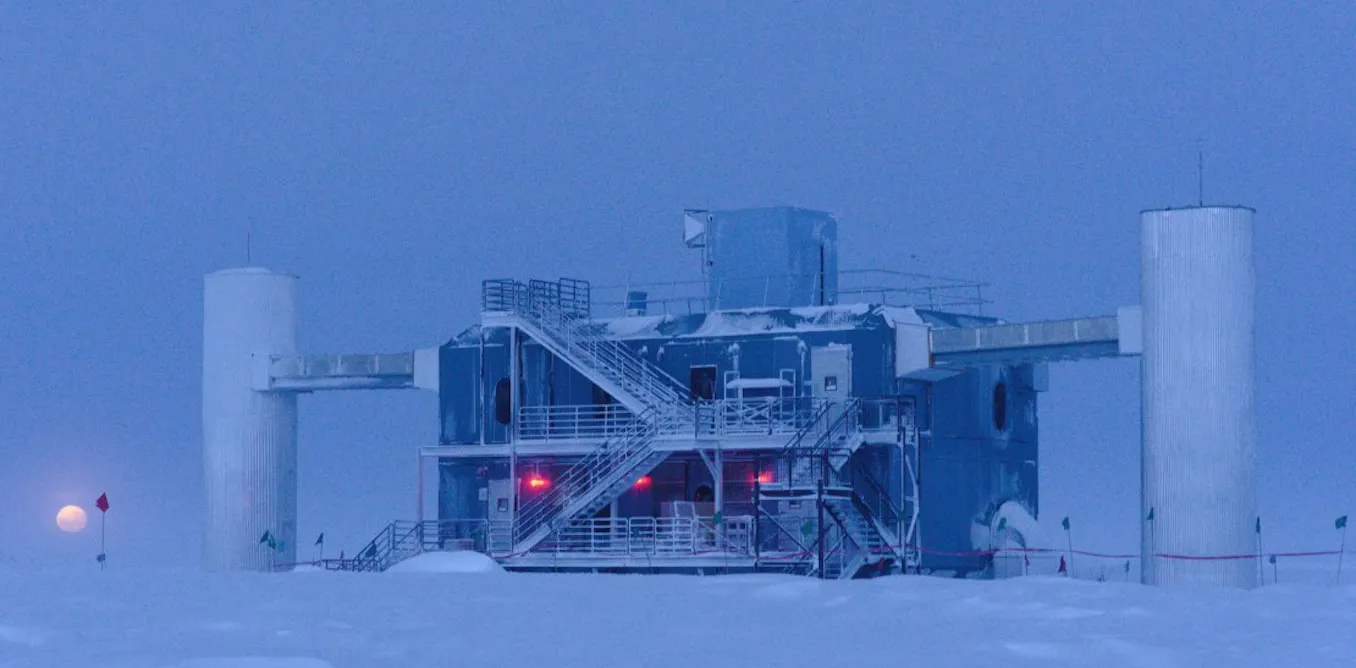
Francis Halzen won the 2026 physics Nobel for IceCube's discovery of high-energy neutrinos of astrophysical origin. A Conversation essay uses the award to review how scientists have used Antarctica as a stand-in for other worlds and as a place to look out from.
The Scientist · Science desk
Key figures: 125 years separate Louis Bernacchi's 1901 comparison of Antarctica to the Moon and the 2026 award; a Japanese expedition found nine meteorites in the Yamato Mountains in 1969; William Cassidy set up US meteorite searches in Antarctica in 1976.
| Figure | Value | Note | Claim |
|---|---|---|---|
| Bernacchi's 1901 Moon comparison to the 2026 award | 125 years | 16 | |
| Yamato meteorite find | 1,969 year | 7 | |
| US meteorite search set up | 1,976 year | 10 |
What happened
- Louis Bernacchi, an Australian physicist, compared Antarctica to the Moon in 1901, describing "a dead silent world above you, and a dead silent world at your feet."
- Before the Viking mission to Mars in 1975-76, several microbiologists worked in the McMurdo Dry Valleys, convinced the region closely resembled Mars.
- Modern meteorite science in Antarctica dates to the 1970s, after a Japanese expedition found nine meteorites in the Yamato Mountains in 1969.
- Blue-ice areas make up about 1% of Antarctica's surface ice and are among the best places on Earth to look for meteorites.
Why it matters
- contradiction Spacesuit, robotics and food-production tests continue in Antarctica while critics say its conditions are too different from space, so the value of the stand-in is still disputed.
- capability Meteorite recovery gave researchers Moon and Mars material without a launch, a different and more direct kind of evidence than analog testing.
- constraint The citation names the instrument and the neutrino discovery, so the tie between the prize and Antarctica's stand-in history is the essay's framing and cannot be treated as the committee's.
The essay folds three uses of the continent into one story, and the evidence behind each is different in kind.
The first use is analogy. Ernst Stuhlinger said in 1968 that NASA officials traveled to Antarctica "because this was as close to lunar conditions as we could get here on Earth" [3]. The logic is still applied: scientists test spacesuits, robotics and food production facilities there, hoping that success in Antarctica will translate into success in space [5]. Critics have said the conditions are too different for Antarctica to serve as a stand-in [17]. We think this is the weakest of the three claims, because it depends on results transferring, and that is exactly what the critics dispute.
The second use is firmer evidence, because meteorites are physical samples. Blue-ice areas hold them in unusual concentration. Strong katabatic winds strip the snow, dark rocks stand out against pale ice, and meteorites either land on the surface or emerge from within the ice after glacial transport [9]. The program recovered the first recognized meteorite from the Moon and one from Mars [11]. The Mars meteorite set off a media firestorm in the mid-1990s, when some scientists suggested it bore evidence of fossilized microbial life [12]. Ursula Marvin, a member of one of the program's earliest expeditions, put the appeal this way: the yearly trips were "an elegant means of significantly extending the range of planetary samples" [13].
The third use, observing, is where the prize sits. The essay says Antarctica is one of the best places on Earth from which to observe the universe [14]. It calls the award a reminder that for more than a century scientists have treated Antarctic environments as windows onto worlds beyond Earth [15]. The citation itself names the IceCube Neutrino Observatory and the discovery of high-energy neutrinos of astrophysical origin [1]. We'd treat the link between the prize and the stand-in tradition as thematic: the essay supplies it, and the citation does not.
The thing this doesn't tell you is how the detector works or what the neutrino result adds. The essay text breaks off before it reaches the telescopes.
Counting from Bernacchi's 1901 comparison, the 2026 award comes 125 years later [16]. The idea had reached treaty law by 1967, when the Outer Space Treaty was modeled on the 1959 Antarctic Treaty [6].
What to watch
- Any measured comparison of Antarctic analog-test results with performance in space, which would settle the critics' objection one way or the other.
- The committee's scientific background on the award, which would show whether the continent figures in its rationale at all.
Clarity's read
What the record supports and how the coverage leans. The claims behind it follow.
Reality
- Evidence68
- Adoption
- Insufficient
- Hype gap+5
- Incentives
- Insufficient
- Confidence60
Claim ledger
Ranked by verification strength, evidence, and original report placement.
- [1]
Francis Halzen was awarded the 2026 Nobel Prize in physics "for decisive contributions to the IceCube Neutrino Observatory and the discovery of high-energy neutrinos of astrophysical origin."
- [2]
In 1901 the Australian physicist Louis Bernacchi compared being in Antarctica to what he thought it would be like on the Moon: "a dead silent world above you, and a dead silent world at your feet."
- [3]
Ernst Stuhlinger said in 1968 that NASA officials traveled to the Antarctic "because this was as close to lunar conditions as we could get here on Earth."
- [4]
In preparation for the Viking mission to Mars in 1975-76, several microbiologists conducted research in the McMurdo Dry Valleys, convinced that the region closely resembled Mars.
- [5]
Scientists continue to test technologies created for space exploration in the Antarctic, including spacesuits, robotics and food production facilities, hoping success there will translate into success in the more extreme environments of space.
- [6]
The Outer Space Treaty of 1967 was modeled after the 1959 Antarctic Treaty.
- [7]
Modern meteorite science in Antarctica dates to the 1970s, following the 10th Japanese Antarctic Research Expedition's 1969 discovery of nine meteorites in the Yamato Mountains.
- [8]
Antarctica's blue-ice areas comprise about 1% of its surface ice and are among the best places on Earth to look for meteorites.
- [9]
In blue-ice areas strong katabatic winds remove snow, exposing hard translucent ice; dark meteorites contrast with the light-blue ice, and the areas hold unusually high concentrations of meteorites that either land on the surface or emerge from within the ice after glacial transport.
- [10]
In 1976 geologist William Cassidy established the United States' formal efforts to search for meteorites in Antarctica.
- [11]
The US Antarctic meteorite effort yielded the first recognized meteorite from the Moon and a meteorite from Mars.
- [12]
The Mars meteorite sparked a media firestorm in the mid-1990s when some scientists suggested that it bore evidence of fossilized microbial life.
- [13]
Geologist Ursula Marvin, a member of one of the program's earliest expeditions, wrote of "an elegant means of significantly extending the range of planetary samples by making our yearly expeditions to Antarctica."
- [14]
Antarctica is one of the best places on Earth from which to observe the universe.
- [15]
The essay says the Nobel award was a reminder that for more than a century scientists have treated Antarctica's environments as windows onto worlds beyond Earth.
- [16]
The 2026 award comes 125 years after Bernacchi's 1901 comparison of Antarctica to the Moon.
- [17]
Some critics have said Antarctica's conditions are too different to serve as a terrestrial stand-in for outer space.
Sources
1 independent publisher whose own reporting we read for this story.
- theconversation.comPhysics Nobel highlights Antarctica’s role in exploring the cosmos
1 article · October 12, 2026
Topics and entities
Follow any of these and your For You feed starts watching them — no settings page required.
Topics
Entities
- IceCube Neutrino ObservatoryFollow
- Francis HalzenFollow
- 1967 Outer Space TreatyFollow
- Antarctic TreatyFollow
- William CassidyFollow
- Louis BernacchiFollow