Science1 publisherNot yet confirmed elsewhere2 min readPublished
Francis Halzen wins the 2026 physics Nobel for catching deep-space neutrinos in South Pole ice
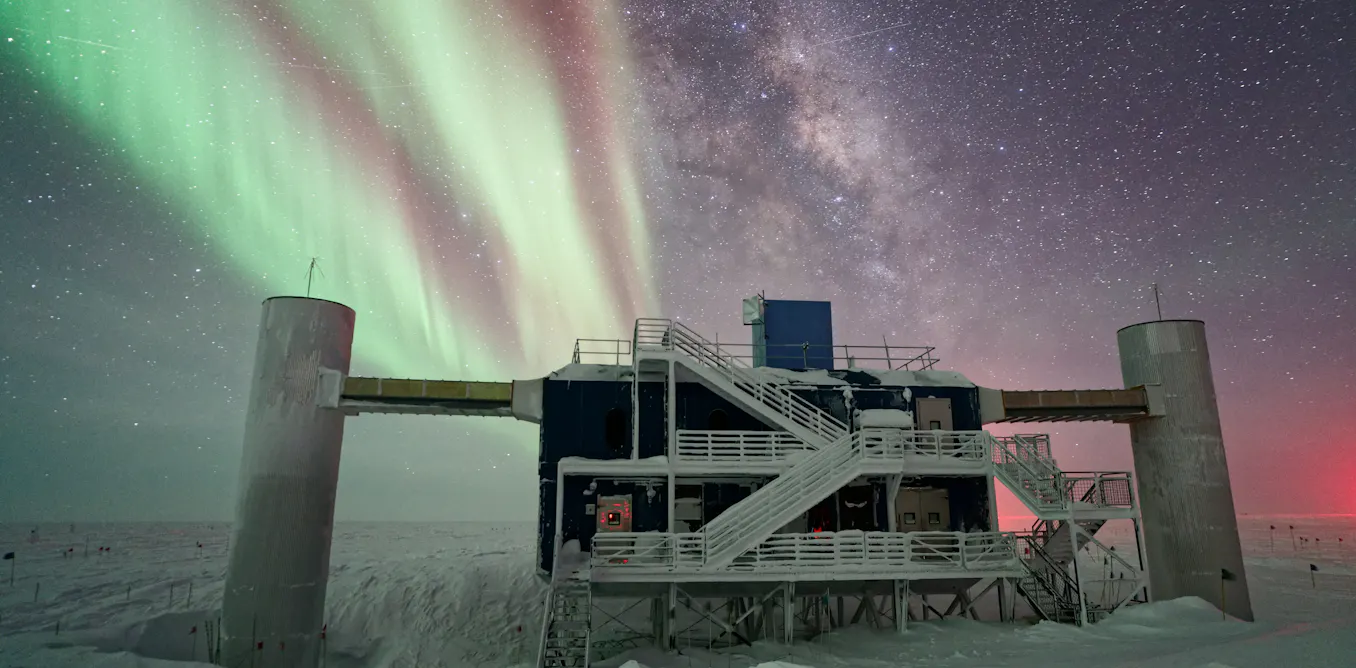
Francis Halzen won the 2026 physics Nobel for IceCube, a cubic kilometre of South Pole ice that caught neutrinos from beyond the solar system. Earlier neutrino prizes stopped at the Sun. This one rewards pointing the particle at the wider sky.
The Scientist · Science desk
What happened
- Halzen proposed a neutrino telescope in Antarctic ice in 1988, and the international team that built IceCube began construction in 2005.
- IceCube registers a neutrino when one of the rare particles strikes a proton or neutron in the ice, and the resulting particle shower reveals its direction, energy and flavor.
- Magnetic fields in space deflect cosmic rays, so the direction they arrive from at Earth does not show where they were made.
- Ski-equipped cargo aircraft can reach the pole for only about four months a year, and two winter-over scientists look after the detector for the rest of it.
Compiled by The ScientistSomething wrong?How this is made
Why it matters
- capability Neutrino arrival directions give astronomers a way to search for the sources of cosmic rays, whose own paths are scrambled before they reach Earth.
- constraint The prize certifies that deep-space neutrinos have been detected; tying cosmic rays to particular objects is a separate claim the data still has to support.
- precedent Detecting astrophysical neutrinos now sits alongside the reactor, atmospheric and solar neutrino discoveries as prize-level physics.
Neutrinos interact so rarely that every advance in the field has needed a bigger target. The 1950s discovery used 10 tons of liquid next to a reactor core [6]. The Sudbury Neutrino Observatory used 1 kiloton of heavy water [9], and Super-Kamiokande holds 50 kilotons of ultrapure water [8]. IceCube instruments a cubic kilometre of ice, about a billion tons [13]. By those figures it has roughly 20,000 times Super-Kamiokande's mass and about 100 million times the mass of the reactor experiment [d1, d3]. A bigger target only raises the odds of catching a neutrino; for astronomy, the number actually recorded matters more. The Conversation accounts do not say how many astrophysical neutrinos IceCube has recorded, or at what energies.
Direction is why the detection counts as astronomy. More than 10,000 high-energy particles from space hit each square metre of Earth's atmosphere every second, and some carry more than a million times the energy of protons in CERN's Large Hadron Collider [15]. Those cosmic rays arrive bent. So the IceCube team looks for neutrinos instead, since they should be produced wherever cosmic rays are accelerated [17]. "One by one, we build up a picture of the sky as it shines in neutrinos, rather than starlight," an astrophysicist on the IceCube team wrote in The Conversation [18].
IceCube has not yet shown which objects do the accelerating. Halzen's prize is for leading IceCube and for discovering high-energy neutrinos of astrophysical origin [3]. IceCube was the first experiment to find neutrinos coming from deep space [10]. Yet the same team member gave the cosmic-ray section of the account a cautious heading: neutrinos "hint at" where cosmic rays come from [22]. In my view that verb is the right one. A neutrino arriving from one patch of sky shows that something there made it. Saying which class of object launches cosmic rays is a second claim, and it needs its own evidence.
IceCube took decades. From proposal to prize was 38 years [27], and the detector has been under construction or in operation for 21 of them [28]. The site was chosen because the South Pole station sits on nearly 3 kilometres of what the team calls the purest, clearest ice in the world [19]. The detector is mostly run remotely, but replacing electronics and installing new hardware still takes people on the ice [21].
What to watch
- A published count of IceCube's astrophysical neutrino events, with their energies, would show how much of the sky the detector has actually mapped.
- A neutrino excess tied to a specific object or class of objects would turn the cosmic-ray question from a hint into an answer.
- Results from the new hardware the team installs during the summer flight window would show whether the detector's reach is growing.