BuildNot yet confirmed elsewhere1 publisher2 min readPublished
Quantinuum's Helios-1 keeps error-correction circuits usable at up to 91 data qubits in a Julich benchmark
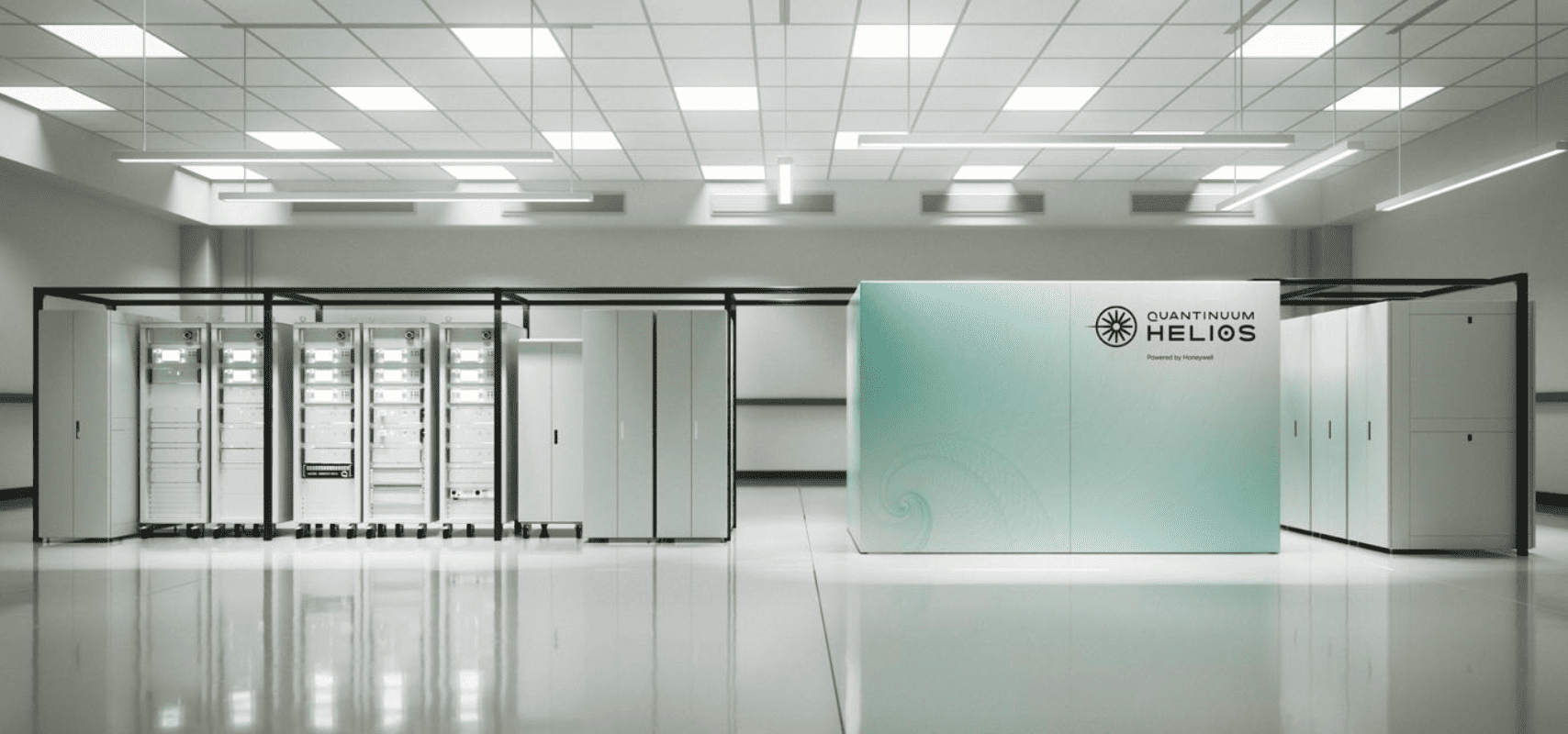
Quantinuum's Helios-1 kept useful output in error-correction circuits of up to 91 data qubits, a Julich preprint benchmarking 10 processors found. Its benchmark needed only 50 runs per circuit to detect gains, a cheap check before committing to a full error-correction experiment.
The Engineer · Build desk
What happened
- IBM processors showed effective error rates roughly ten times higher when circuits included mid-computation measurements and the actions that follow them.
- Quantinuum's processors added measurement errors about as large as the errors from their own two-qubit operations.
- Helios-1 beat every other processor in the comparison at every circuit depth tested in a 25-data-qubit surface-code test.
- A validation run on IBM's Phoenix chip found that regions scoring better on the benchmark generally stored an error-corrected quantum state better.
Why it matters
- constraint Running the operation patterns at 91 data qubits is a precondition for error correction at that size, and the findings do not yet confirm error correction working there, so that result is still to come.
- constraint The link between benchmark score and stored error-corrected states has been reported on one IBM chip, so Helios-1's benchmark lead does not yet predict how well it would hold a logical state.
- decision Teams with a large measurement penalty can use a short benchmark run to test whether rescheduling operations or moving work to more reliable chip regions improves performance.
The numbers come from a preprint by J. A. Montanez-Barrera and Kristel Michielsen of Germany's Julich Supercomputing Centre, as summarised on dev.to [14]. Their test is differential. They run one task twice: once with measurements taken during the computation and the actions that follow them, once with those steps removed [2]. The gap between the two error rates is what measuring costs. I think that is the right design. Whatever the two versions share drops out, and the benchmark runs before anyone spends time on experiments with protected quantum information [1].
Error correction cannot skip measurement. It is how the computer spots signs of an error and steers the correction [3]. The checks have to repeat, and the processor has to run them without damaging the information they protect [10]. The same checks can add errors of their own, disturb neighbouring qubits, or leave other qubits waiting [12].
The 50-run figure holds where the gaps are wide. In the 25-qubit surface-code comparison, each data point rested on 50 executions, and Helios-1's margin ran two to four standard deviations per point [18]. The 30-qubit chain comparison is where 50 runs were not enough. Helios-1 posted a lower estimated error rate there, but the uncertainty was too large to call it an improvement [19]. For 50 runs to settle another lab's comparison, the chips in it have to differ by roughly as much as the 25-qubit candidates did [21].
The larger runs reached 81 data qubits on surface-code layouts, 91 on triangular color codes and 48 on bivariate-bicycle codes [4]. The bivariate-bicycle family is designed to cut the resources error correction needs [5]. The 91-qubit run has about 3.6 times the data qubits of the 25-qubit head-to-head test [20]. The summary presents the larger runs as Helios-1 results and does not report the IBM or IQM chips at those sizes [11][13].
What to watch
- A logical-memory experiment on Helios-1 at 81 to 91 data qubits that shows logical errors falling, which the current findings do not yet confirm.
- Whether the Phoenix result, where benchmark score tracked error-corrected state storage, is reproduced on Quantinuum or IQM hardware.
- Whether operation-scheduling changes on IBM processors shrink the measurement penalty on this benchmark.
Clarity's read
What the record supports and how the coverage leans. The claims behind it follow.
Reality
- Evidence50
- Adoption
- Insufficient
- Hype gap+20
- Incentives
- Insufficient
- Confidence45
Claim ledger
Ranked by verification strength, evidence, and original report placement.
- [1]
The researchers devised a benchmark of how well quantum computers execute the foundational operations of error correction, run before full-scale experiments with protected quantum information.
- [2]
To quantify the extra error from intermediate measurements, the researchers ran two versions of the same task: one with measurements during computation and their subsequent actions, and one without these measurement-based steps.
- [3]
Intermediate measurements are indispensable for quantum error correction, letting a computer detect signs of errors and guide corrective operations.
- [4]
The larger code-based experiments reached 81 data qubits for surface-code structures, 91 for triangular color-code structures and 48 for bivariate-bicycle structures.
- [5]
The bivariate-bicycle family is designed to minimize the resources needed for error correction.
- [6]
The findings do not yet confirm successful error correction at these scales.
- [7]
A separate validation test on IBM's Phoenix processor found that regions that performed better on the benchmark generally performed better when storing an error-corrected quantum state.
- [8]
The results suggest the benchmark can evaluate hardware enhancements, pinpoint more reliable sections of a chip, and determine whether changes to operation scheduling improve performance.
- [9]
Researchers needed only 50 test runs per circuit to detect performance improvements.
- [10]
Quantum error correction requires repeated checks, and a processor must perform them while safeguarding the information it aims to protect.
- [11]
Helios-1 maintained meaningful results, preserving useful output, in larger-scale tests involving up to 91 data qubits structured around three families of error-correction codes.
ReportedSupportedSource: dev.to summary of the preprint2 sources— create a free account to open themView cited source - [12]
Intermediate measurement checks can introduce new errors, disturb adjacent qubits, or cause delays for other qubits awaiting processing.
- [13]
The study, posted on the arXiv preprint server, compared 10 processors from Quantinuum, IBM and IQM.
- [14]
The study was conducted by J. A. Montanez-Barrera and Kristel Michielsen of Germany's Julich Supercomputing Centre; Michielsen is also affiliated with the University of Cologne.
- [15]
On the IBM processors tested, versions with measurements showed effective error rates roughly ten times higher than the versions without them.
- [16]
On Quantinuum's processors, the additional errors from measurements were comparable in magnitude to those from two-qubit operations.
- [17]
In surface-code-based tests with 25 data qubits, Helios-1 outperformed the other processors at every circuit depth evaluated in the comparison.
- [18]
In the 25-data-qubit comparison, the differences amounted to two to four standard deviations per data point, based on 50 executions for each point.
- [19]
A comparison with 30-qubit chains showed a similar but less definitive trend: Helios-1 recorded a lower estimated error rate, but the uncertainty was too large to conclude an improvement from that measurement alone.
- [20]
The 91-data-qubit color-code run used about 3.6 times as many data qubits as the 25-data-qubit head-to-head surface-code test.
- [21]
Fifty runs per point resolved gaps of two to four standard deviations at 25 data qubits but not the 30-qubit chain gap, so the 50-run figure applies to comparisons with gaps of similar size.
Sources
1 independent publisher whose own reporting we read for this story.
- dev.toQuantinuum Quantum Processors Excel in Error Correction Study
1 article · October 8, 2026
Topics and entities
Follow any of these and your For You feed starts watching them — no settings page required.
Topics
- Quantum computing benchmarksFollow
- Quantum Error CorrectionFollow
- Quantum HardwareFollow