Science2 publishers3 min readPublished
Sandia scores the best quantum hardware 137,000 times short of breaking RSA-2048
The Sandia-led QUOPS benchmark rates a quantum computer by the largest useful circuit it can finish and how fast it finishes it. Across Google, IBM and Quantinuum machines the best score was 1,824, against a chemistry target of 250 million.
The Scientist · Science desk
What happened
- Sandia National Laboratories led a team that built QUOPS, a benchmark that measures the largest computationally relevant circuit a quantum computer can successfully run and the speed at which it completes those operations.
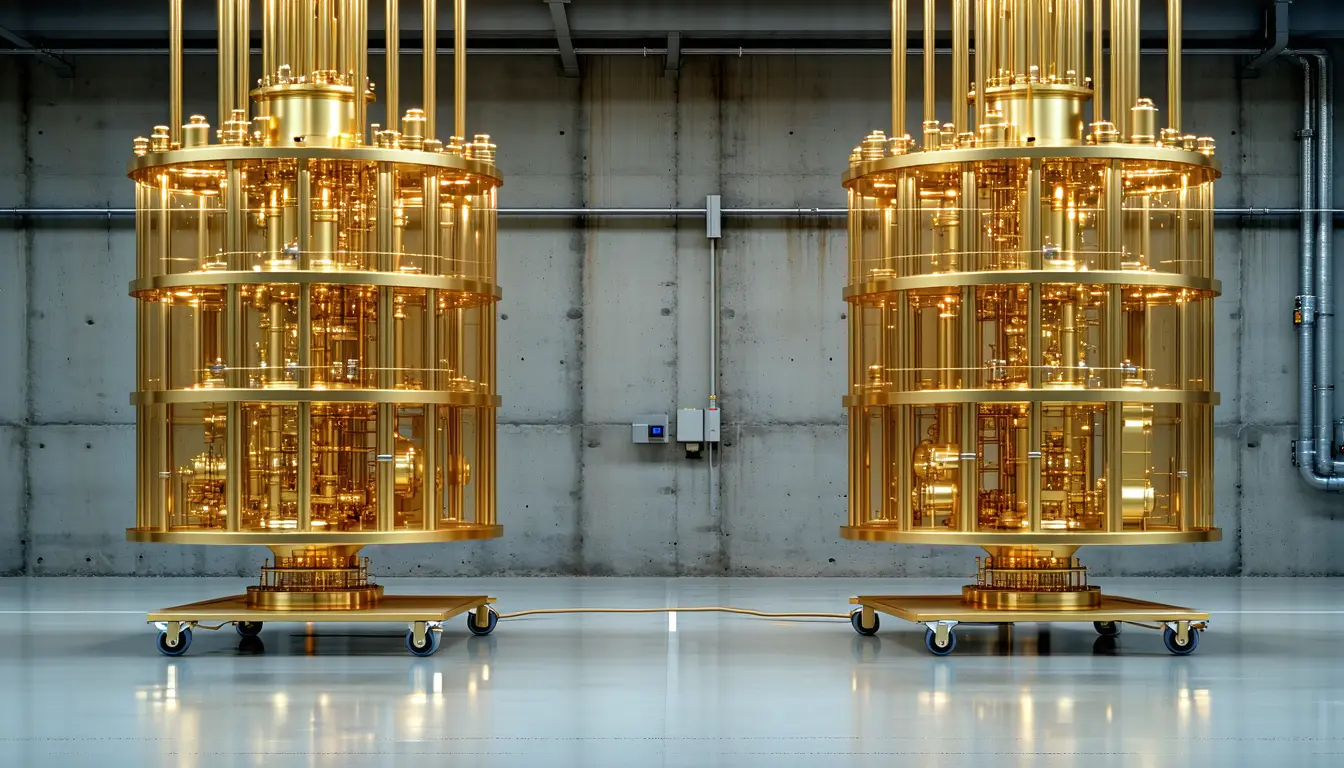
- Quantinuum's Helios-1 trapped-ion processor ran the largest calculations, scoring more than 1,500 QUOPS on the strength of a layout in which any qubit can talk to any other, though moving the ions makes it slow.
- Google's and IBM's superconducting processors, whose qubits sit in rigid grids, were capped near 200 QUOPS but ran much faster, with Google's Willow handling 20 million operations per second.
- Breaking RSA 2048 or modeling complex molecules would take roughly 250 million to 340 million QUOPS, and the highest score any physical hardware reached was 1,824.
Compiled by The ScientistSomething wrong?How this is made
Why it matters
- cost Error correction costs capability: on the same Quantinuum hardware, the fault-tolerant configuration ran circuits more than 37 times smaller, even though researchers call that design route the only viable one.
- constraint The requirement figures on the record are for cryptanalysis and FeMoco-class chemistry. Nobody has worked out the equivalent number for a bank pricing financial risk or a shipper optimising logistics.
- decision Procurement conversations can move off qubit counts and onto two numbers, a size score and a rate, with trapped-ion and superconducting machines landing on opposite sides of them.
- contradiction Nvidia, which collaborated on the work, treats the score as a reality check, while Mauerer says the benchmark cannot capture what quantum compute power really is, so its own users disagree about what a QUOPS number settles.
Error correction costs capability today, and the paper shows how much. Run as a fault-tolerant machine, one that catches and corrects its own errors, Helios-1 scored about 40 QUOPS, more than 37 times below what the same hardware managed with plain physical qubits [3]. Adding qubits makes a machine more error-prone, and researchers think error-correcting designs are the only viable future [18].
The distances to the useful targets are far larger. The low end of the requirement for breaking RSA-2048 or modeling a molecule like FeMoco, which is central to nitrogen fixing [16], is 250 million QUOPS [6]. The best physical-hardware result in the paper falls short of that by a factor of about 137,000 [1], and by about 186,000 against the top of the requirement range [2]. The fault-tolerant configuration is short by roughly 6.25 million [4]. Sandia's authors wrote that "Computational capability must grow by 5 orders of magnitude, motivating fault-tolerant approaches" [9]. Proctor told New Scientist that the turning point arrives when logical qubits reach higher QUOPS scores than ordinary qubits, after which the goal is matching those scores to useful algorithms [19].
The comparison is the part a buyer would use. An algorithm gets a QUOPS score too, and if the algorithm's score is larger than the machine's, the computation will not work; if the machine's score is comparable or larger, it ought to be useful for that problem [14]. Phys.org reported that no common scale for comparing different systems existed before this [24]. The score comes from randomized patterns of qubit operations that stand in for circuits used in some real scientific calculations, not from any customer's workload [3]. Requirement figures on the record cover cryptography and molecular chemistry [6]. Phys.org lists financial risk and logistics optimization among the problems these machines are being built for [11]. Neither report says what those problems would require.
The two figures do not rank the machines the same way. Helios-1's ions can each interact with any other, which is what let it run the largest circuits, and transporting those ions is what makes it slow [4]. Google and IBM fix their qubits in rigid grids. The grids restrict communication, cap the size score near 200 and make the machines fast [5].
The work is a preprint by Timothy Proctor and colleagues, posted to arXiv [10]. Nvidia collaborated on it, and Sam Stanwyck there described the result as a reality check [20]. Wolfgang Mauerer at the Technical University of Applied Sciences Regensburg said "These kinds of benchmarks are very useful at the moment" [21], and he also said "What quantum compute power really is, that is not yet fully understood, and that cannot be captured in the benchmark" [22].
What to watch
- Whether the 250 million to 340 million QUOPS requirement estimates survive peer review of the arXiv preprint.
- Whether Google, IBM and Quantinuum begin publishing QUOPS scores and rates for their own machines.
- Mauerer's extension: QUOPS scores for machines built on qubit types other than trapped ions and superconducting circuits.