Science1 publisherNot yet confirmed elsewhere3 min readPublished
Shotgun DNA delivery screens millions of metabolic pathways in mammalian cells at once
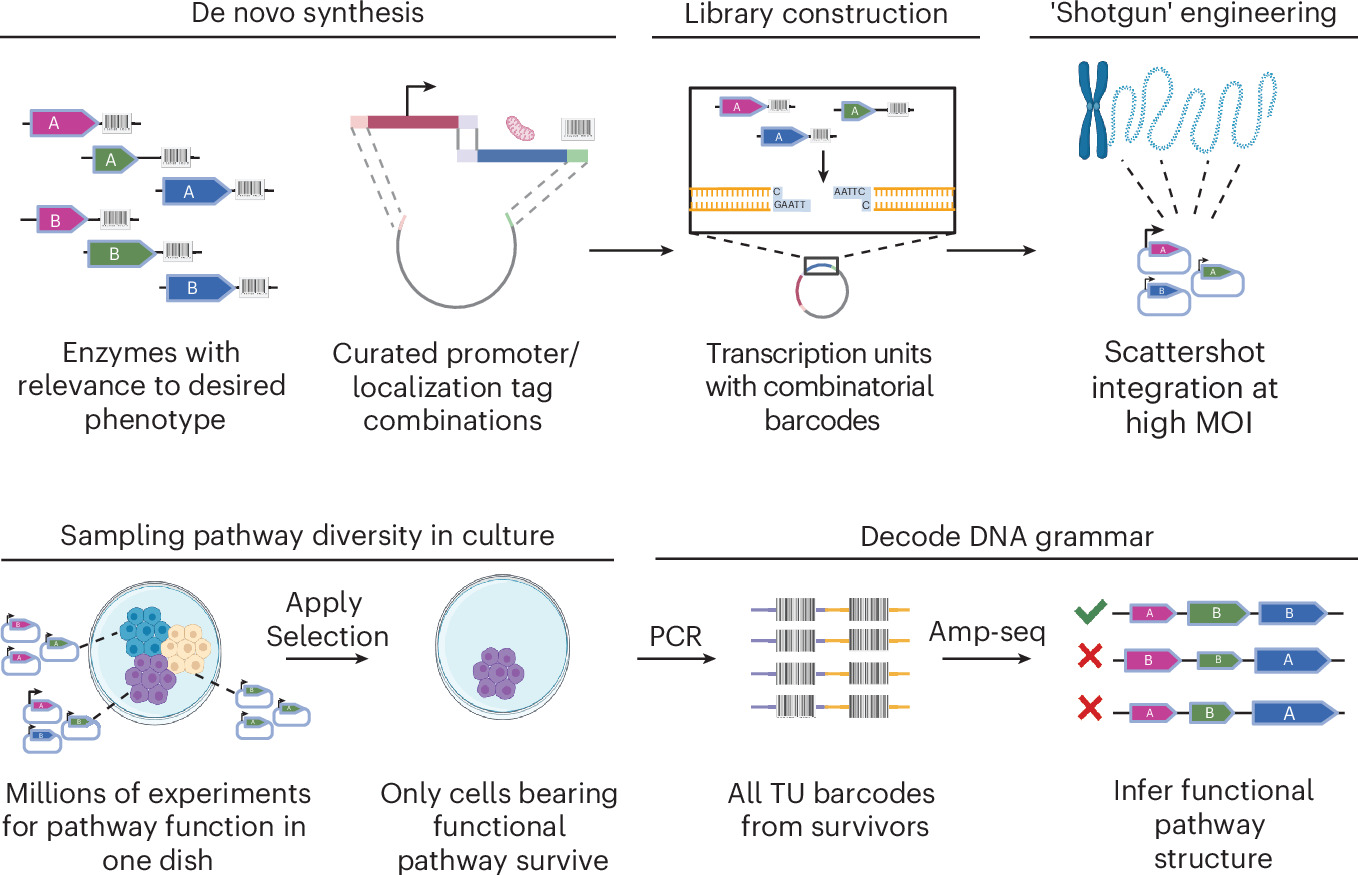
Trolle and colleagues screened millions of synthetic metabolic pathways at once and grew hamster cells without the essential amino acid valine. Their method, shotgun genetic engineering, breaks the slow build-and-test loop that had confined such work to fast-growing microbes.
The Scientist · Science desk
Drafted by a language model from the sources cited here and checked against its claim ledger before publication. How we use AISend a correction
What happened
- The approach also produced valine-free growth in Jurkat cells, a second cell line.
- Working pathways tended to route their enzymes to the mitochondria and required integrating tens of kilobases of synthetic DNA, more than conventional screens handle.
- The group had engineered valine biosynthesis into CHO cells back in 2022, so the advance is doing it at screening scale and adding a second amino acid.
Compiled by The ScientistSomething wrong?How this is made
Why it matters
- constraint Mammalian cells divide at least 60 times more slowly than E. coli. That forecloses the quick guess-and-iterate loop microbial engineers lean on and forces the design search into one parallel screen.
- capability Screening millions of variants in a single run reaches pathway designs that one-construct-at-a-time delivery, inefficient in mammalian cells, could never cover.
- precedent Because the screen logs which barcode combinations survived, its datasets can train models to predict good designs.
Delivering a large DNA construct into a mammalian cell is inefficient and poorly suited to high-throughput screening [18]. Trolle and colleagues, writing in Nature Biotechnology, inverted the problem [9]. Instead of one big construct, they delivered many small barcoded pieces, so each cell ended up with a different random combination of pathway parts [1]. Each cell then became its own experiment, testing a particular set of genes, how much of each to make, and where in the cell to send the proteins [2]. They grew the population under selection and sequenced the barcodes from the surviving cells to read out the winning designs [3].
That design matters because the combinatorics are brutal. A pathway coordinates several transcription units, and each brings choices about which coding sequence to use, how to regulate it, where to localize the protein and how strongly to express it, with little mechanistic theory to guide any of them [19]. In microbes you can afford to guess and iterate. Escherichia coli doubles in about 20 minutes [16]; mammalian cells typically take more than 20 hours [17], at least 60 times slower [20]. SGE moves the whole search into one experiment [6].
The headline result is uneven, and the paper's wording tracks it. In Chinese hamster ovary cells the screen reached near-wild-type growth without valine [5]; for isoleucine it enabled growth without the amino acid but did not claim the same vigour [7]. The same approach produced valine-free growth in Jurkat cells [8]. The group had already engineered valine biosynthesis into CHO cells in 2022 [10], so the new result is doing it at scale and adding a second amino acid.
Two findings stand apart from the demonstration. Working pathways favored sending their enzymes to the mitochondria, and they required integrating tens of kilobases of synthetic DNA, more than conventional screens handle [13]. That is an enrichment the screen observed, a design heuristic. For scale, one of the larger microbial feats, tropane alkaloid synthesis in yeast, used 26 genes across six subcellular locations [11], and pathway engineering at that size had stayed rare in mammalian cells [15].
The paper demonstrates a screening method and the biology it turns up, not a production process. Its stated payoff is better control of mammalian cells for complex biologics, viral-vector manufacture and cell therapy [15], and it does not show that an engineered CHO line makes a drug more cheaply. The authors report that the screen's datasets can train models to predict which designs work [14]. In an accompanying commentary, Rai and Bashor wrote that the method "enables discovery of new productive metabolic pathways in mammalian cells, including solutions for synthesizing two essential amino acids" [12].
What to watch
- Whether the engineered CHO or Jurkat lines actually raise biologic yield or cut media cost in production, which the paper does not test.
- Whether machine-learning models trained on these datasets can predict working pathways for metabolites beyond amino acids.
- Whether other groups reproduce isoleucine-free growth and push it to near-wild-type rates.