Waste polystyrene, CDs and LEGO bricks become water-harvesting sponges at the University of Vienna
University of Vienna chemists turned waste polystyrene into a sponge that adsorbs water at 20% of its own weight in dry, desert-like conditions. The same route worked on CD polycarbonate, LEGO plastic and one mixed batch, though long-term performance is still being assessed.
The Scientist · Science desk
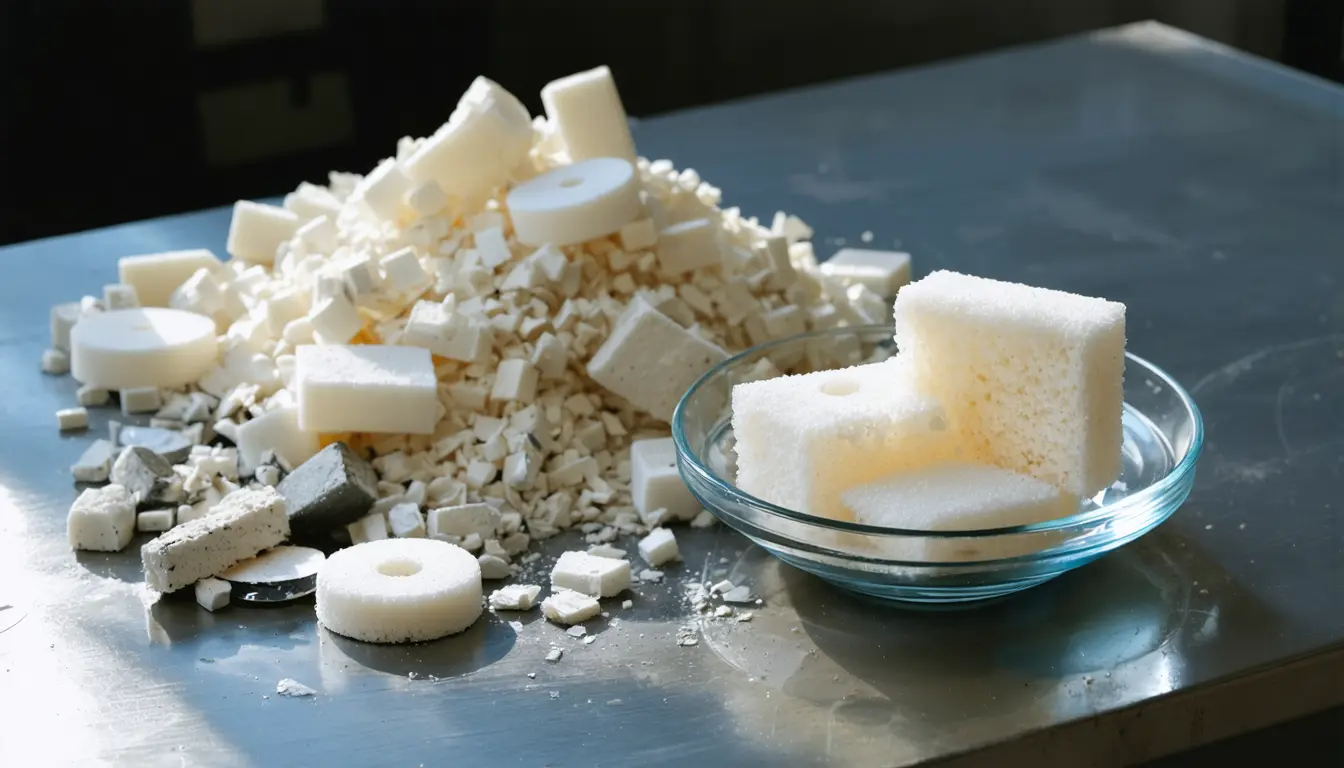
Key figures: the general-purpose polystyrene sponge adsorbs 20% of its own weight in water in dry, desert-like conditions, against almost 60% from humid air. At 20%, collecting 1 kg of water in one full cycle takes about 5 kg of sponge, assuming all the water is released.
| Figure | Value | Note | Claim |
|---|---|---|---|
| Water uptake in dry, desert-like conditions | 20% of own weight | 9 | |
| Humid-air uptake, almost | 60% of own weight | 8 | |
| Sponge for 1 kg of water at 20% uptake, about | 5 kg | Assumes all water is released | 13 |
What happened
- The route relies on aromatic polymers, whose six-carbon rings give sites where the chains can be tied together into a porous network.
- A sulfuric acid treatment then adds sulfonic acid groups that attract water even from relatively dry air.
- From humid air, the general-purpose polystyrene sponge took up almost 60% of its own weight in water.
- Mild heat such as sunlight releases the water, and most adsorption and desorption occurs within one hour.
- The team says further work on the sponges' long-term performance and overall resource requirements is ongoing.
Why it matters
- constraint In dry air the polystyrene sponge holds roughly a third of its humid-air load, so the 60% figure is the wrong one to size an arid deployment on.
- capability A mixed-plastic batch also worked, so the feedstock need not be a single sorted polymer, at least for the one mixture tested.
- cost The sulfuric acid step and the unfinished resource assessment leave the footprint of a liter of harvested water unknown.
Percentages of a sponge's own weight are hard to picture, so convert them. Assume the figures are fractions of dry sponge mass and that the full load comes back out each cycle. Then a kilogram of water takes 5 kg of the polystyrene sponge at its dry-condition uptake [13] and about 1.7 kg, or somewhat more, at its humid-condition uptake [14]. Both are per cycle, and both are our assumptions about the basis of the percentages.
The phys.org account of the Chem Circularity paper [5] lists three things a water-harvesting adsorbent must do: attract moisture, hold large quantities of it, and withstand repeated capture-and-release cycles [3]. The uptake figures speak to the first two. On the third, the account reports that the sponges withstand cycling well [11].
The thing this account doesn't tell you is how many cycles that covers. It also leaves out the humidity and temperature behind "humid" and "desert-like", the basis of the percentages, and whether any release step used real sunlight.
We think the feedstock result is the sturdier one. Polystyrene, polycarbonate and ABS all became sorbents [6], and a selected mixture of waste plastics did too [7]. Whether any of them is a practical water source depends on cycle life and on what the acid step costs. The sulfonation uses sulfuric acid [2], and the team says work to assess overall resource requirements is ongoing [12].
What to watch
- Cycle-life data from the Vienna team's ongoing long-term performance work, with the number of capture-and-release cycles stated.
- The resource assessment, including what the sulfuric acid treatment adds to the footprint per kilogram of sponge.
- A test that reports humidity and temperature for each condition and uses real sunlight for release.
Clarity's read
What the record supports and how the coverage leans. The claims behind it follow.
Reality
- Evidence50
- Adoption
- Insufficient
- Hype gap+10
- Incentives
- Insufficient
- Confidence55
Claim ledger
Ranked by verification strength, evidence, and original report placement.
- [1]
Aromatic polymers contain rings of six carbon atoms; these rings act as sites from which to tie the polymer chains together, forming a porous network with tiny internal spaces.
- [2]
A subsequent treatment with sulfuric acid adds sulfonic acid groups that attract water even from relatively dry air.
- [3]
A suitable adsorbent for water harvesting must attract moisture, be able to hold large quantities of it and withstand repeated capture-and-release cycles.
- [4]
Materials chemists Anastasiia Naryshkina, Paul Schweng and Robert Woodward at the University of Vienna converted several types of plastic waste into water-attracting polymer networks that take up water even in dry climates and release it again under moderate heating, for example using sunlight.
- [5]
The study was published in Chem Circularity (2026).
- [6]
The researchers produced the water-loving molecular sponges using various polystyrene packaging materials, old CDs made from polycarbonate and LEGO bricks made of acrylonitrile butadiene styrene as feedstock.
- [7]
The researchers also treated a selected mixture of waste plastics, demonstrating versatility across these feedstocks.
- [8]
The sponge made from general-purpose polystyrene could adsorb almost 60% of its own weight in water from humid air.
- [9]
The sponge made from general-purpose polystyrene could adsorb 20% of its own weight in water in dry, desert-like conditions.
- [10]
The water can be re-released for collection using mild heat sources such as sunlight, with most adsorption and desorption occurring within one hour.
- [11]
The sponges withstand the cycling process well, meaning they can be used to generate water over and over again.
- [12]
Further work to assess the long-term performance and overall resource requirements of the sponges is ongoing.
- [13]
At 20% of its own weight, collecting 1 kg of water in one full cycle takes about 5 kg of sponge, assuming the percentage is of dry sponge mass and all the water is released.
- [14]
At almost 60% of its own weight, collecting 1 kg of water in one full cycle takes about 1.7 kg of sponge or slightly more, under the same assumptions.
- [15]
The polystyrene sponge's dry-condition uptake is roughly a third of its humid-condition uptake.
Get this ledger inside ChatGPT. Ask about any of our stories and the answer brings its figure, each claim’s verdict and the sources. Free, no account.
Sources
1 independent publisher whose own reporting we read for this story.
- phys.orgWaste plastics become molecular sponges that capture water from air
1 article · October 14, 2026
Topics and entities
Follow any of these and your For You feed starts watching them — no settings page required.